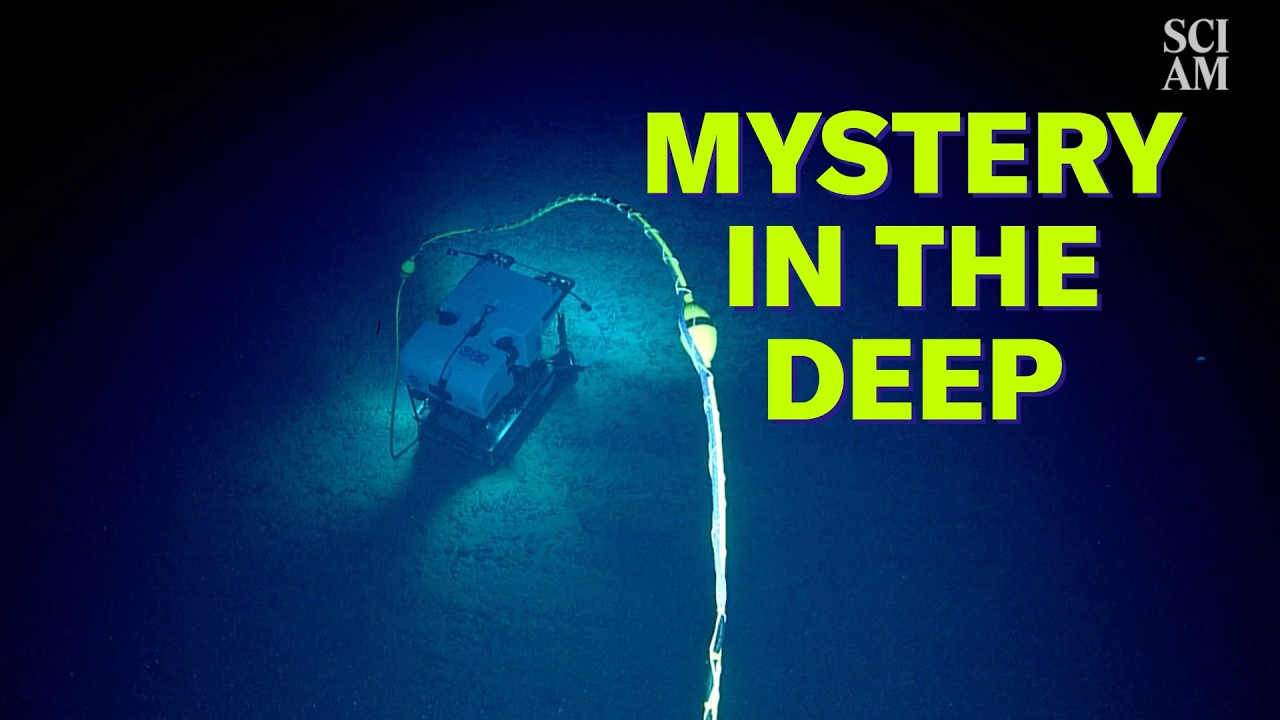
Four thousand meters beneath the ocean surface, pitch darkness reigns and sunlight never arrives. For centuries, science assumed every breath of oxygen on Earth originated from photosynthetic life like plants and plankton. A landmark discovery in the Pacific Ocean proved that potato-sized seabed rocks generate their own oxygen completely in the dark.
What is Dark Oxygen? the 4,000-meter deep mystery
Oxygen without sunlight sounds like an impossibility.
In July 2024, a team led by Professor Andrew Sweetman from the Scottish Association for Marine Science (SAMS) published a study in Nature Geoscience that upended basic biology. While measuring oxygen consumption on the abyssal seafloor of the Clarion-Clipperton Zone (CCZ), their benthic landers recorded something bizarre.
Normally, seabed sensors track how deep-sea microbes consume dissolved oxygen. Instead, the oxygen levels inside sealed benthic chambers kept rising over two-day cycles. Sweetman initially suspected the sensors were malfunctioning. He sent them back to the manufacturer for recalibration, only for the exact same numbers to appear year after year.

When alternative sensor techniques confirmed the spikes, the research team realized this was not an instrument glitch. Something abiotic — something non-living — was actively pumping fresh oxygen into the abyss. They coined the term dark oxygen to describe this process.
How do Polymetallic Nodules produce oxygen?
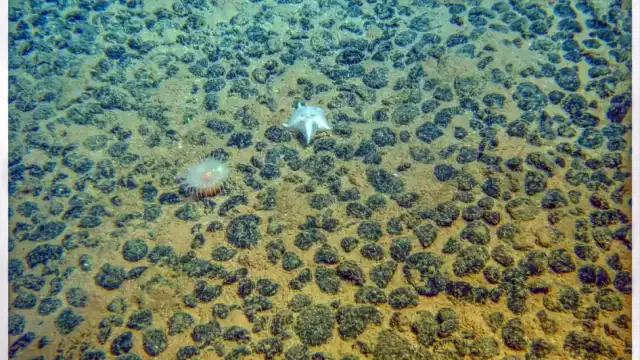
These mysterious rocks are called polymetallic nodules (or manganese nodules). They look like charred lumps of coal or lumpy black potatoes, taking millions of years to grow as dissolved metals precipitate around tiny fragments like a shark tooth or shell fragment.
How does a solid rock produce breathable gas?
| Step | Process | Result |
|---|---|---|
| 1 | Natural “Geobattery” effect | |
| 2 | Surface voltage (~0.95V) from manganese, nickel, cobalt, and iron | |
| 3 | Neighboring nodules stacked in series | |
| 4 | Combined voltage exceeds ~1.5V | |
| 5 | Seawater electrolysis: ( \rightarrow ) | |
| 6 | Abyssal oxygen released | Final outcome |
1. The chemistry of seawater electrolysis
Splitting a water molecule into hydrogen and oxygen gas requires electrical energy. In industrial laboratories, engineers dip electrodes into saline water and apply an external electrical current:
Under standard marine conditions, splitting seawater requires a minimum voltage threshold of 1.5 volts — roughly the same charge as an ordinary household AA battery.

2. The natural “Geobattery” mechanism
Polymetallic nodules are not homogeneous stones. They contain dense alternating layers of:
- Manganese (around 25–30%)
- Iron (around 5–7%)
- Nickel, Copper, and Cobalt (around 1–2% combined)
These metals possess differing electrochemical potentials. When Sweetman’s team placed micro-electrodes onto individual nodule surfaces, they recorded electrical potential differences reaching up to 0.95 volts.
While a single nodule falling just short of 1.5 volts cannot split seawater entirely on its own, resting against one another allows them to act like batteries wired in series. The combined voltages exceed the 1.5V electrolysis threshold, triggering electrochemical reactions that pull oxygen right out of surrounding seawater.
Photosynthesis vs Deep-sea electrolysis
| Feature | Photosynthetic Oxygen | Dark Oxygen (Electrolysis) |
|---|---|---|
| Primary Energy Source | Solar radiation (photons) | Chemical voltage gradients (geobatteries) |
| Location | Sunlit photic zone (upper 200m) | Abyssal seafloor (3,000–6,000m) |
| Active Agents | Phytoplankton, algae, plants | Polymetallic manganese nodules |
| Byproduct | Organic glucose () | Hydrogen gas () |
| Light Requirement | Strict requirement | Zero light required |
The Clarion-Clipperton zone: ground zero for mining
The Clarion-Clipperton Zone (CCZ) is a vast abyssal fracture zone stretching 4.5 million square kilometers across the central Pacific between Hawaii and Mexico. It houses the planet’s richest deposit of battery metals, holding more nickel, cobalt, and manganese than all known terrestrial reserves combined.
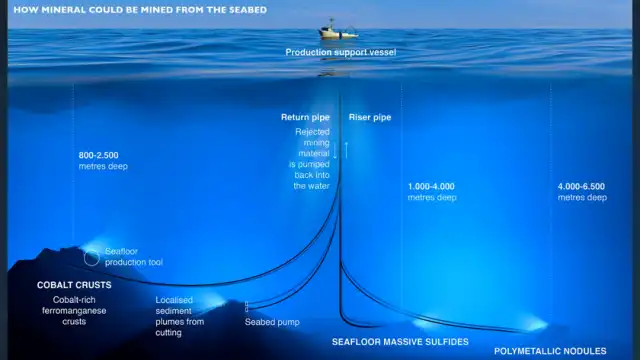
Those exact minerals happen to be the primary building blocks of electric vehicle (EV) batteries and clean-energy grid storage. Commercial mining consortia have designed tractor-sized seafloor crawlers to scrape the ocean floor, vacuuming up nodules and pumping them up through four-kilometer riser pipes to surface ships.

The discovery of dark oxygen ignited an intense political storm at the International Seabed Authority (ISA) in Kingston, Jamaica.
- The Conservation Argument: Over 30 nations, including France, Germany, Costa Rica, and Panama, alongside dozens of marine NGOs, have called for an immediate moratorium or precautionary pause on deep-sea mineral extraction. If nodules supply baseline oxygen to endemic abyssal fauna — such as ghost octopuses, glass sponges, and xenophyophores — stripping the rocks could trigger long-term ecosystem collapse.
- The Industry Pushback: Mining proponents and companies like The Metals Company (TMC) have questioned the methodology, releasing rebuttal papers arguing that oxygen spikes might stem from trapped air inside lander chambers or unmeasured microbial shifts. Independent scientific teams continue conducting targeted follow-up expeditions to test the replicability of nodule electrolysis under natural abyssal pressures.
Rethinking the origins of life
Why does this discovery matter beyond marine policy?
Standard evolutionary biology suggests aerobic life had to wait for cyanobacteria to evolve photosynthesis roughly 2.4 to 3 billion years ago during the Great Oxidation Event. If electrochemical rock formations produced localized pockets of oxygen in the dark prior to sunlight-driven photosynthesis, ancient aerobic organisms might have emerged far earlier than previously assumed.
This mechanism also widens the search for extraterrestrial life. Ice-covered ocean worlds in our solar system — such as Jupiter’s moon Europa or Saturn’s moon Enceladus — possess mineral-rich seabeds shielded under miles of ice. If subsurface rock beds generate dark oxygen through galvanic reactions, their subterranean oceans could harbor oxygenated micro-habitats without receiving a single ray of sunlight.
Explore the geopolitical and ecological debate surrounding these nodules in Deep-Sea Nodules: Life Givers or Energy Resource?. This documentary unpacks how the dark oxygen discovery shifted negotiations at the International Seabed Authority as diplomats balance clean-energy mineral demands against deep-ocean preservation.