
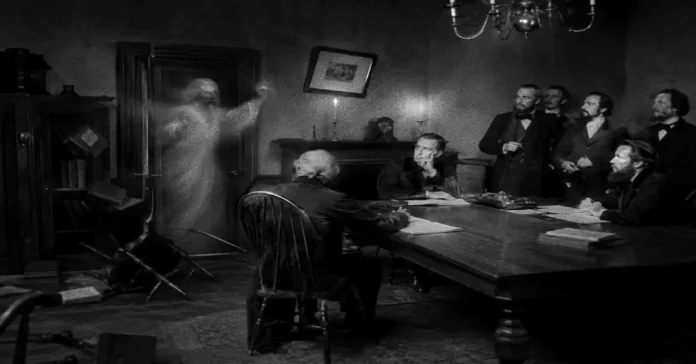
A haunted house is one thing. A haunted house that ends up in front of a judge is another thing entirely. That’s exactly what happened in a small French village called Cideville in the winter of 1850. By the time it was over, a shepherd accused of witchcraft was suing a Catholic priest for defamation.
What actually happened at Cideville?
The trouble started in the parsonage of Cideville, a farming village in Normandy roughly 80 miles from Paris. Two boys, aged twelve and fourteen, lived there while studying for the priesthood under the local curé, Jean Tinel. Sometime after late November 1850, things got weird. Really weird.
Loud raps echoed through the house — and they’d get louder or quieter on request, like something on the other side was listening. The knocking even tapped out the beat to songs people hummed. Furniture slid across rooms on its own. Doors jammed shut for no reason. Bedcovers got yanked off sleeping residents in the middle of the night, and a cold draft would suddenly cut through the hallways.
One of the boys reported being followed by a shadowy, human-shaped figure. Both boys said an invisible “black hand” slapped them across the face, over and over. Here’s the detail that really sells it: the moment the boys were pulled out of the house in February 1851, the phenomena stopped cold. Every bit of it.
Sounds like a textbook poltergeist story, right? A haunting tied to two kids, then it vanishes when they leave. Except this one didn’t stay in the realm of ghost stories. It became a legal matter.
The shepherd who bragged about black magic
Here’s where Cideville splits off from every other 19th-century haunting. A local shepherd named Félix Thorel had a reputation for boasting about dark powers. According to several accounts, Thorel had a personal grudge to settle — a man he associated with, sometimes named as “Gosselin,” had been an unlicensed folk healer whom Curé Tinel reported to the authorities. That healer landed in jail, and word is he swore revenge on the priest before he even got out.

Tinel put two and two together. He decided Thorel — tied to that same circle — was behind the disturbances tormenting his pupils.
So the curé confronted him. And instead of denying it, Thorel leaned in. He bragged about his supposed powers, then supposedly visited one of the boys to place a fresh hex on him — right after which the disturbances flared up again, worse than before. Bold move for a guy who was about to lose his job over it.
When the priest snapped
Thorel’s little performance cost him. Word of his self-proclaimed sorcery got him fired from his shepherding position. Tinel, worn down by weeks of unexplained chaos in his own home, eventually confronted Thorel again — and beat him with a cane, reportedly drawing blood.
That should have been the end of it. It wasn’t.
Thorel turned around and sued. Not for assault — for defamation. His argument: the priest had ruined his reputation and his livelihood by publicly branding him a sorcerer. He demanded 1,200 francs in damages — a serious sum for a rural shepherd in 1851 France.
Think about that setup for a second. A man who spent weeks bragging about his witchcraft was now telling a courtroom he’d been wrongly accused of it. There’s an irony there that basically writes itself.

Inside the courtroom: A Poltergeist on trial
The case, Thorel v. Tinel, opened before the justice of the peace at Yerville in January 1851, with hearings stretching across several sessions that winter (Cock Lane and Common-Sense, Andrew Lang). This wasn’t a quiet, forgettable small-town dispute — it pulled in a genuinely wide cast of witnesses.
Here’s who took the stand:
- The mayor of Cideville, who testified about the disturbances and Thorel’s threats against the priest
- Several local priests, backing up accounts of the phenomena
- A Parisian occultist, brought in as something close to an expert witness on the paranormal
- More than thirty additional witnesses in total — farmers, tradesmen, and neighbors — describing raps, moving furniture, and things they genuinely couldn’t explain.
Nearly all of them agreed on one point: the boys couldn’t have staged any of it. Not with that many people watching, that many different rooms involved, that many separate nights.
Picture a 19th-century French courtroom, packed with farmers and clergy, formally testifying under oath about a black hand slapping children. That’s not folklore repeated over a fireside. That’s sworn legal testimony, recorded and preserved.
The verdict nobody expected
By mid-February 1851, the judge had heard enough — and still had no real answer. The ruling, delivered around February 15, landed on a conclusion that satisfied absolutely no one looking for a tidy explanation:
“Whatever might be the cause of the extraordinary facts which occurred at the parsonage of Cideville, it is clear, from the sum total of the testimony adduced, that the cause of these facts remains unknown.” (Strange Company)
Translation: we have no idea what happened, but something clearly did.

Thorel still lost. The court reasoned that since he’d gone around town claiming credit for the sorcery himself, he couldn’t turn around and complain about being called a sorcerer. He was ordered to cover the legal costs, reportedly amounting to roughly £6 in the currency conversions of the time. Not exactly a fortune, but a humiliating loss all the same.
With the case closed, Tinel finally agreed to permanently remove the two boys from his household. And just like that, the disturbances at Cideville were gone for good.
About cideville case today?
Most 18th- and 19th-century poltergeist stories live in diaries, newspaper columns, or secondhand ghost-story collections. Cideville is different, and that’s why researchers keep coming back to it. This case was documented under oath, cross-examined by a judge, and preserved in official court records — not just retold around a fire.
Later psychical researchers, including Andrew Lang, later dug through those French court records and called Cideville one of the last real “witchcraft trials” in Western Europe — even though, technically, nobody was ever tried for witchcraft. The witch was the one demanding damages.
Was it two bored teenagers pulling off an elaborate, months-long prank? Was Thorel somehow rigging tricks from outside the house? Or did something genuinely unexplained happen in that Normandy parsonage? Nobody proved any of it one way or the other — and that’s kind of the point. A judge, dozens of witnesses, and a room full of legal scrutiny still couldn’t pin down an answer.
That’s rare in the world of ghost stories. Usually the mystery just fades with time. At Cideville, it got legally certified instead.

