
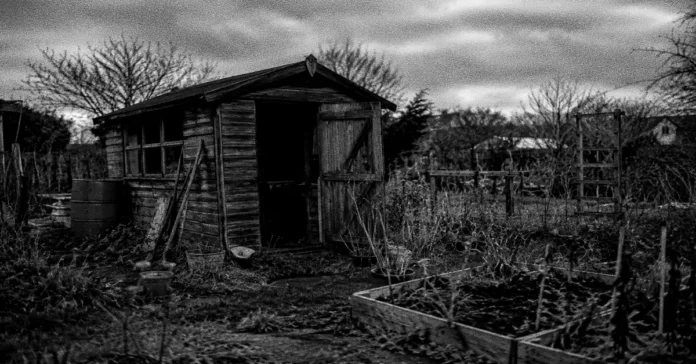
The Bromley Allotment Poltergeist: The Strange Case of the Haunted Shed
Most ghost stories haunt old mansions or crumbling churches. This one picked a gardening shed. For nearly two years, three retirees running a small allotment supply business in England got tormented by something that threw fertilizer, tore shirts, and left a skull burned into a countertop.
Three pensioners, two sheds, and a small business
Back in the early 1970s, three older men — Alfred Taylor, Tony Elms, and Clifford Jewiss — ran a modest little outfit called the Kentish Garden Guild out of two sheds at the Grove Park allotments near Bromley, England. They sold gardening supplies to fellow allotment holders. Nothing fancy. Just a way for retired guys to stay busy and make a bit of pocket money.
Sheds don’t usually make headlines. This one did.
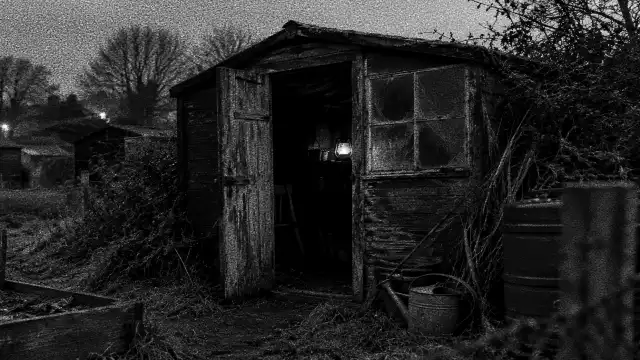
The day things got weird
On April 26, 1973, everything changed. The three men were working inside one of the sheds when a strange powder suddenly hit the ceiling out of nowhere. Before anyone could process that, a small jug flew clean across the room.
Jewiss picked it up and locked it inside a covered box. Seconds later, it was back on the floor. Not knocked over — back. As if it had passed straight through solid material to get there.
That was just the opening act.

What actually happened inside the shed?
Over the following months, the disturbances escalated fast. Here’s a taste of what the men reported dealing with:
- Fertilizer exploded from its storage bin, spraying anyone standing nearby
- A seven-pound weight sailed through the air, circling Taylor’s head like it had a mind of its own
- Bottles unscrewed themselves and dumped their contents on the floor
- Coffee got swapped for fertilizer in Elms’ cup — he caught it just before drinking
- Half-ton bags of fertilizer shifted position on their own
- The shed itself would shake, like a mini earthquake had hit just that one building
One regular customer, George Bentley, summed it up about as plainly as anyone could: “There were some right queer goings on”.
Here’s the thing worth sitting with for a second: this wasn’t one spooky night. This ran for months, in front of customers, with real financial consequences. Who wants to shop for garden tools while dodging flying fertilizer bags? Understandably, business dropped off, and the three men grew genuinely scared for their own safety.
The exorcism that made things worse
Elms decided to fight back. He consulted a group of self-described “white magicians” and performed an exorcism inside the shed one night. People waiting outside heard the walls thudding and the heavy iron door swinging open and shut, over and over. When Elms finally came out, he was bruised and bleeding from a head wound.
The next morning told the real story. The shed looked, in one man’s words, “as if it had been hit by a bomb.” Items were suspended mid-air. And crosses — dozens of them — had been scratched or painted onto every surface inside: walls, chairs, storage bins, everywhere you looked.
Whatever was in there clearly wasn’t impressed by the exorcism. If anything, it seemed to be mocking them.
When the haunting followed them home
This is where the Bromley case stops resembling a “haunted building” story and starts looking like something following specific people. Taylor reported being tormented by the presence in his own home, with witnesses present. On another occasion, while standing in an office building nowhere near the allotments, he felt invisible hands shove him hard from behind.

There was no clocking out from this one.
Bringing in the experts
By September 1973, Taylor had reached his limit. He reached out to the Society for Psychical Research (SPR), Britain’s oldest organization dedicated to investigating paranormal claims. Two researchers, Pauline Runnells and Manfred Cassirer, took the case seriously enough to visit the sheds repeatedly.
Cassirer later wrote a full account of the case, The Persecution of Mr Tony Elms: The Bromley Poltergeist, published in 1993, and both he and Runnells reported finding no evidence of a hoax or deliberate deception (Psi Encyclopedia). That’s a significant detail — trained investigators, actively looking for tricks, came away unconvinced this was staged.
And the poltergeist apparently had a flair for showing off in front of an audience. During the SPR visits:
- Security bolts vanished from windows in plain view
- The building shook from what felt like violent blows against the walls
- Elms’ shirt got physically torn, and a saw was somehow shoved down the back of it
- A flower bulb was forced into Elms’ mouth
- Money disappeared, then two coins suddenly reappeared and struck Runnells on the head — right after she’d asked the entity to return the missing cash.
Why Elms specifically? Nobody’s ever had a solid answer. He just seemed to draw the worst of it.
The creepiest detail nobody can explain
If you’re looking for the moment this case tips from “weird” into “genuinely unsettling,” here it is. On a shelf inside the shed, the outline of a child’s face slowly began to appear. Around the same time, a small piece of brass stamped with the letters “MN” simply dropped to the floor — an object none of the men had ever seen before or could identify.
Nobody ever figured out what “MN” stood for. That mystery is still just… sitting there, unsolved.

Later, using two chemicals kept in the shed — white sulphite and a brown fertilizer called Maxicrop — something outlined a full skull on the counter. Witnesses said it appeared almost instantly, far faster than any human hand could have managed it. Then it slowly faded away on its own.
How it ended (sort of)
The whole ordeal ran for close to two years — an unusually long run for a poltergeist case, most of which tend to burn out in weeks — before stopping as suddenly as it had started. Interestingly, the timing lined up with the completion of construction work on a nearby block of garages. Correlation? Coincidence? Nobody’s ever proven a connection, but it’s the kind of detail that sticks with you.
Bromley, Lewisham, or somewhere in between?
Here’s a genuinely interesting wrinkle that most retellings of this story skip entirely. Grove Park, where the allotments actually sit, technically falls within the London Borough of Lewisham, not Bromley — even though it sits right on the Bromley border. The SPR dubbed it “The Bromley Poltergeist” back in 1973, and the name stuck in every book and article since, geographic accuracy be damned.
It’s a small thing. But it’s a good reminder that even well-documented paranormal cases can carry small errors that just get copied forward for decades, simply because that’s what everyone already calls it.
Most poltergeist stories center on a house and a family, usually with kids in the mix — that’s the classic setup. Bromley breaks the mold. No children were involved. The location was a working-class business, not a home. And the entity, if you want to call it that, targeted specific adults wherever they went, not just a single building.
Add in direct investigation by SPR researchers who found no signs of trickery, and you’ve got one of the more thoroughly documented British poltergeist cases of the 20th century — right up there with the far more famous Enfield case that came a few years later.
Was it genuine paranormal activity? Elaborate group deception? Something psychological, tied to stress and suggestion, that somehow manifested physically? More than fifty years on, nobody’s landed on a satisfying answer.

