
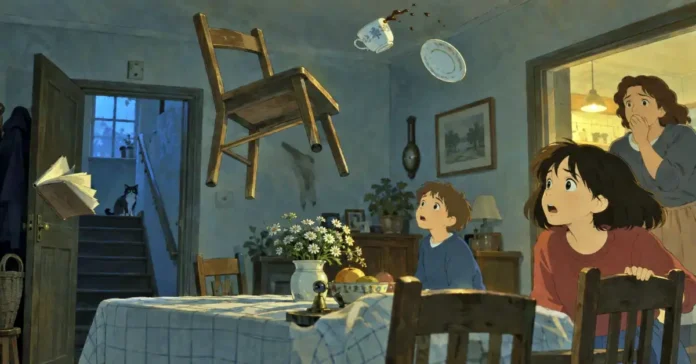
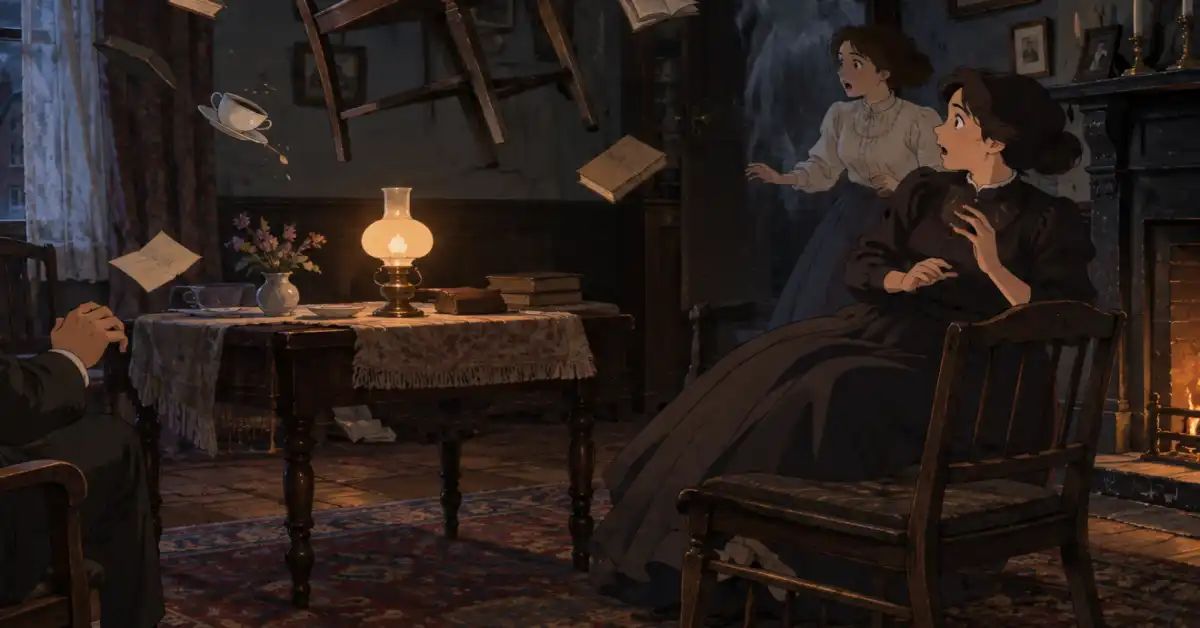
In late August 1952, an ordinary terraced house in northern England became the center of an impossible physical disturbance. Heavy oak tables slid across linoleum, dining chairs tipped over without human contact, and porcelain knick-knacks sailed through the air like thrown darts. Even veteran police officers tasked with catching a trickster left the building pale, shaken, and utterly unable to explain what they had just seen.
The quiet street that lost its mind
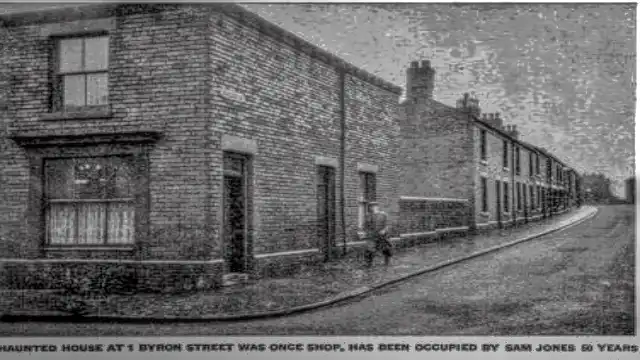
Byron Street sat squarely in the industrial heart of Runcorn, Cheshire. It was a modest, working-class row of brick terraced homes where neighbors scrubbed their front doorsteps, hung laundry in narrow back yards, and kept their business private. Britain was slowly shaking off post-war rationing, Queen Elizabeth II had just ascended the throne, and life ran on routine.
Number 1 Byron Street was home to the Jones family. Living there were 73-year-old widow Mrs. Lucy Jones, her adult son John Jones, and her two teenage grandchildren, 17-year-old John Jr. and 14-year-old Joyce. Grandson John worked as an apprentice clerk, known around town as a quiet, polite lad who rarely caused a ripple.
Everything changed on the sweltering evening of Saturday, August 16, 1952.
It started with rhythmic, hollow thumps inside the walls. Mrs. Jones initially blamed rowdy neighborhood kids kicking a ball against the gable end. Yet the noise did not come from outside. The rapping vibrated directly under floorboards, shifted into the chimney breast, and hammered inside wardrobe panels. Within twenty-four hours, the phantom taps turned violent.
| Area | Description |
|---|---|
| Back Kitchen | flying teacups, shaken pans |
| Living Room | heavy table flips, piano moves |
| Front Parlor / Hall | police observation post |
When furniture took flight
By Monday morning, subtle noises gave way to full-blown domestic demolition. Household items no longer stayed pinned to gravity. The disturbances seemed to target the heavy, clunky furniture typical of a 1950s British parlor.
Eyewitnesses — including bewildered neighbors called in to verify the family’s sanity — described a scene of pure chaos:
- The Runaway Dressing Table: A bulky wooden chest upstairs slid several feet away from the wall, shuddered violently, and crashed onto its side while onlookers stood in the doorway.
- Airborne Bric-a-Brac: Framed family pictures peeled off picture rails, hovered briefly, and dropped to the carpet. Saucers flicked off dressers like clay pigeons.
- The Marching Dining Table: Downstairs, a solid four-legged dining table scraped across the floorboards without a soul touching it, pinning an uncle against the wall before flipping flat onto its back.
- Bed Shaking: When teenagers John and Joyce tried to sleep, their mattresses shuddered so violently that bedclothes were ripped clean off the mattress frame.
Imagine sitting down for an evening cup of tea only to watch your sugar bowl lift off the saucer and shatter against the far wall. How would you react?
The family bolted out the front door, terrified their floorboards were collapsing or that an underground gas pocket was detonating beneath the foundations.
Enter the cheshire constabulary
If this were merely a ghost story passed down over campfire cocoa, you could easily brush it off. Families exaggerate, children pull pranks, and old houses settle.
Except the local police were called in to catch the vandal red-handed.
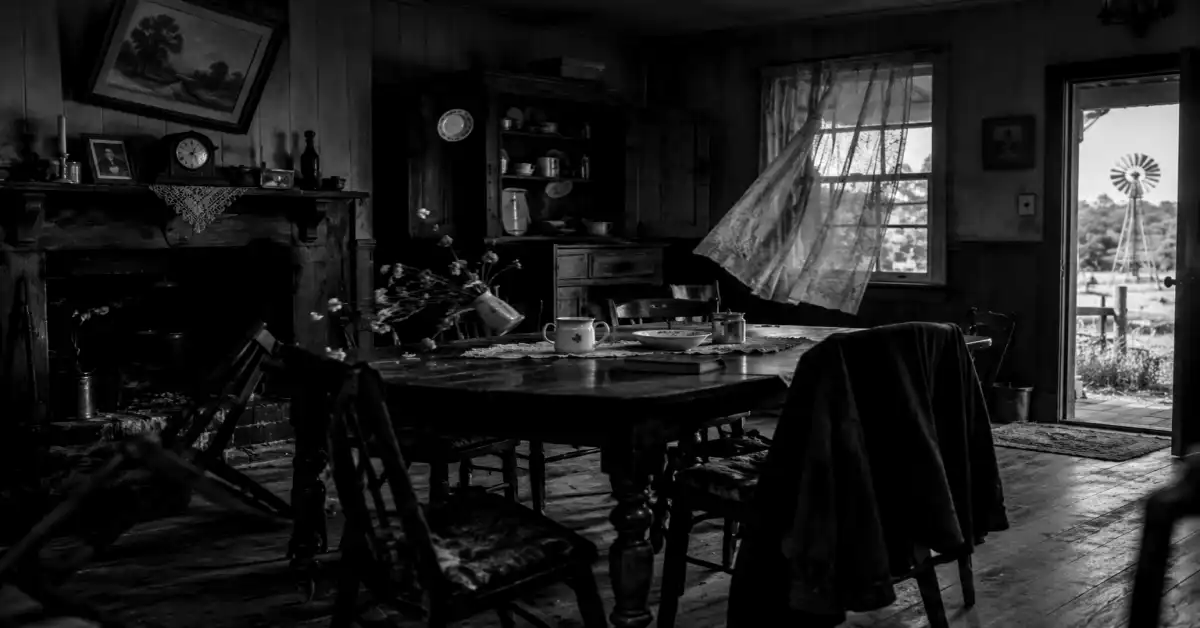
Superintendent Arthur Wolstencroft, head of the Runcorn division, dispatched his most level-headed constables to 1 Byron Street. Officers walked into the property expecting a spiteful relative hiding under the stairs or a clever teenager pulling strings through floorboard gaps.
They set up a systematic sweep:
- Floor Inspections: Constables pulled back carpets and examined floorboards for hidden wires, foot pedals, or mechanical levers. They found none.
- Structural Integrity Checks: Gas board inspectors and town council surveyors checked the pipes, coal cellars, and masonry for industrial vibrations from nearby chemical works. Everything was structurally sound.
- Physical Guarding: Officers stood guard inside the rooms, placing themselves directly between family members and pieces of furniture.
What happened next entered the official logs.
While two officers stood inside the parlor watching young John Jones sit with his hands flat on his knees, an armchair three feet away rocked up on two legs, rotated ninety degrees, and toppled over. Books slid off a wall shelf one by one, landing neatly in a pile on the floor.
“I have never believed in ghosts or spirits,” one attending constable told a local reporter, visibly rattled. “But seeing a heavy sideboard walk itself across a room while nobody is within arm’s reach shakes everything you think you know about the world.”
The police department soon realized they could not arrest an invisible force. There was no crime to charge, no intruder to cuff, and zero evidence of physical rigging.
Fleet street and the byron street circus
News like this could not stay confined to a quiet industrial borough. By Wednesday, August 20, national newspapers caught wind of the “Haunted House of Runcorn.”
Fleet Street reporters, photographers with giant flashbulbs, amateur sleuths, and self-proclaimed spiritualists descended on Byron Street like locusts.
| Date | Event |
|---|---|
| Aug 16 | First unexplained raps heard in the walls. |
| Aug 18 | Heavy furniture overturns; neighbors alerted. |
| Aug 20 | Police launch overnight stakeouts inside house. |
| Aug 22 | Crowds reach hundreds; police erect barricades. |
| Aug 26 | Spiritualist séances fail; activity fades away. |
Hundreds of people packed the pavement outside Number 1. Spectators brought folding chairs, fish-and-chip suppers, and binoculars, hoping to spot a flying kettle through the lace curtains. Traffic through Runcorn ground to a crawl. The local council had to deploy additional officers just to handle crowd control and keep eager rubberneckers off Mrs. Jones’s tiny front garden.
Reporters crammed into the parlor alongside family members, scribbling frantic notes while waiting for a show.
They were not disappointed. Journalists reported seeing small ornaments lift off mantels and land softly on the carpet without breaking, defying normal trajectories. A heavy sideboard reportedly nudged forward into the room, groaning under an invisible push.
The focal point: John Jones Jr.
Whenever researchers investigate poltergeist outbreaks, a familiar pattern pops up. The disturbances rarely wander around at random. Instead, the wild physical events cluster tightly around a single person: the epicenter.
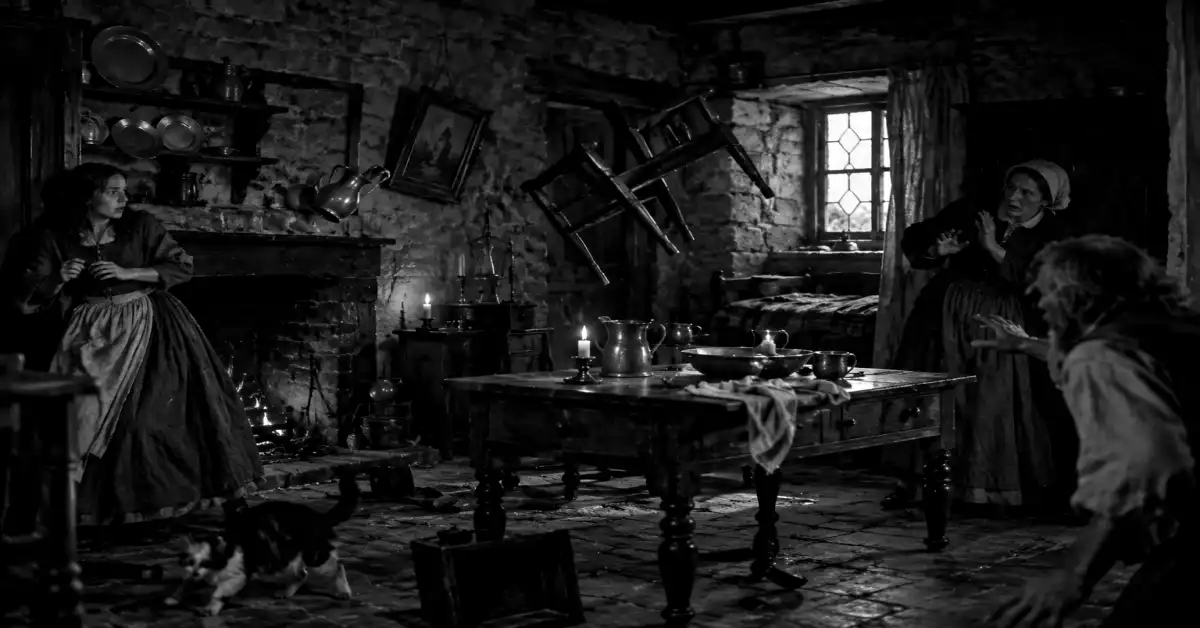
In the Runcorn case, all signs pointed to 17-year-old John Jones Jr.
| Element | Description |
|---|---|
| John Jones, Jr. | 17-year-old clerk |
| High Stress / Pubertal Age | Repression |
| Recurrent Spontaneous Psychokinesis (RSPK)? | Kinetic discharges |
| Flying Objects, Raps, Overturned Tables |
Whenever John left the house to run an errand or speak to officers outside, the house fell deathly still. The moment he stepped back across the threshold, floorboards groaned, pictures rattled, and heavy objects began shifting.
Witnesses noted that the boy appeared exhausted, nervous, and genuinely bewildered by the circus erupting around his ears. He was not giggling in a corner like a mischievous schoolboy pulling off a caper. He was scared.
Parapsychologists who later analyzed the surviving accounts, including theories popularized by researchers like Guy Lyon Playfair and William G. Roll, classify cases like this under Recurrent Spontaneous Psychokinesis (RSPK).
The core theory suggests:
- Poltergeist activity is not caused by dead spirits, demons, or restless phantoms.
- The chaos represents an unconscious externalization of intense emotional stress, anxiety, or repressed subconscious conflict.
- Adolescents, going through rapid physiological, psychological, and hormonal changes, serve as biological pressure valves that trigger anomalous kinetic bursts.
Was young John releasing bottled-up tension in the form of raw physical kinetic energy? Or was he simply one of the most brilliant teenage stage magicians Britain had ever produced?
Investigating the skeptical explanations
To be fair to the skeptics — and there were plenty in 1952 — we must look at rational alternative explanations. Extraordinary claims require cold, clear scrutiny. Could a normal physical phenomenon explain the flying furniture of Byron Street?
1. Geological subsidence and brine pumping
Cheshire is famous for its underground salt mines. For generations, companies pumped salt brine from deep beneath the county’s soil, frequently causing dramatic sinkholes, shifting foundations, and cracking masonry throughout the region.
Could subterranean subsidence make a house shake? Absolutely.
Could ground settlement cause a heavy dining table to levitate, turn completely upside down, and land without crushing the people around it? That stretches credibility past the breaking point. Subsidence cracks walls and tilts floors; it does not throw teacups horizontally across a hallway or pick up books and drop them in neat stacks.
2. Deliberate, calculated fraud
Teenagers love pulling pranks. History is packed with mischievous youngsters who fooled gullible adults using fishing line, hidden kicking techniques, and ventriloquism. The famous Fox Sisters launched modern American spiritualism in 1848 by popping their toe joints against floorboards.
Could John have engineered the whole thing?
Pulling this off requires immense skill. John would have needed to manipulate heavy, multi-hundred-pound wardrobes right under the noses of seasoned police detectives who were specifically watching him for sleight of hand. Multiple independent witnesses stated that objects moved across rooms while John sat under full view in good lighting, hands completely visible.
Tricking your grandmother is easy. Tricking a room full of skeptical, cynical newspaper reporters and hard-nosed Northern cops all at once? That is an entirely different league.
3. Mass suggestion and hallucination
When a neighborhood enters a state of panic, human perception warps. An old pipe bangs, and someone swears they heard a demon screaming. A loose picture frame falls due to traffic rumbles outside, and a startled neighbor swears it flew across the ceiling.
While mass hysteria definitely fed the frantic crowds gathered outside Byron Street, it fails to explain the physical aftermath indoors. Cracked plaster, smashed chinaware, bruised shins, and fractured furniture legs left concrete evidence behind. Something physically real wrecked that parlor.
Runcorn vs Enfield
The Runcorn outbreak shares an uncanny blueprint with another legendary British haunting that occurred twenty-five years later: the Enfield Poltergeist of 1977.
| Case Feature | Runcorn Poltergeist (1952) | Enfield Poltergeist (1977) |
|---|---|---|
| Location | Council/terraced home, Cheshire | Council semi-detached house, North London |
| Focal Individual | John Jones Jr. (Age 17) | Janet Hodgson (Age 11) |
| Primary Phenomena | Shifting heavy furniture, wall raps | Flying toys, furniture slides, vocalizations |
| Police Verification | Yes (Supt. Wolstencroft & constables) | Yes (WPC Carolyn Heeps & partner) |
| Duration | Short burst (approx. 10 to 14 days) | Extended siege (over 18 months) |
| Resolution | Sudden, spontaneous cessation | Gradual decline following interventions |
The parallel between the two police accounts is striking. In both cases, uniformed police officers arrived expecting domestic disputes or petty pranks, only to watch furniture glide across the floor with their own eyes.
How it ended: the sudden silence
Just as quickly as the madness began, the storm ran out of rain.
By the final days of August, the loud rappings softened back into faint murmurs. The dining table stayed firmly on its legs. Ornaments remained resting peacefully on the mantelpiece. John Jones Jr. went back to his normal routines, the reporters packed up their typewriters and caught trains back to London, and the police barricades were dismantled.
The family never charged admission, never wrote a tell-all book, and never joined a traveling spiritualist circuit. They simply wanted their lives back.
Mrs. Lucy Jones swept up the broken porcelain, set her home back in order, and lived out her days on Byron Street without another chair budging an inch.
Was it an adolescent psychic outburst, an elaborate practical joke executed with master-class precision, or something truly inexplicable lurking beneath the surface of post-war British life? More than seventy years later, the strange case of 1 Byron Street remains one of the most compelling, thoroughly witnessed cold cases in the annals of paranormal history.
Sources & historical references
- The Runcorn Weekly News (August 1952 editions; contemporary local reportage on the Byron Street incidents and police patrols).
- The Liverpool Echo (August 20–25, 1952; eyewitness coverage, interview transcripts with local officers, and crowd reports).
- The Cheshire Observer (Archival reports on local industrial conditions, mining subsidence evaluations, and regional reactions).
- Roll, William G. The Poltergeist (1972). Foundational study on Recurrent Spontaneous Psychokinesis and adolescent focal points.
- Playfair, Guy Lyon. This House Is Haunted (1980). Comparative documentation of British anomalous kinetic disturbances.
- Strange Company Archives: The Runcorn Poltergeist (Case file overview and timeline analysis).

