
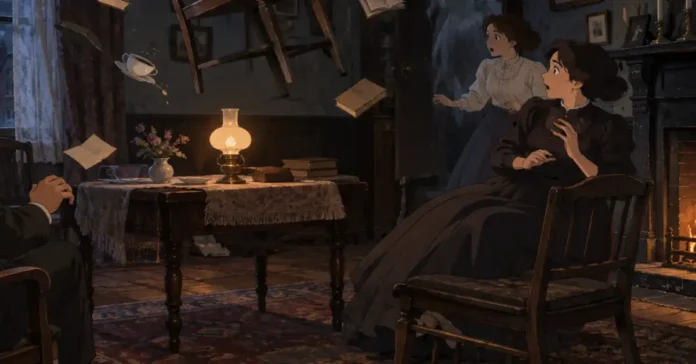
Most classic haunted house stories feature chilling moans, rattling chains, or phantom footsteps in the dead of night. Dublin had something far weirder: a ghost who simply refused to keep his mouth shut. Meet Corney, an opinionated entity who spent years interrupting family chats right from a basement coal bin.
When your townhouse comes with an unwanted roommate
Picture living in a tidy Dublin townhouse back in the nineteenth century. Red brick facade, drafty sash windows, and a cool, damp cellar down below where the household kept the fuel. Everything seemed peaceful until the “A— ” family unpacked their trunks.
Trouble began with a limp.
Mr. A had sprained his knee rather badly, leaving him dependent on a stout wooden crutch. Every night before turning out the lamp, he rested the crutch right beside his bedpost. Then the midnight theater began.
Mrs. A woke up to a rhythmic, heavy thudding on the landing outside their bedroom door. Thump. Drag. Thump. Someone was pacing the hallway, flawlessly imitating her husband’s clumsy gait. She struck a match, checking the room in a hurry. The wooden crutch sat untouched right where her husband had left it.
Phantom footsteps are scary enough on their own. Yet this invisible tenant was only getting warmed up. Within days, the phantom found its voice, transforming a quiet Irish household into a scene of daily paranormal bedlam.
Who documented corney?
How did this peculiar tale survive for over a century? We owe the record to an extraordinary book published in Dublin back in 1914 titled True Irish Ghost Stories.
The authors were not dime-store novelists chasing cheap scares. The project was led by the Reverend St. John Drelincourt Seymour, a Church of Ireland clergyman and scholar, alongside Harry L. Neligan, a District Inspector in the Royal Irish Constabulary. One was a theologian trained in historical texts; the other was a veteran police officer seasoned in grilling witnesses and sifting real evidence from tall tales.
To collect material, Seymour placed public notices in leading Irish newspapers asking readers for firsthand or family accounts of uncanny phenomena. Letters poured into his rectory by the hundreds.
Among these submissions came a detailed testimony provided by a woman identified as “Mrs. C.” Her daughter worked as a governess for a family friend of the authors, and Mrs. C. had heard the entire saga directly from her parents, Mr. and Mrs. A. To protect their social standing in polite Dublin society, real surnames and the exact street were shielded behind blank dashes — a standard courtesy in Edwardian documentation that researchers have highlighted when studying the case.
Neligan and Seymour found the family’s narrative gripping because it defied the standard ghost script. Spirits were supposed to glide through walls and look sorrowful. Corney preferred to shout through the floorboards.
What did a talking ghost sound like?
What does an invisible entity sound like when it decides to chime in on your morning gossip? According to everyone who lived in the home, Corney’s voice had a distinctive, uncanny acoustic quality:
- Acoustic timbre: His words boomed with a deep, hollow resonance, as if he were shouting from the bottom of an empty wooden barrel.
- Physical headquarters: He chose the kitchen coal-cellar as his primary parlor, lurking in the dark behind piles of damp briquettes.
- Conversational habit: Whenever people gathered in the basement kitchen to chat, Corney joined right in. He would interrupt family arguments, answer mundane questions, or crack sarcastic jokes at the household’s expense.
The family quickly took to calling him “Corney.” Oddly enough, he responded to the nickname without complaint. Once, during a softer moment, he actually whispered his true mortal name to Mrs. A.
Did she write it down? Unfortunately, no. The poor woman got so flustered that she forgot the name almost immediately, leaving the entity forever branded as Corney.
His social quirks did not stop there. Corney possessed distinct personal prejudices. He detested anyone who was not frightened of him. If an arrogant guest came downstairs hoping to cross-examine him like a lawyer, Corney gave them the silent treatment. Threaten him, and he shut down completely. Coax him gently with polite chatter, however, and he was happy to chew your ear off for hours.
Kitchen chaos
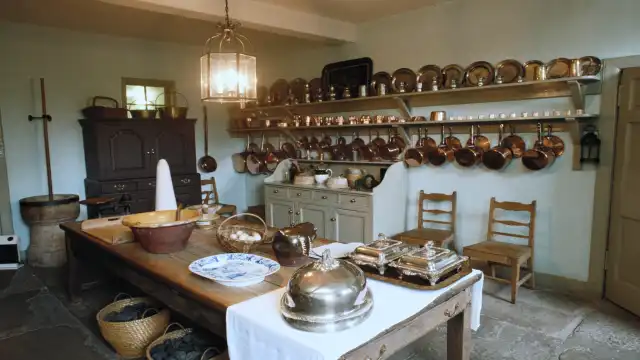
Living with a chatty phantom might sound funny from a distance, but the household staff found it exhausting. The kitchen servants slept in an old-fashioned press-bed — a fold-down cabinet bed tucked against the wall. Having an unseen specter heckling them from the coal bunker proved too much to bear.
They begged Mrs. A to move their bed to the attic, far away from the coal cellar. She agreed. The very first night upstairs, before the maids could even blow out their candles, a familiar barrel-like voice rattled the rafters:

“Ha, ha! I am here before you! I am not confined to any one place in the house!”
The terrified women grabbed their pillows and fled straight back downstairs. If Corney was going to torment them anyway, they preferred sleeping near the warm hearth.
The flying fish incident
Domestic life in the house was punctuated by practical jokes that kept everyone on edge. One afternoon, a young housemaid was gutting fish on the kitchen table for the evening meal. Stepping away for a moment to grab a clean bowl, she turned back only to find the counter bare. The fish was gone.
In Victorian Dublin, missing meat or fish was no laughing matter. Maids were regularly accused of pilfering food to sell or feed secret sweethearts, an offense that meant losing one’s job without a character reference.
The poor girl slumped onto a kitchen stool, weeping hysterically at the thought of being fired.
Right on cue, the coal cellar door rattled. Corney’s voice roared across the room:
“There, you blubbering fool, is your fish for you!”
With those words, the raw fish flew through the air and slapped hard onto the stone floor at her feet.
Interior decorating and broken iron
Country relatives frequently visited the A— residence, bringing gifts of fresh garden produce. Corney evidently had strong opinions about kitchen aesthetics. Whenever sacks of vegetables arrived, the ghost took it upon himself to string the turnips, onions, and cabbages across the ceiling beams, hanging them like festive holiday garlands.
He also established strict household boundaries. There was one specific wooden press in the kitchen that Corney claimed as his own property. Put a stack of plates or a jar inside, and he promptly hurled it out onto the flagstones.
Tensions eventually boiled over. An uncle visiting the home grew sick of hearing about the invisible pest. Marching down into the kitchen, the man snatched up a heavy iron fireplace poker, strode to the coal-cellar door, and hammered on the wood with all his might:
“I’ll make you speak!” the uncle yelled.
Corney did not make a peep. The uncle smirked, assuming he had put the spirit in its place.
Next morning, the household walked into the kitchen to prepare tea. Lying on the floor right in front of the coal door was the heavy iron poker — snapped cleanly into two pieces.
The midnight soot party and the silent priest
Could an invisible presence host a social gathering? Corney certainly thought so.
One afternoon, the spirit shouted a rare polite warning to the family: he was expecting company that evening. If they wanted clean water for cooking or drinking, they had better pump it before going to bed.
The family took the hint. After sunset, everyone locked their doors and huddled under their quilts.
Around midnight, a cacophony erupted in the lower corridors. Five or six distinct, unfamiliar voices were heard arguing, laughing, and muttering in the shadows.
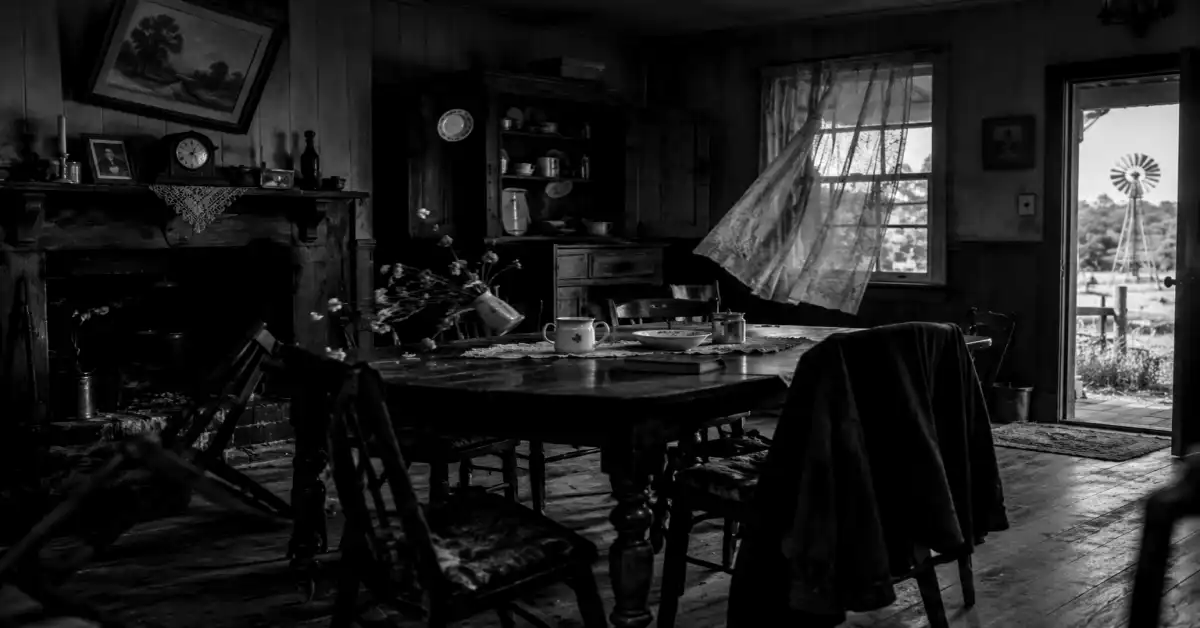
Dawn revealed a ghastly scene:
- The household’s main water cistern was filled with liquid as black as printer’s ink.
- Pantry shelves looked like a crime scene.
- Every loaf of bread and brick of fresh butter had been handled, covered in oily streaks left by sooty spectral fingers.
The undercover clergyman
Shaken by the vandalism, the A— family sought spiritual guidance. A local clergyman offered to visit and perform an assessment, hoping to determine what kind of force occupied the building.
Mrs. A knew Corney’s stubborn nature all too well. She warned the minister to dress in ordinary civilian clothes, hide his collar, and sit quietly by the hearth without mentioning his holy orders. Corney had an uncanny radar for authority figures; giving away the game would guarantee silence.
The clergyman sat patiently for hours. The hearth crackled. Teacups clinked. Nothing happened. Corney remained stubbornly quiet, refusing to utter a single word. Tired and disappointed, the minister finally tipped his hat and walked out into the Dublin rain.
As soon as the street door latched shut, the servants hurried to the cellar door.
“Corney, why didn’t you speak to him?” they asked.
From the dark came his sheepish, muffled reply:
“I could not speak while that good man was in the house.”
Whenever the maids pressed him about where he had come from, or why he was bound to an earthly basement, Corney’s sarcastic tone vanished. His answer remained solemn and chilling:
“The Great God would not permit me to tell you.”
What did corney look like?
Nearly all poltergeist cases are entirely auditory and tactile. We hear bangs, watch candlesticks slide across tables, and find shattered crockery. Sightings of an actual physical body are vanishingly rare.
Across all the years the A— family occupied the Dublin house, Corney revealed his physical appearance only twice:
- The unnamed victim: A visitor or resident allegedly caught sight of the figure standing in a hallway. The shock was so profound that the person took ill and reportedly died from pure fright.
- The seven-year-old child: The second witness was Mrs. C.’s father when he was a boy of seven.
Running to his mother in sheer bewilderment, the boy described seeing a pale man standing without any clothes on in the dim corridors. The child noted two striking details: the figure had a single tight dark curl of hair plastered flat against his forehead, and his flesh was strangely bloodless — a hue the boy described as looking like “a clothes-horse,” the bleached wooden frame used by Victorian laundresses to dry clean linen.
Was this the lingering shade of a former servant? Local neighborhood rumors suggested that an elderly domestic named Cornelius had died in the house a year or two before the A— family took up the lease. If true, perhaps Corney never realized his employment had ended.
Corney sells the house
By this stage, Mr. A had reached his breaking point. The broken poker, ruined butter, ruined water tanks, and constant domestic chatter were too much. He decided to break his lease, pack up the furniture, and move his family far away.
Selling an ordinary lease in Dublin was straightforward. Selling a house with a loudmouthed invisible roommate was an absolute nightmare.
Whenever prospective buyers toured the property, things went well through the parlor and bedrooms. The second they descended the staircase to inspect the kitchen scullery, disaster struck. Corney would clear his phantom throat and begin yelling insults or rambling incoherently from the coal cellar.
Every single prospective buyer fled into the street without looking back.
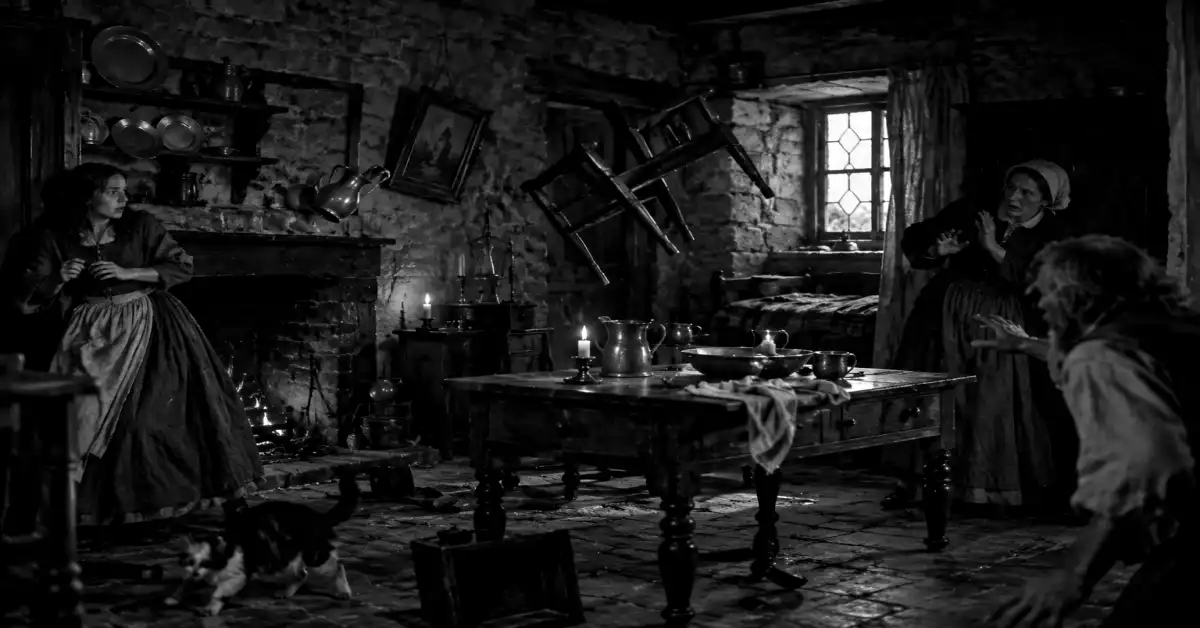
The family began to panic. Would they ever escape this place? Desperate, they called down into the cellar, asking Corney if he intended to pack up and haunt their next house.
His reply was direct:
“No! But if they throw down this house, I will trouble the stones.”
Hearing that, Mrs. A decided on a radically different tactic: she chose kindness over confrontation. Walking down to the coal-cellar door alone, she pleaded her case woman-to-ghost. She pointed out that her family had never wronged him, never disrespected his space, and had treated him with patience. Why destroy their livelihood by chasing off every buyer?
Her plea worked. Corney relented.
“You will be all right now,” the voice declared from the dark. “For I see a lady in black coming up the street to this house, and she will buy it.”
The family stared at each other in disbelief. Not thirty minutes later, a carriage stopped at the curb. A widow dressed in full mourning black walked up the front steps, inspected the property in serene silence, and bought the lease on the spot. Corney kept his word, remaining as quiet as a tomb.
When Seymour and Neligan compiled their notes around 1914, their informant decided to check the local Dublin Street Directory to see who lived in the mysterious house. The listing had only one word next to the address: Vacant.
How corney compares to other vocal spirits
In paranormal literature, poltergeists almost never talk. Parapsychologists typically define poltergeist activity as spontaneous physical chaos: objects flying, rappings, mysterious puddles, or small fires. When an entity actually talks back, historians sit up and pay attention.
| Characteristic | The Dublin Poltergeist (“Corney”, 1914) | The Bell Witch (Tennessee, 1817) | Gef the Talking Mongoose (Isle of Man, 1931) |
| Primary Sound | Booming hollow voice like an empty barrel | High-pitched feminine whisper growing into a shout | Squeaky, high-pitched vocal chatter |
| Favorite Lair | Kitchen coal-cellar | House walls and bedroom rafters | Wall cavities and ceiling panels |
| Social Behavior | Gossiped, teased maids, made prophecies | Quoted sermons, sang hymns, cursed enemies | Spied on neighbors, gossiped, demanded snacks |
| Physical Pranks | Hanging vegetables, inky water, broken poker | Slapping, pinching, throwing furniture | Throwing pebbles, killing rabbits |
| Departure | Relented after a polite plea; predicted the buyer | Departed after fulfilling a violent grudge | Faded out as the family moved away |
Looking at this comparison, Corney feels remarkably grounded in domestic Irish life. He was not a demonic figure bent on violence, nor was he an otherworldly beast like Gef. He acted like an unruly, grumpy retired servant who simply refused to leave his favorite warm spot by the hearth.
Practical joke or genuine mystery?
How should modern readers view the story of Corney? There are several fascinating ways to unpack what might have actually happened in that Dublin basement.
1. The architecture of sound
Townhouses built during the Georgian and Victorian eras were filled with intricate acoustic quirks. Hollow timber floorboards, disused dumbwaiters, speaking tubes, and chimney flues created natural voice pipes.
A voice spoken near an outside coal chute or through a basement drain can produce a strange, muffled echo. Could street urchins, neighbors, or cellar-dwellers have exploited those acoustics? It certainly explains why his voice sounded like it was coming from inside a wooden barrel.
2. Domestic power plays
Domestic servants in Victorian Ireland endured brutal hours, tiny wages, and strict social isolation. The kitchen basement was their exclusive territory, while the family ruled upstairs.
Could the ghost have been an ingenious cover for frustrated household maids?
- Accidentally drop the dinner fish on the floor? Blame Corney throwing it from the cellar.
- Want to frighten away demanding guests or prevent relatives from staying too long? Have an accomplice rattle the cellar latch.
- Tired of having the mistress rifle through a specific cabinet? Tell her the ghost throws out anything placed inside.
It is a clever theory, yet it struggles to explain the sheer volume of witnesses. Could teenage maids easily snap an iron fire poker in half without tools? Could they fool a family across multiple years without ever being caught?
3. The uncanny prophecy
The most baffling detail remains the final transaction. A prankster maid might throw raw cod across a room, but how could someone predict the arrival of a widow in black walking down the avenue thirty minutes before she knocked on the door?
That detail lifts Corney’s story out of simple household mischief and firmly embeds it into classic Irish folklore. Whether he was a genuine earthbound spirit, a clever domestic hoax, or a heavily embellished family legend polished around winter firesides, Corney remains one of the most uniquely charming ghosts in urban history.
Key takeaways
- The Case: Documented by clergyman St. John D. Seymour and police inspector Harry L. Neligan in their 1914 study, True Irish Ghost Stories.
- The Quirk: Unlike mute spirits, Corney spoke daily in a barrel-like voice, trading banter with residents and scolding servants.
- The Behavior: Threw fish, hung vegetables like party garland, refused to let anyone touch his favorite press, and snapped an uncle’s iron poker.
- The Exit: Stopped scaring buyers after Mrs. A appealed to his decency, accurately predicting that a widow in black would purchase the lease.

