

Riding the historic yellow tram through Lisbon’s steepest alleys sits right near the top of almost every traveler’s wishlist. Waiting two sweaty hours in a chaotic queue at Praça Martim Moniz only to end up squished against a stranger’s backpack definitely does not. Here is your street-smart playbook to experience the full journey in comfort, dodge the brutal lines, and save your hard-earned euros.
The Martim Moniz trap: why traditional guides get it wrong
Most travel itineraries tell you the exact same thing: take the metro to Praça Martim Moniz, find the tram pole, and hop aboard. What those guides fail to mention is the human bottleneck waiting for you. Between 9:30 AM and 6:00 PM, that square turns into a slow-moving gridlock of exhausted tourists. You stand on baking asphalt, breathing exhaust fumes, watching one packed tram pull away after another.

Why is the line so painfully slow? The vintage yellow cars — known locally as Remodelados — were built in the 1930s. They have only 20 wooden seats and standing space for around 38 passengers. Because these trams run through active city traffic on narrow, single-track corridors, dispatchers cannot simply run an endless conveyor belt of vehicles. If a parked delivery van blocks the tracks in Alfama, the entire line grinds to a halt. By the time you finally step on board at Martim Moniz, every seat is taken. You spend the next forty minutes clutching a polished brass pole, staring at someone’s collarbone instead of the tiled facades.
To make matters worse, crowded boarding zones act as open invitations for professional pickpockets (carteiristas). Working in teams of two or three, they bump against distracted passengers stepping up the high entrance stairs. Is that really how you want to spend your morning in Portugal? Fortunately, a single strategic tweak completely flips the experience in your favor.
The reverse route hack: start at Campo de Ourique (Prazeres)
If you want to know how to ride tram 28 lisbon like a seasoned local, throw out the default eastern starting point. Flip the script entirely. Head west to the opposite end of the line: Campo de Ourique (Prazeres).
Campo de Ourique is a charming, leafy residential neighborhood far removed from the cruise ship crowds. Tour buses rarely venture out here, which means the boarding queue at the Prazeres terminus is virtually nonexistent for most of the day. Instead of shuffling forward in a two-hour line of hundreds of people, you will often find fewer than ten riders waiting quietly under the jacaranda trees.

Getting to Prazeres is surprisingly simple:
- Take the Metro Yellow Line to the Rato station, followed by a pleasant 15-minute uphill walk or a five-minute hop on bus 709 or 774.
- Grab an affordable rideshare (Uber or Bolt) directly from the city center for roughly €5 to €7.
- Catch the modern, sleek Tram 25E from Praça da Figueira to its terminal stop near the cemetery.
Starting your ride here turns waiting time into sightseeing time. Right beside the tram turnaround sits the historic Cemitério dos Prazeres. Far from spooky, this 19th-century cemetery features elaborate family mausoleums, shaded cypress pathways, and an incredible overlook framing the 25 de Abril Bridge and the Tagus River. A three-block stroll down Rua Coelho da Rocha brings you to the Mercado de Campo de Ourique, a bustling food hall where you can sip an espresso and eat a warm custard tart without dodging selfie sticks.
When your yellow tram rolls into the Prazeres loop, you will walk right on. You get first pick of the polished wooden benches. Slide onto the right-hand side of the car, crack open the heavy sash window, and enjoy the ride while everyone else is still waiting in line across town.
Tram 28 Route Map: what you see along the way
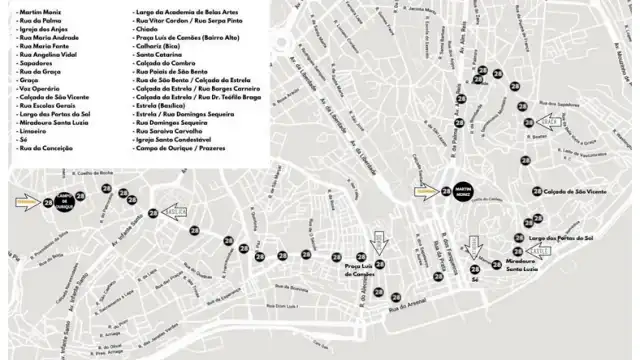
The full journey spans roughly 7 kilometers and takes between 45 and 60 minutes depending on traffic. Tracking the tram 28 route map reveals why this humble commuter route achieved global fame: it slices through centuries of Lisbon’s architectural history.
The ride divides into four distinct visual chapters:
- The Grand Boulevards of Estrela: Leaving Prazeres, the tram glides past the baroque white dome of the Basílica da Estrela and the lush botanical gardens of Jardim da Estrela. The streets here are broad, giving you a smooth, gentle introduction to tram travel.
- The Steep Descents of Bica and Chiado: Past São Bento (Portugal’s Parliament), the track tilts downhill into the bohemian streets of Chiado. Here you will hear the wooden floorboards creak, the iron brakes groan, and the driver frantically stomp the brass foot bell to clear delivery vans and jaywalkers off the tracks.
- The Bustling Flats of Baixa: The tram crosses the downtown gridiron along Rua da Conceição. This short stretch connects Lisbon’s hills, buzzing with traditional fabric shops, pastelarias, and banking halls.
- The Medieval Maze of Alfama and Graça: The route saves its most dramatic drama for the climb up into Alfama. Alleys become so narrow that you can practically reach out and touch laundry hanging from wrought-iron balconies. You will rumble past the stone battlements of the Sé de Lisboa (Lisbon Cathedral), sweep past the viewpoint terrace at Miradouro de Santa Luzia, and climb past the monastery of São Vicente de Fora before descending to Martim Moniz.
For the best photos, sit on the right side when traveling east from Prazeres toward Martim Moniz. That gives you unobstructed vistas of the Tagus River and the facade of the Cathedral as the tram maneuvers around tight street corners.

How to avoid queues on Tram 28
Route direction matters, but timing determines your comfort. If you must board near the city center, knowing when to show up makes all the difference.
- The Early Bird Window (Before 8:30 AM): Trams begin running around 5:40 AM on weekdays and 6:45 AM on weekends. Between dawn and 8:30 AM, you share the car almost exclusively with Portuguese grandmothers running morning errands and hospital staff heading to work. The early morning light cuts through the hills, casting sharp shadows across empty cobblestone alleys.
- The Golden Hour & Evening Run (After 7:00 PM): Day-trippers vanish by sunset, heading back to cruise docks or dinner tables. Boarding after 7:30 PM offers cooler temperatures, empty seats, and an enchanting nighttime journey under amber streetlamps.
- The Danger Zone (10:00 AM to 5:30 PM): This window belongs to tour groups and cruise excursions. Queues stretch past sixty minutes at Martim Moniz, Chiado, and Graça. Unless you enjoy standing belly-to-back in an un-air-conditioned wooden box, steer clear during midday hours.
Tickets and Fares: stop paying the onboard tourist tax
One of the costliest blunders travelers make is paying the driver in cash when boarding. The municipal transport authority, Carris, intentionally penalizes cash purchases to discourage delays at stops.
- Onboard Cash Fare: Buying a single ticket directly from the driver costs €3.30. The driver must stop, count coins, and print a slip, which irritates local commuters and drains your pocketbook.
- Navegante Ocasional Card (Formerly Viva Viagem): Purchase a reusable green card for €0.50 at any automated machine inside a Metropolitano de Lisboa metro station.
- The “Zapping” Option: Load pay-as-you-go credit onto your card (from €3 to €40). With Zapping, a tram journey drops to just €1.72. That saves you nearly 50% compared to paying cash on board.
- The 24-Hour Network Pass: For €7.25, load a 24-hour pass onto your card. It grants unlimited rides on all Carris buses, trams, funiculars (like the iconic Bica and Glória), and the entire metro network. If you plan to ride Tram 28, hop on a funicular, and ride the metro twice in a single day, this ticket pays for itself by lunchtime.
- Contactless Bank Card: Carris validators now allow you to tap a standard contactless credit or debit card directly at the front reader for €1.92 per trip. It beats the cash surcharge, though Zapping remains the cheaper option.
Keep in mind that each passenger needs their own physical card. You cannot scan your Navegante card twice at the validator to pay for a travel partner.

Secret alternative: why you should ride Tram 12E instead
What if you only care about seeing historic Alfama from a wooden tram window and could care less about the rest of the line? Skip line 28 completely and head to Praça da Figueira for Tram 12E.
Tram 12E is Lisbon’s best-kept public transit secret. It runs on a compact circular loop starting downtown at Praça da Figueira, grinding straight up through Mouraria, climbing past Miradouro das Portas do Sol, and looping back down past the Sé Cathedral.
Why choose Tram 12E over 28?

- It utilizes identical vintage Remodelado wooden tram cars.
- It navigates the very same hairpin turns and narrow stone alleys through Alfama.
- It carries roughly 70% fewer tourists, meaning lines rarely exceed ten people.
- The entire circular trip takes barely 20 to 25 minutes, making it quick and easy to fit into a busy afternoon schedule.
Another worthy option is Tram 25E. Running from Praça da Figueira through Santos and the wealthy diplomatic quarter of Lapa up to Campo de Ourique, line 25 delivers an authentic glimpse of working-class Lisbon without tourist crowds.
Outsmarting pickpockets and staying safe
Historic tram lines are hunting grounds for skilled pickpockets. These thieves do not look suspicious; they often dress like polished tourists carrying light jackets, folded newspapers, or cloth tote bags.
Their favorite technique is the “boarding pinch.” One person stops abruptly at the tram doorway pretending to fumble for a ticket, while their partner pushes behind you, apologizing profusely while sliding a hand into your back pocket or unzipped bag.
Protecting your gear takes only basic awareness:
- Turn your backpack around and wear it over your chest before stepping onto the platform.
- Never place your phone or wallet in your back pocket or loose jacket compartments.
- Keep your phone securely stowed while standing near open windows; thieves on passing mopeds have been known to snatch devices right out of riders’ hands during street stops.
- If someone drops coins or presses uncomfortably close against you on a half-empty tram, step back and secure your belongings immediately.
Rider etiquette
Amid the charm and scenic photos, remember that Lisbon Tram 28 is an essential lifeline for locals. For elderly residents living atop Alfama’s steep hills, this tram is their only practical link to pharmacies, grocery markets, and medical clinics.
- Give up your seat: If an elderly local, pregnant woman, or parent with small children boards, stand up and offer your seat immediately.
- Keep the aisles clear: Slide your daypack between your feet on the floor so others can move past.
- Fold your strollers: Bulky, unfolded baby strollers block the aisle and can create severe safety hazards during sudden stops.
- Leave oversized luggage behind: Carris rules prohibit large suitcases on vintage trams. Taking oversized rolling luggage aboard will likely result in the driver refusing you entry.
- Respect the terminus rules: You cannot buy a single ticket and stay seated for an endless loop. When the tram reaches Martim Moniz or Prazeres, the driver will clear the cabin. All passengers must step off so the vehicle can reset. If you want to ride back, step to the rear of the platform queue.
By heading out early, boarding at Campo de Ourique, and tapping with a preloaded card, you will enjoy one of Europe’s most enchanting rail journeys without the headaches that trap unsuspecting visitors.

