
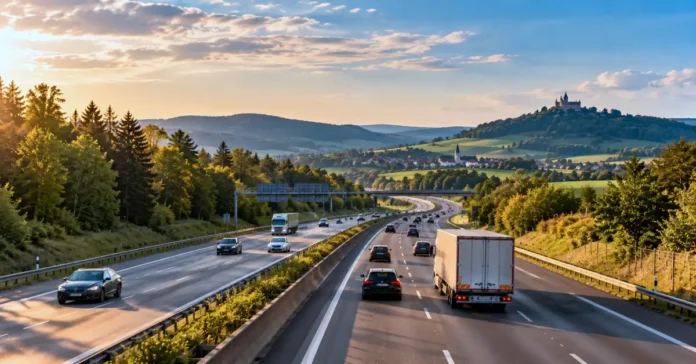
Renting a car in Germany often tops the bucket list for drivers eager to experience the legendary motorway system. Popular myths paint this highway as a lawless playground where pedal-to-the-metal driving reigns supreme. In reality, Germany’s highway network functions smoothly only because it operates under some of the strictest traffic statutes on earth.
Speed limit myth: what unrestricted actually means

Pop culture loves to claim the Autobahn has no speed limits whatsoever. Talk to any local commuter, and they will quickly burst that bubble.
Data from the Federal Highway Research Institute (BASt) reveals that roughly 30% of the entire Autobahn network has permanent, statutory speed limits. Another 10% to 15% relies on dynamic electronic overhead gantries that adjust speed caps in real time depending on weather, congestion, or localized pollution. Add seasonal construction zones (Baustellen) into the mix, and you quickly realize that wide-open, unrestricted tarmac is a privilege, not a blanket guarantee.
How do you know when you can legally unleash your engine? Look for Zeichen 282. This circular white sign features five thin diagonal black stripes across its face. Passing this marker cancels all previous speed restrictions and passing bans.
Once you clear that sign, the statutory maximum vanishes, but an advisory ceiling immediately takes its place: the Richtgeschwindigkeit. Set at 130 km/h (roughly 81 mph), this recommended speed is not an enforceable limit on paper. You cannot receive a speeding ticket simply for cruising at 180 km/h in an unrestricted zone.
Here is the legal catch that catches most visitors off guard: civil liability. German courts, backed by Federal Court of Justice (Bundesgerichtshof) precedent, hold fast drivers to a much higher standard of accountability. If you choose to travel well beyond 130 km/h and find yourself in a collision, judges routinely assign partial liability (Mithaftung) to you. That liability applies even when another driver committed the initial error by pulling into your lane. The legal reasoning is simple: at 200 km/h, your stopping distance stretches dramatically, denying you the buffer needed to avoid an accident. Insurance companies take full advantage of this legal loophole to slash payouts.
Posted numbers mean business. When you see a standard circular sign bordered in vivid red displaying 120, 100, or 80 km/h, drop your speed before reaching the signpost. German traffic authorities position speed cameras right behind these signs, including hidden mobile tripods and unmarked police interceptor sedans equipped with calibrated video rigs.

Rechtsfahrgebot (Keep right)
If German highway culture had a single commandment etched in stone, it would be Rechtsfahrgebot. Codified in Section 2, Paragraph 2 of the German Road Traffic Act (Straßenverkehrs-Ordnung or StVO), this statute requires drivers to stay in the rightmost lane whenever it is empty.
Think of the left lane as a momentary utility space rather than a cruising lane. You move left exclusively to pass a slower vehicle. The moment your maneuver finishes and a safe gap opens up on your right, you flick your blinker and move back over. Staying planted in the middle or left lane when the right lane is clear for hundreds of meters is an infraction known as Mittelspurschleichen. German traffic police will pull you over and issue an on-the-spot fine with penalty points registered in the Flensburg driver fitness registry.
Can you pass someone on their right side? Absolutely not.
Undertaking on the right (Rechtsüberholen) outside city boundaries is strictly forbidden. Undertaking is treated as a major traffic offense under the German fine catalog (Bußgeldkatalog), bringing a fine of around €100 and a penalty point on your driving record. Even if an oblivious driver is dawdling at 110 km/h in the center lane, you may not sneak around their passenger side. You must move all the way across to the left, pass cleanly, and migrate back across to the right.
There is one narrow exception: dense traffic jams (Stau). When all lanes are backed up and crawling at speeds below 60 km/h, the law permits vehicles in the right lane to roll gently past cars on their left, provided the speed difference never exceeds 20 km/h. Outside that gridlock scenario, never pass on the right.
Flashing lights, tailgating, and legal coercion
Picture this: you are cruising at 150 km/h, passing a convoy of freight trucks, when an executive wagon appears out of thin air, gluing itself three feet from your rear bumper while flashing its high beams like a strobe light.
Riding someone’s bumper (Drängeln) is not merely bad manners under German law. Paired with aggressive headlight flashing (Lichthupe), severe tailgating crosses the line from a simple civil traffic offense into a criminal charge known as coercion (Nötigung, Section 240 of the German Criminal Code). Prosecutors regularly secure criminal convictions against aggressive drivers, resulting in massive income-scaled fines (Tagessätze), points, and immediate driving bans.
How close can you legally follow another car? Germany uses the Halber Tacho rule: your following distance in meters must equal at least half your speedometer reading. Rolling at 140 km/h? Keep at least 70 meters of tarmac between you and the car ahead. Highway bridges across the country hide automated distance-measuring cameras. These camera systems record your front bumper against painted road markings while snapping a high-resolution portrait of the driver. Drop below a fraction of the required distance, and you will face steep fines reaching several hundred euros, accompanied by a mandatory one-to-three-month license suspension.
A quick, polite flash of your high beams from a generous distance to signal an intention to overtake outside urban areas is technically allowed under StVO § 5 Abs. 5. Still, applying that flash while closing in rapidly will almost certainly be interpreted as intimidation. Patience pays off every single time.
Rettungsgasse
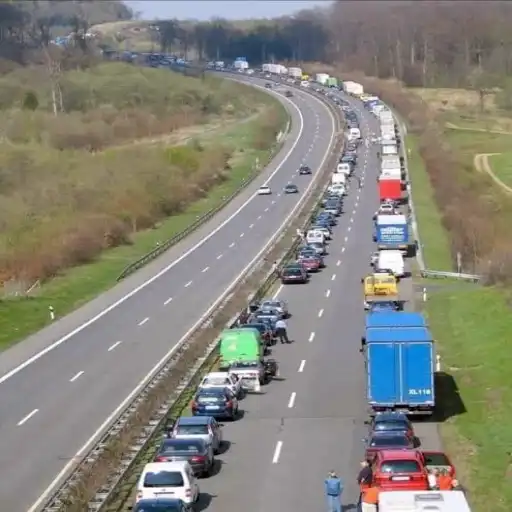
Nothing demonstrates the disciplined precision of German drivers quite like the Rettungsgasse.
Under Section 11, Paragraph 2 of the StVO, motorists must form an emergency channel the moment traffic slows to walking speed or comes to a dead stop. Notice the crucial phrasing: you do not wait until you hear sirens or spot blue flashing lights in your rear-view mirror. You build the corridor preemptively as traffic halts.
The geometry of the corridor is straightforward:
- On a two-lane highway, cars on the left lane hug the far-left guardrail, while cars on the right lane pull toward the far-right edge of their lane. The lane in between opens wide for emergency personnel.
- On highways with three, four, or five lanes, remember one rule: the channel always opens between the far-left lane and the lane immediately next to it. Everyone in the leftmost lane shifts hard left; vehicles in every other lane steer hard right.
Keep the hard shoulder (Standstreifen) clear unless highway conditions physically force you to dip slightly onto it to make room.
Failing to establish a Rettungsgasse attracts fines between €200 and €320, plus two penalty points and a one-month driving suspension. Using the cleared corridor to skip ahead of traffic is a severe violation that carries heavy financial penalties and criminal inquiry.

Unwritten road realities every tourist must know
Beyond the statutes, smooth Autobahn travel demands sharp awareness and practical foresight.
Check your rear-view mirror twice before every single lane change. A high-performance vehicle traveling at 250 km/h covers roughly 70 meters every second. A speck in your mirror can transform into a two-ton machine right on your bumper in less than four seconds. Trust your indicators, signal early, and verify your blind spot.
Running out of fuel on the Autobahn is illegal. The law considers an empty gas tank a completely preventable vehicle failure. Stranding your car on the shoulder because you gambled on an empty tank will earn you a fine for obstructing traffic, on top of exorbitant towing charges.
Know the difference between a Raststätte and an Autohof. A Raststätte sits directly on the highway edge, featuring fuel pumps, convenience stores, and franchised restaurants. They are accessible without exiting the highway, but their fuel prices are steep, often costing 20 to 30 cents more per liter. An Autohof sits just off the exit ramp, roughly one or two minutes away. These off-highway service stations cater to long-haul truckers, offering significantly cheaper fuel, better homestyle food, and ample parking.
Passenger cars do not pay highway tolls in Germany. Unlike neighboring Switzerland or Austria, you do not need to buy a toll sticker (Vignette) for your windshield. Heavy commercial trucks pay automated tolls through satellite transponders (Toll Collect), leaving ordinary sedans and rental cars to travel without toll booths.
Pack the mandatory safety gear inside your passenger cabin, not buried beneath heavy suitcases in the trunk. German law mandates that every car carry a warning triangle, an intact first-aid kit complying with DIN 13164 standards, and high-visibility reflective vests for the occupants. If your car breaks down, slip on the reflective vest before your feet touch the pavement, exit the car on the passenger side, and stand behind the metal barrier while awaiting roadside assistance.
Germany’s highway network works seamlessly because millions of drivers commit to mutual predictability. Respect the right lane, watch your mirrors, yield gracefully, and you will enjoy one of the most rewarding driving experiences in the world.

