

The World’s Weirdest Book: Is the Codex Seraphinianus Art, or an Artifact from Another Dimension?
There are books you read, and there are books you experience. And then there is the Codex Seraphinianus — a book that experiences you.
Imagine stumbling upon an encyclopedia from a parallel universe. A heavy, beautifully illustrated volume filled with bizarre flora, impossible creatures, and baffling physics, all described in an elegant, flowing script that you cannot, for the life of you, read. Not a single word.
That is the Codex Seraphinianus. It’s a book that has baffled linguists, captivated artists, and fueled conspiracy theories for over 40 years. It’s an enigma bound in paper.
But what is it?
Is it simply an artist’s masterpiece — a breathtaking, 360-page work of surrealist genius designed to mimic the feeling of wonder and confusion? Or could it be something more? A channeled text? A traveler’s guide to a world that is very real, but not our own?
What is the Codex Seraphinianus?
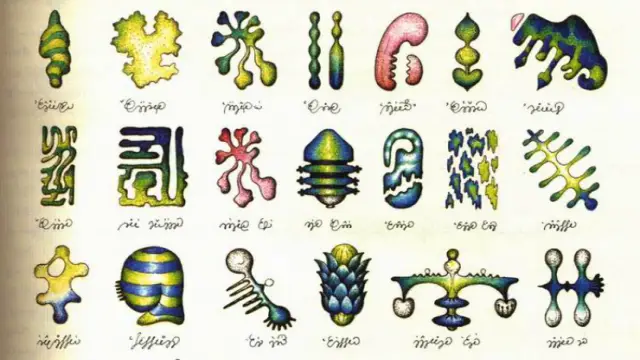
On a purely factual level, the Codex is an illustrated encyclopedia of an imaginary world, created by the Italian artist, architect, and designer Luigi Serafini between 1976 and 1978. It was first published in a lavish, two-volume edition in 1981 by the legendary publisher Franco Maria Ricci.
The book is divided into two sections and eleven chapters, covering everything from botany and zoology to physics, chemistry, and sociology in its fictional world. But that description is like calling the ocean “wet.” It doesn’t even begin to scratch the surface of the sheer, unadulterated strangeness within.

Opening the Codex is like stepping into a dream you can’t quite remember. The illustrations are drawn with the precision of a scientific textbook, but what they depict is anything but scientific.
- Flora: You’ll find trees that uproot themselves to migrate, plants that grow into the shape of chairs, and fruits that bleed when you cut them open.
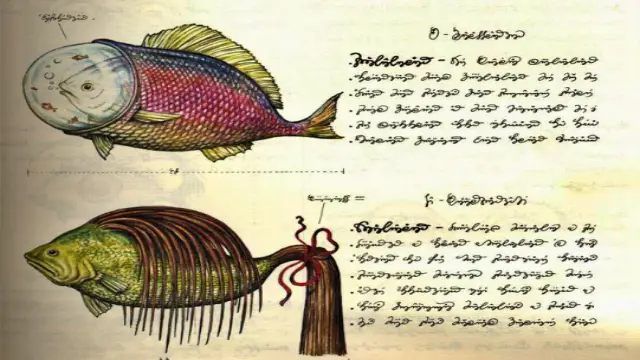
- Fauna: Prepare to meet fish that look like eyeballs, deer with legs like coat-hangers, and most famously, a pair of lovers who, in the process of making love, slowly metamorphose into a single, unified alligator. Yes, you read that right.
- Physics & Machines: There are rainbow bridges that seem to be woven from light, cars covered in soft green bumps, and inexplicable, Escher-like contraptions that defy all known laws of engineering.
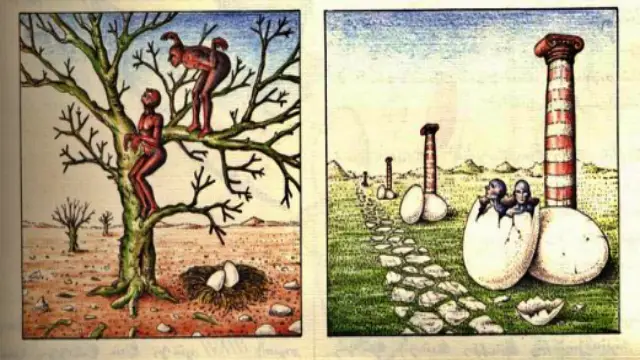
- Humanoids & Culture: The “people” of this world are just as strange. They wear bizarre, conical hats that are part of their skulls, live in houses balanced on stilts, and have customs that are illustrated in meticulous, but completely incomprehensible, detail.
And every single page is filled with handwritten text in that maddeningly beautiful, unreadable script.
Language Without Meaning?
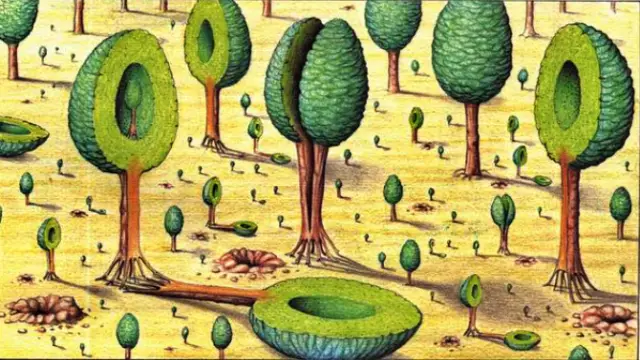
The script of the Codex is perhaps its greatest mystery. It flows across the page with all the confidence of a real language. It has uppercase and lowercase letters, punctuation, and what appears to be a consistent grammar. It looks like it should mean something.
And yet, no one has ever successfully decoded it.
Cryptographers, linguists, and amateur sleuths have thrown everything at it for decades. Some have claimed to have “cracked” the numbering system, suggesting it’s a variation of base 21. But the text itself remains silent.
Luigi Serafini himself has been playfully evasive. In a 2009 talk at the University of Oxford, he claimed that the script is a form of asemic writing — writing that is purely formal, with no semantic meaning. He said the experience he wanted to create was that of a child who can’t yet read, looking at an encyclopedia. The book becomes a canvas for the child’s own imagination, who creates their own story from the pictures.
The writing process, he claims, was akin to “automatic writing.” He didn’t invent a language; he just let his hand flow, creating the illusion of meaning.
Case closed, right? It’s art. It’s not meant to be read.

…Or is that just what he wants us to think?
Theory 1: The Codex is a Surrealist Masterpiece
Let’s look at the evidence for the most logical explanation: the Codex is a landmark work of surrealist art.
Serafini is an artist, not a linguist or a dimension-hopper. The book is a product of its time, echoing the works of surrealists like Max Ernst and fantasy authors like Italo Calvino and Jorge Luis Borges, who loved to play with the idea of fictional encyclopedias and imaginary worlds.
From this perspective, the book’s purpose is not to convey information, but to evoke a feeling. It’s a psychological tool.
- It rewires your brain. By presenting you with a world that is visually logical but contextually absurd, and a language that is syntactically sound but semantically empty, the Codex forces your brain to abandon its usual patterns of comprehension. You can’t analyze it; you can only experience it.
- It returns you to a state of childhood wonder. Remember looking at a grown-up book before you could read? The pictures told a story, but the text was just mysterious squiggles. The Codex masterfully recreates this feeling of pure, unmediated imagination.
- It’s a commentary on the information age. Serafini created the book on the cusp of the digital revolution. Was this a reaction against a world that was becoming obsessed with data and literal meaning? The Codex is the ultimate “analog” experience — it provides infinite imagery but zero data.
In this view, the Codex is a profound artistic statement about the limits of knowledge and the power of the unknown. It’s a masterpiece.
Theory 2: The Codex is a Genuine Artifact
Okay, but let’s entertain the more exciting possibility. Let’s put on our tinfoil hats (conical ones, of course) and look at the evidence that this book is more than just art.
The argument is that the Codex is too complex, too internally consistent, to be a mere doodle.

- The Internal Logic: While bizarre, the world of the Codex follows its own rules. The anatomy of the creatures, the life cycles of the plants — it all feels part of a coherent, albeit alien, ecosystem. It doesn’t feel random; it feels observed.
- The Uncrackable Code: If the writing is just asemic scribbling, why does it exhibit such strong statistical patterns? Why does the numbering system seem to follow a complex mathematical rule? Some argue that Serafini didn’t “invent” the language but “channeled” it, perhaps without even understanding it himself.
- Serafini’s Persona: The artist himself has always been a bit of an enigma. He rarely gives straight answers about the book, preferring to speak in riddles and metaphors. Is this the coyness of an artist protecting his work, or the guardedness of a gatekeeper protecting a genuine secret? He once claimed that a stray white cat joined him in his Rome apartment while he was creating the Codex, and that this cat was the true author, telepathically transmitting the information to him. A joke? Probably. But with this book, who knows?
In this view, the Codex is not a work of fiction. It is a piece of non-fiction from a place we can’t get to. It’s a genuine field guide to another reality.
Verdict
So, what’s the truth? Is it an artist’s surreal vision, or a traveler’s guide to another dimension?
After 40 years, the most profound answer seems to be this: it’s both, and it’s neither.
The true genius of the Codex Seraphinianus is that it refuses to be just one thing. Its power comes from the unanswerable question it poses. The book is a key, but it doesn’t unlock a secret language or another world. It unlocks the imagination of the person holding it.
By providing form without content, Serafini created a perfect mirror. A scientist might see patterns in the numbers. An artist sees surrealist beauty. A mystic sees a channeled text. The book becomes whatever the reader projects onto it.
The lack of meaning is the meaning. It is an invitation to stop trying to understand and to simply wonder. It’s not a guide to a strange world; it is a guide to seeing our own world as strange and wondrous again. It reminds us that the greatest undiscovered territory is the one behind our own eyes.
What do you think? Is the Codex Seraphinianus a work of pure artistic genius, or do you believe it holds a deeper, more mysterious secret? Share your theory in the comments below!

