

The D.B. Cooper Paradox: Was He a Criminal, a Ghost, or a Corporate Saboteur from an Alternate Timeline?
Let’s get real. The D.B. Cooper story makes no sense.
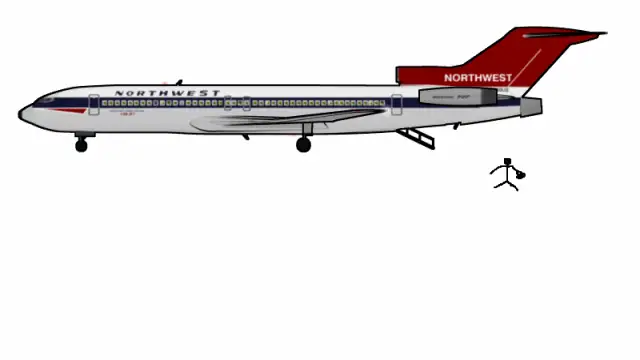
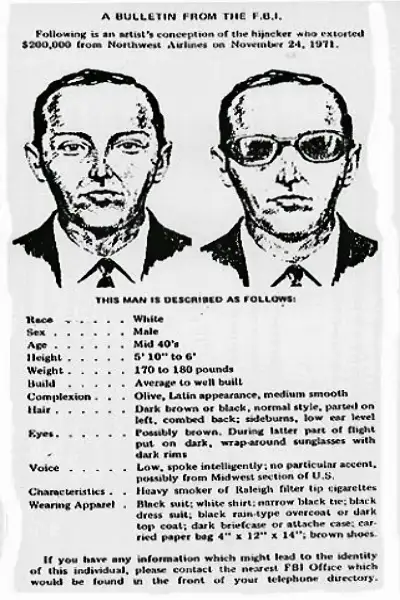
On November 24, 1971—the day before Thanksgiving—a man in a suit and tie, using the name “Dan Cooper,” hijacked a Northwest Orient Airlines Boeing 727. He claimed to have a bomb, demanded $200,000 and four parachutes, and got exactly what he wanted. Then, somewhere over the dense, freezing forests of southwest Washington, he jumped from the rear of the plane and into legend.
He was never seen again.
The FBI launched one of the most extensive and expensive manhunts in U.S. history. They called it NORJAK, for Northwest Hijacking. They found nothing. No body, no briefcase, no parachute. For nearly 50 years, the FBI chased ghosts until they officially closed the active case in 2016.
The problem? Every logical explanation has a fatal flaw. The “experienced skydiver” theory doesn’t explain why he’d jump on a pitch-black, stormy night into treacherous terrain. The “amateur who died on impact” theory doesn’t explain why not a single shred of his gear was ever found.
What if the reason no theory works is because we’re all working with the wrong assumptions? What if he wasn’t a common criminal from our world?
Let’s explore a theory that’s so far out it circles back to making a weird kind of sense. What if D.B. Cooper was a highly trained operative from an alternate timeline, sent here on a mission of corporate espionage to ruin a competitor? This isn’t just a wild story. It’s a framework that might just explain the case’s most baffling paradoxes.


A Flawed Legend: The Holes in the Official Story
To understand why a radical theory is even necessary, you have to appreciate just how weird the facts of this case are. The D.B. Cooper legend is a puzzle where none of the pieces fit.
- The Cool-Headed Hijacker: Cooper was freakishly calm. He politely ordered a bourbon and soda (and paid for it) while casually showing a flight attendant what he claimed was a bomb. He was never agitated, never cruel. His demeanor was that of a businessman closing a deal, not a man committing a federal crime. Is that the behavior of a desperate individual?
- Expert Knowledge of the 727: Cooper’s demands were incredibly specific. He knew the Boeing 727’s unique aft airstair could be opened mid-flight. He knew the exact wing flap setting (15 degrees) needed to keep the plane slow and stable. He demanded the plane fly below 10,000 feet. This wasn’t a guess; this was the knowledge of an aviator or an engineer. Yet, no known criminals or disgruntled airline employees fit the profile.
- The Perfect Disappearance: The search area was vast, but the odds of finding something should have been high. A body, a ripped parachute, an empty money bag. The searchers found zip. It’s as if Cooper and everything he jumped with simply evaporated the moment he left the plane.
- The Tena Bar Money: In 1980, a young boy digging a fire pit on a sandbar on the Columbia River (Tena Bar) found three packets of the ransom money. The bills were decayed and bundled together, totaling about $5,800. This discovery only deepened the mystery. It was miles from the proposed jump zone and offered no clues as to Cooper’s fate. Why would only a fraction of the money be found there, partially buried, nine years later?
- The “Geek” Tie: Cooper left behind his black clip-on tie. Decades later, a team of citizen scientists analyzed it with an electron microscope. They found something astonishing. The tie contained particles of pure, unalloyed titanium and other rare earth elements. As researcher Tom Kaye noted, this was not common in 1971. These materials were only used in very specific, high-tech applications, like advanced aerospace manufacturing or, perhaps, things that hadn’t been invented yet.
The Alternate Timeline Theory: A Mission of Corporate Sabotage
Now, let’s build the scenario. Forget thinking of this as a crime. Think of it as a special operation.
The Premise:
In a parallel timeline—let’s call it Earth-7—aerospace technology advanced slightly faster than in our own. By the early 1970s, a brutal corporate war is being waged between two airline giants: our familiar Northwest Orient and a powerful, aggressive competitor we’ll call Aero-Continental. In this timeline, Aero-Continental is losing. Badly. Facing bankruptcy, they turn to their clandestine R&D division, which has developed a crude but functional temporal displacement technology. They can’t send armies back in time, but they can send one man.
The Mission:
The goal was never the $200,000. That was misdirection—a plausible motive for our world’s authorities to chase. The real mission was to create a permanent, high-profile, and utterly unsolvable act of terror that would become inextricably linked with the Northwest Orient brand name. They didn’t want to just hurt the airline; they wanted to haunt it. They wanted to create a legend of incompetence and vulnerability so powerful it would erode public trust for generations.
The Operative:
“Dan Cooper” was a carefully chosen operative. Not a common thief, but a former military specialist or corporate engineer from Earth-7. He was selected for his cool nerves, his intimate knowledge of 727-equivalent aircraft, and his unwavering loyalty to Aero-Continental. He knew it was likely a one-way trip, but he was a soldier fighting for his company’s survival.
Solving the Paradoxes: How the Theory Plugs the Holes
This is where it gets interesting. When you apply the “temporal saboteur” lens, the baffling pieces of the puzzle suddenly click into place.

1. His Unshakable Calm
Cooper was calm because he wasn’t a desperate man. He was a professional executing a mission plan. He had trained for this. The hijacking was a performance, and he was playing a role. The bourbon and soda? Just part of the “unassuming businessman” character he was portraying.
2. His Expert Aircraft Knowledge
His knowledge wasn’t just from a flight manual. On Earth-7, Cooper might have been part of the team that designed the 727’s equivalent. He didn’t just know the plane’s limits; he had defined them. He knew exactly what to ask for because he understood the machine better than the pilots in our timeline did.
3. The Impossible Vanishing Act
This is the core of the theory. Cooper never hit the ground. His mission was complete the moment he jumped into the stormy night. At a predetermined moment, his team on Earth-7 activated their device and “extracted” him from our timeline. He simply blinked out of existence mid-air, along with his parachute, his bomb-less briefcase, and the ransom money. This is why no trace was ever found. You can’t find debris that was never there. He didn’t survive a death-defying jump; he was pulled from the game before it ended.
4. The Strange Tena Bar Money
The money was just a prop. But the temporal extraction process was new and unstable. During the extraction, a few bundles of the cash—the part of the payload furthest from the extraction field’s center—could have been “dropped” or glitched out, slipping through the temporal rift. The process would have violently agitated and damaged the bundles, spitting them out into our timeline at a location displaced from the actual jump point. This explains why only a small amount was found, why it was so deteriorated, and why it was far from the designated flight path. It wasn’t carried by water; it was deposited by a technological malfunction.
5. The Smoking Gun: The Titanium Tie
This is the most compelling piece of physical evidence. In our 1971, finding pure titanium on a J.C. Penney clip-on tie is deeply strange. But in a slightly more advanced alternate timeline, such materials could be more common. Or, more likely, the tie wasn’t just a tie. It could have been subtly integrated with technology from his world. Perhaps it contained filaments that functioned as a locator beacon for the extraction team or monitored his biometric data. The rare earth particles weren’t from a factory he worked at in our world; they were physical traces of his world, clinging to his clothes.
The Aftermath: A Mission Accomplished
From Aero-Continental’s perspective on Earth-7, the mission was a spectacular success.
- Real-World Impact: The D.B. Cooper hijacking had a massive and lasting impact. It forced a complete overhaul of airport security. It led to the installation of a device called a “Cooper Vane” on every Boeing 727, a simple mechanical wedge that prevents the aft airstair from being opened in flight—a direct engineering response to the event.
- Brand Damage: For decades, the name “Northwest Orient” was synonymous with the hijacking. It became a cultural touchstone representing vulnerability. The mystery kept the story alive, ensuring the brand damage never fully healed. It was the most successful, and cheapest, smear campaign in history.
The $200,000 was a small price to pay for crippling a rival with a ghost story that would never die.
Conclusion: A Mystery Too Perfect for Our World?
There is, of course, no proof of alternate timelines or corporate time-traveling saboteurs. This is a thought experiment. But it stands apart from nearly every other theory because it doesn’t leave any loose ends. It provides a cohesive, if fantastical, narrative that accounts for every bizarre element of the D.B. Cooper case: the calmness, the expertise, the impossible escape, the strange money, and the futuristic tie.
Sometimes, a mystery is so perfect, so devoid of clues, that you have to wonder if it was designed that way. The story of D.B. Cooper might not be about a man who got away with it. It might be about a man who was never meant to be caught, because his mission was to create the mystery itself. He wasn’t just a hijacker; he was a ghost in the machine, sent to throw a wrench in the works of our reality and then vanish back to his own.
What other unsolved historical events feel a little too perfect?
What’s Your Craziest D.B. Cooper Theory?
You’ve heard ours, now we want to hear yours. Was Cooper a disgruntled vet, a CIA op, or something else entirely? Drop your wildest theories in the comments below. The truth might be stranger than any of us think.

