
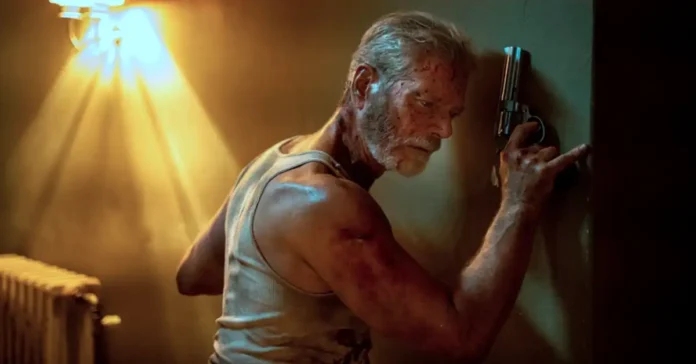
The final frame of Don’t Breathe 2 leaves you with racing pulses, bloody hands, and a massive question mark hanging over its ruthless protagonist. After ninety-eight minutes of bone-crunching violence, the film closes in an empty concrete basin where blood and water mix around a seemingly dead man. Did the Blind Man truly breathe his last breath, or did director Rodo Sayagues leave the back door wide open for another chapter?
The brutal climax in the abandoned pool
The climax of the 2021 sequel moves far away from the claustrophobic house in Detroit. Instead, the final battle erupts inside a derelict recreational complex that Raylan’s gang uses as their criminal base. Norman Nordstrom infiltrates the building with one goal: retrieve the young girl he raised for eight years.
What follows is an absolute bloodbath. Norman systematically wipes out Raylan’s crew by cutting the building’s electrical power, turning pitch-black darkness into his greatest tactical ally. He blinds one henchman with chemical liquid, traps another in water, and uses acoustic cues to dispatch every mercenary in sight.
Everything boils down to a nasty three-way confrontation inside a drained, crumbling swimming pool. Raylan, played with greasy menace by Brendan Sexton III, refuses to let Norman walk away with the girl. Raylan ambushes Norman, driving a blade into him. Norman retaliates with vicious efficiency, pinning Raylan down and gouging out the man’s eyes with his bare thumbs.
Just when you think Norman has closed the book, a blinded and disoriented Raylan grabs a blade and lunges backward, delivering a catastrophic stab wound directly into Norman’s torso. Phoenix steps in to end the nightmare once and for all, stabbing her biological father to save the only guardian she has ever truly known. Raylan collapses into the filth, permanently dead.
Norman falls against the grimy wall of the pool basin, gasping for shallow air as blood pools beneath his worn jacket. His breathing rattles. His skin turns ash-gray. When Phoenix rushes to his side with tears in her eyes, trying to staunch the bleeding, Norman gently pushes her hands away.
Biological mother’s heart scheme
To understand why the final showdown feels so emotionally messy, you have to peel back the sickening reveal behind Raylan’s true motive. For the first half of the film, viewers assume Raylan and his thugs are random child traffickers or scumbags looking for revenge. When Raylan corners the girl and reveals that her name is actually Tara — and that he is her real father — it looks like a dramatic, albeit violent, family reunion.
The script flips the table twenty minutes later. Raylan does not care about being a loving dad.
Eight years before the events of this sequel, Raylan and his wife, Josephine, operated a volatile clandestine meth lab out of their suburban home. A catastrophic chemical fire destroyed the house and sent Raylan to federal prison. Josephine survived the blast, but her internal organs were ruined by smoke, fire, and toxic chemical inhalation.
By the time Raylan finishes his prison sentence, Josephine is bedridden, paralyzed, and clinging to life on mechanical support. Her heart is failing rapidly. Rather than scouring legal donor registries or accepting her fate, the couple hatches a ghoulish plot. They track down their abandoned daughter, not to bring her home, but to slice her open.
Raylan hires an illicit street surgeon to harvest Tara’s living heart and transplant it into Josephine’s chest. Think about that for a second. Her biological mother looks Tara dead in the eyes and essentially tells her that her only purpose on Earth is to serve as spare parts for the woman who neglected her. It is an unspeakable violation that strips away any illusion of biological sanctity.
That repulsive scheme recontextualizes the entire movie. Up until this reveal, Norman looked like a possessive kidnapper keeping a young girl trapped in a secluded home under the guise of homeschool survival training. Once you see what her actual parents planned to do to her, Norman’s harsh training begins to look like the only reason the girl survived long enough to fight back.
Norman nordstrom’s moral devolution: monster or anti-hero?
Few characters in modern horror have generated as much moral whiplash as Norman Nordstrom. In the original 2016 sleeper hit Don’t Breathe, directed by Fede Álvarez, Norman was unequivocally terrifying. When three teenage burglars broke into his home to steal his cash settlement, audience sympathy initially sided with the blind military veteran.
That sympathy evaporated the second Rocky, played by Jane Levy, discovered Cindy Roberts chained up in Norman’s soundproofed basement. Cindy was the wealthy driver who killed Norman’s young daughter in a car accident. To replace his dead child, Norman held Cindy captive, subjected her to forced insemination with a turkey baster, and murdered her when the robbery went sideways. When Cindy died, he turned his sights on Rocky to take her place. Norman was a monster, plain and simple.
Fast forward to the sequel, and the filmmakers attempt something risky. They place this unrepentant predator into the role of a protective father figure.
Does the movie try to absolve him? Some critics at outlets like Rotten Tomatoes argued the film pushed too hard to turn a villain into a righteous action hero. If you pay close attention to Norman’s dying confession, the narrative deliberately pulls back from total redemption.
Lying in the empty pool, Norman knows his time is up. Phoenix weeps, begging him to hold on so she can get help. Norman stops her cold.
He confesses everything. He admits that he took her from the wreckage of the burning house eight years ago not out of pure charity, but out of selfish grief. He confesses that he lied to her about her mother dying in a harmless accident.
Then comes the gut punch. Norman plainly states: “I am a murderer. I am a rapist. I took you to replace what was mine.”
He looks into his own soul and refuses to hide behind excuses. Norman does not ask God for forgiveness, nor does he demand gratitude from Phoenix. He acknowledges that his protection of her was tangled up in obsession, guilt, and possessiveness. By commanding her to walk away and let him die, Norman makes the only genuinely unselfish choice of his entire adult life: he releases his grip on her future.
Why phoenix rejects her birth name
The final scene before the credits roll focuses entirely on the young survivor. After walking away from Norman’s bleeding form, she travels across the city toward an orphanage and children’s residential shelter. Earlier in the story, Norman forbid her from going near this facility, isolating her from other kids her age under the excuse that the outside world was too dangerous.
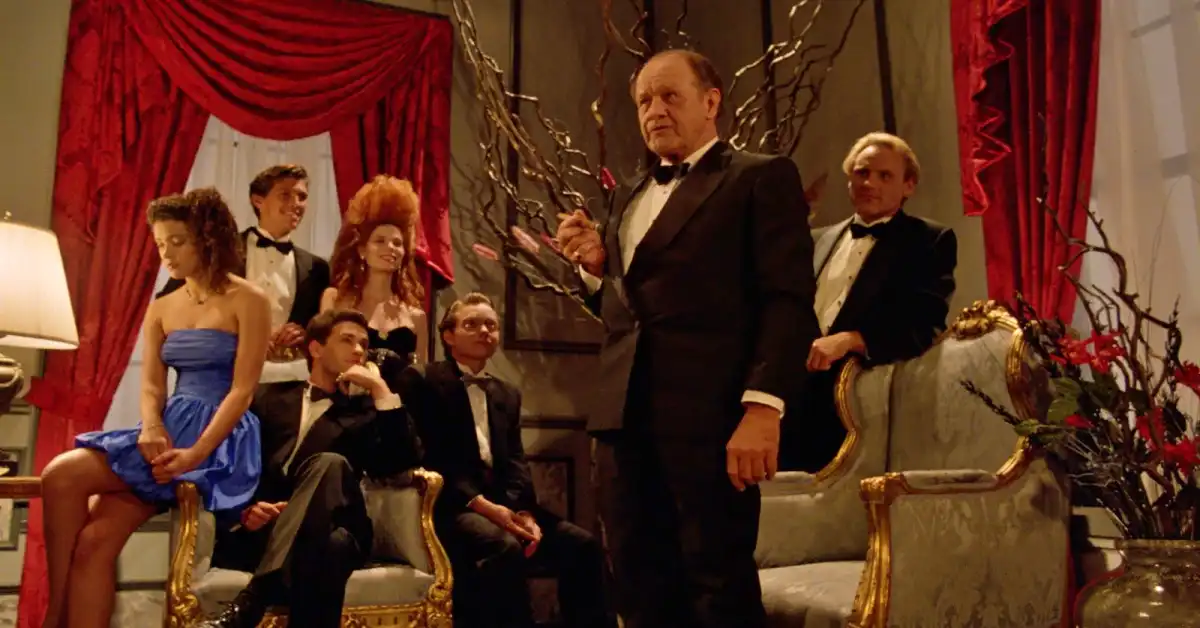
Now, she walks through the iron gates on her own terms. The sun shines down on an open courtyard where children run, laugh, and play soccer. A young girl spots her standing by the fence and approaches with an open smile, inviting her to join the group.
When the girl asks for her name, our protagonist pauses.
Her biological parents called her Tara. That name belongs to a meth lab cradle, a father who wanted to sell her organs, and a mother who viewed her as a medical carcass.
Norman gave her the name Phoenix when he plucked her from the smoke and ash of that burning house eight years prior. While Norman committed horrific acts throughout his life, the identity he built for her was rooted in resilience, survival, and strength.
She smiles softly and answers: “Phoenix.”
Choosing the name Phoenix is not an endorsement of Norman’s past crimes. Rather, it represents an intentional act of self-definition. A mythical phoenix burns to ashes and emerges reborn, completely unburdened by its former decay. She refuses to be the tragic victim Tara, nor will she remain the hidden prisoner of Norman Nordstrom. She takes the survival skills Norman taught her, discards his toxic baggage, and steps into normal society as a self-made person.
Post-credits scene breakdown: is norman dead in don’t breathe 2?
If you turned off the movie the moment the end credits began to roll, you walked away convinced that the Blind Man perished in that desolate swimming pool. After all, the man suffered multiple gunshot grazes, took brutal beatings from blunt instruments, and sustained a deep, untreated blade puncture right through his midsection.
Wait through the credit roll, however, and the camera pulls you right back into the darkness.
The screen cuts to the damp concrete floor of the abandoned pool. Norman lies completely motionless on his side, his face pale and his clothes soaked in dark, congealed blood. Everything about the staging screams coroner’s case.
Then, a familiar set of four paws pads into the frame.
It is the large Rottweiler belonging to Raylan’s gang. Earlier in the film, Raylan locked the dog in an attic room with Norman, expecting the beast to tear the blind intruder apart. Instead of fighting the animal, Norman demonstrated surprising empathy. He quieted the growling dog, fed it, freed it from the burning room, and won its fierce loyalty. That dog later guided Norman straight to Raylan’s hideout.
In this bonus scene, the dog approaches Norman’s still body. It lowers its head, whines softly, and begins licking the dried blood off the old man’s fingers.
The camera holds steady on Norman’s hand for several agonizing seconds.
Suddenly, his fingers twitch. His hand curls slightly upward against the dirty floor. A faint breath rattles in his chest, and the screen instantly cuts to dead black.
What does this mean for viewers asking is norman dead in dont breathe 2? That microscopic twitch confirms that Norman Nordstrom is still breathing. The post-credits stinger is an undeniable cinematic wink telling the audience that this old war dog simply refuses to lie down and die.
From a practical medical standpoint, surviving those injuries without immediate emergency trauma surgery seems impossible. Yet this franchise has always treated Norman like a classic slasher villain wrapped in military combat boots. He survived gunshot wounds and falls through skylights in the 2016 original. He survived brutal hand-to-hand punishment across two movies. As long as his heart beats, he remains a lethal force of nature.
How the sequel shifts the franchise
To grasp where the narrative lands when the dust settles, look at how the central dynamic shifts between the two films:
- The Nature of the Threat: In the 2016 original, Norman was defending his own house from petty thieves, only for the movie to reveal he was hiding a kidnapped woman in his basement. In the sequel, Norman’s home is invaded by a organized drug crew, forcing him out into the open to fight on unfamiliar turf.
- The Paternal Obsession: Norman’s motivation across both stories stems from the tragic loss of his daughter. In part one, he tried to artificially manufacture a replacement child through horrific imprisonment. In part two, he stole an abandoned toddler from a fire, trying to convince himself that he could raise her with love while still keeping her isolated from the world.
- The Fate of the Child: Phoenix escapes both sets of fathers. She walks away from the biological parents who saw her as an organ donor and walks away from the adoptive father who treated her as emotional property. Her arrival at the children’s shelter gives her genuine autonomy for the first time in her life.
- The Loyalty of Animals: Dogs play a pivotal role in Norman’s survival across the series. In the first film, his trained attack dog was a terrifying weapon against Rocky and Alex. In the sequel, Norman saves an enemy’s neglected attack dog, and that very animal repays the debt by staying by his side when human allies abandon him.
What could Don’t Breathe 3 look like?
With Norman’s survival confirmed by that finger twitch, where could a third movie possibly go? The franchise creators have built a fascinating, deeply uncomfortable puzzle.
Phoenix’s arc is essentially complete. Dragging her back into another kidnapping or hostage situation would feel cheap and repetitive. She found safe harbor, accepted her chosen name, and finally stepped into normal childhood friendships. Her story deserves to stay closed.
Norman, on the other hand, is completely untethered. He has lost his secluded house to fire. His money, his tools, and his carefully constructed routine are gone. The world believes he is dead, and the young girl who kept his humanity grounded has walked out of his life forever.
If Sony Pictures and producer Fede Álvarez ever greenlight a third installment, Norman would essentially operate as a ghost on the fringes of society. Without a child to protect or a home to defend, he returns to the status of a dangerous drifter. Imagine a blind, scarred, aging military veteran moving through forgotten industrial towns, crossing paths with criminal organizations that have no idea what kind of monster they just provoked.
Whether audiences truly want to root for Norman again remains a contentious debate among horror fans. What cannot be disputed is the raw physical presence Stephen Lang brings to the screen. Even when choking on his own blood in an abandoned swimming pool, Norman Nordstrom proves that keeping him quiet is easier said than done.

