

Haunted Andersonville Prison: 10 Chilling Ghost Stories from the Civil War’s Deadliest Camp
Some places are just scary because they look creepy. Old houses with cobwebs? Sure. Abandoned asylums? Definitely. But then there are places like Andersonville Prison in Georgia. This isn’t just a “spooky” spot; it is a scar on American soil.
If you visit the Andersonville National Historic Site today, you’ll see green grass and rolling hills. However, if you close your eyes, you’re standing in a graveyard where nearly 13,000 men died in just 14 months. That is not a typo. Thirteen. Thousand.
History buffs know it as Camp Sumter, the Confederate military prison that became hell on earth during the Civil War. Paranormal investigators, on the other hand, know its as one of the most active and tragic haunted sites in the South.
Is Andersonville haunted? Well, when you pack 45,000 starving men into a muddy pen designed for 10,000, tragedy doesn’t just “leave” when the war ends. It soaks into the ground. It lingers.
Here is the dark history and the 10 chilling ghost stories.
The Nightmare of 1864: Why the Ground Bleeds History
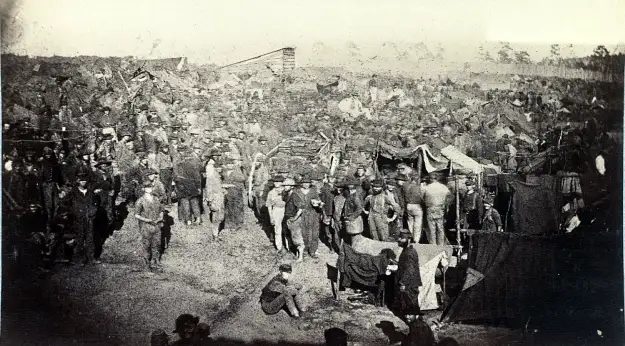
Before we dive into the ghost stories, you need to understand why the energy here is so heavy. Imagine a field without shelter. No barracks. No tents. Just you, the blazing Georgia sun, and a stream filled with human waste.
That was the reality for Union soldiers here.
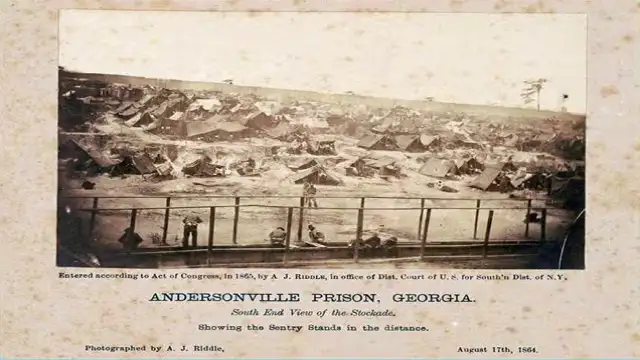
Established in early 1864, Andersonville was meant to be a solution to prison overcrowding. Instead, it became a death trap. Men died from scurvy, dysentery, starvation, and exposure. The water source, Stockade Branch, was a slow-moving sewer.
Consequently, the death rate was staggering. At its peak, over 100 men were dying every single day. They were buried shoulder-to-shoulder in trenches, effectevely erased from the world until a young soldier named Dorence Atwater secretly copied the death list (more on him later).
With that much suffering concentrated in one spot, is it any wonder visitors report feeling watched?

10 Chilling Ghost Stories from Andersonville Prison
These aren’t just campfire tales. These are the recurring reports from visitors, reenactors, and history buffs who have walked the grounds and felt something… off.
1. The Phantom of the Deadline
The most terrifying rule at Andersonville was “The Deadline.” This was a crude wooden railing about 19 feet inside the massive stockade walls. If a prisoner even touched it, let alone crossed it, guards in the pigeon roosts (guard towers) were ordered to shoot to kill.
Many starving men crossed it on purpose, choosing a quick bullet over slow starvation. Today, visitors near the reconstructed stockade walls often report seeing a lone figure darting toward the perimeter. Then, they hear a sharp crack like a musket shot even when the park is silent. It’s a residual replay of a soldier’s final, desperate choice.
2. Captain Wirz’s Eternal Patrol
Captain Henry Wirz was the commandant of Andersonville. He is a controversial figure; some say he was a monster, while others argue he was a scapegoat for a broken Confederate supply chain. Regardless, he was the only Confederate officer executed for war crimes after the Civil War. He was hanged in November 1865.
Legend says he never left his post. People have reported seeing a man in a Confederate officer’s uniform riding a horse along the perimeter road. Others claim to see a solitary figure pacing near the Star Fort, looking angry and anguish-ridden. He seems to be eternally guarding a camp that no longer exists.
3. The Curse of the Raiders
Not all the villains were guards. Inside the prison, a gang of Union prisoners known as “The Raiders” terrorized their own comrades. They stole food, beat the sick, and murdered for blankets. Eventually, the other prisoners had enough. With the blessing of the Confederate command, they rounded up the Raiders, tried them, and hanged six ringleaders on July 11, 1864.
Their graves are in the National Cemetery, but they are set apart from the honorable dead. Visitors who approach these six isolated graves often report a sudden, overwhelming feeling of nausea or dread. Some even claim their cameras malfunction specifically in this area, as if the bad energy is still repelling people 160 years later.
4. The Miracle at Providence Spring
This is one of the few “good” ghosts. By August 1864, the water situation was critical. Prisoners were dying of thirst. According to history, a massive thunderstorm rolled in, and a lightning bolt struck the ground (or opened a spring near the deadline). Fresh, clean water gushed out. The men called it Providence Spring.
Today, a stone pavilion marks the spot. It is a peaceful place, but it’s arguably the most active. People often hear the sound of running water even when the spring is trickling quietly. More eerily, many have reported hearing the low murmur of men praying or cheering, a phantom echo of the moment hope returned to the camp.
5. The Olfactory Hallucination (The Stench of Death)
Ghosts aren’t always things you see. Sometimes, they are things you smell. The conditions in 1864 were horrific; the smell of the camp could be detected miles away by local residents. It was a mix of swamp, sickness, and death.
Fast forward to 2025. You’re walking the beautiful green lawns on a crisp autumn day. Suddenly, you are hit with a wave of a putrid, rotting odor. You check your shoes. You check the wind. Nothing. Then, just as quickly as it came, it vanishes. This “phantom smell” is one of the most common reports at Andersonville, a sensory memory of the tragedy burned into the landscape.
6. The Reenactor’s Musket
Civil War reenactors take their craft seriously, often sleeping on the actual grounds of historic sites. However, few like to sleep in the prison site at Andersonville.
During living history events, participants have reported hearing the distinct sound of musket fire in the middle of the night. We aren’t talking about a car backfiring; this is the heavy, black-powder thud of a specific era. When they investigate, the grounds are empty. Is it the guards shooting at the Deadline? Or the echo of the battles these men fought before they were captured?
7. Father Whelan’s Comforting Presence
Father Peter Whelan was a Catholic priest who ministered to the prisoners. He was known for his incredible kindness, staying in the filth to pray with the dying and provide water. He was a light in the darkness.
Sensitive visitors often report a sudden feeling of warmth and peace near the hospital site, completely contrasting the heavy dread felt elsewhere. Some believe this is the spirit of Father Whelan, still offering comfort to the souls who never made it home. It’s a reminder that even in hell, there were angels.
8. The Watchful Spirit of Dorence Atwater
Dorence Atwater is a hero. A young prisoner assigned to record the deaths, he realized the Confederates might never release the true names of the deceased. So, he secretly copied the list, hiding it in the lining of his coat. Because of him, we know who is buried in the National Cemetery.
Paranormal enthusiasts believe Atwater’s spirit still guards the cemetery. There are reports of a young man in tattered Union blue standing near the graves, looking at the headstones as if checking a list. He isn’t scary; he’s diligent. He’s making sure no one is forgotten.
9. The Cries of the 13,000
This is the most disturbing phenomenon. It usually happens at dusk. The park is closing, the tourists are leaving, and the wind dies down. That is when you hear it.
It starts as a low hum like a hive of bees. Then, it resolves into human sounds. Moans. Coughing. The low murmur of thousands of men talking at once. It’s called “residual haunting” the idea that the sheer emotional intensity of 30,000 suffering men imprinted a recording onto the environment. It’s not one ghost; it’s the sound of the crowd.
10. The Cold Spots of the Stockade
The stockade walls are mostly gone, marked now by white posts to show the perimeter. But the temperature doesn’t seem to care about the missing walls.
On hot Georgia summer days, where the humidity feels like a wet blanket, hikers will walk through sudden, inexplicable cold spots. These aren’t just breezes. We are talking about a 20-degree drop in a specific, three-foot circle. Paranormal investigators interpret these cold spots as manifestations of energy spirits trying to draw heat from the living to manifest.
The Science vs. The Supernatural: What’s Really Happening?
Look, I get it. Not everyone believes in ghosts. A skeptic would say that pareidolia (the brain’s tendency to see patterns like faces or figures) explains the visual sightings. The sounds? Wind through the Georgia pines can sound a lot like whispering.
Furthermore, there is the Stone Tape Theory. This geological idea suggests that minerals in the earth (like quartz or limestone) can “record” high-stress emotional events and replay them under certain atmospheric conditions. Given the intense trauma at Andersonville, if the earth could record history, this would be the place.
But ask the park rangers. Ask the historians who have spent decades preserving this land. While they stick to the facts for the textbooks, many will admit off the record that there are moments when the air feels too heavy, and the silence is too loud.
Planning Your Visit (If You Dare)
If you want to pay your respects (or see if you can feel the chill), here is what you need to know.
- Location: Andersonville National Historic Site, Georgia.
- Hours: Generally 8:00 AM to 5:00 PM.
- Respect: This is a place of mass death. If you go ghost hunting, do it with reverence. No Ouija boards on the graves. Seriously.
- Must-See: The National Prisoner of War Museum on-site is incredible and gives necessary context to the suffering.
Pro-Tip: Visit the National Cemetery adjacent to the prison site. Seeing the endless rows of white headstones—so close together—hits harder than any ghost story ever could.
Frequently Asked Questions
Is Andersonville Prison haunted?
Many visitors and paranormal researchers believe it is active due to the traumatic history of 13,000 deaths. Common reports include phantom smells, apparitions of soldiers, and cold spots.
Can you visit the prison site at night?
Generally, no. The park closes at 5:00 PM. Ghost hunting investigations usually require special permits or are part of sanctioned historical tours, though night access is rare.
Who was the Captain executed for Andersonville?
Captain Henry Wirz. He was the commandant of the inner stockade and was hanged for war crimes in Washington, D.C., in 1865.
What is the “Deadline” at Andersonville?
It was a line 19 feet inside the stockade wall. Any prisoner crossing it was shot immediately. It is a focal point for paranormal activity today.
The tragedy of Andersonville isn’t just in the past; it lives in the memory of the soil. Whether you believe in ghosts or not, the spirits of those 13,000 men demand one thing: that we never forget what happened here.
Have you visited Andersonville? Did you feel the chill? Plan your trip to the National Park Service website to learn more about this solemn ground.

