

Lost in the Illegal Paris Catacombs: Real Survival Stories and Unmapped Tunnels
Paris is universally celebrated as the beautiful, glowing City of Light. However, directly beneath its romantic, bustling streets lies a terrifying world of absolute, pitch black darkness. Have you ever wondered what happens when an underground adventure goes completely sideways? Today, we are exploring one of the most deeply mysterious places on earth. We are diving into the grim reality of the illegal Paris catacombs.
Key takeaways;
- The Massive Scale: The unmapped tunnels stretch for roughly 200 miles (300 kilometers), yet only a tiny 1 mile section is legally open to tourists.
- A Historical Tragedy: Back in 1793, a hospital worker named Philibert Aspairt became the first documented victim to die after getting permanently lost in the dark.
- A Modern Miracle: Two teenagers miraculously survived a grueling three day ordeal in 2017, escaping with severe hypothermia.
- The Secret Subculture: A hidden society known as “cataphiles” illegally explores, parties, and creates art within the forbidden network.
- Extreme Dangers: Zero cell reception, freezing temperatures, and intense sensory deprivation make these unmapped tunnels a literal death trap.
Before we talk about getting lost, we really need to understand why this massive labyrinth even exists. So, grab a flashlight. We are heading completely off the grid.
What are the illegal paris catacombs?
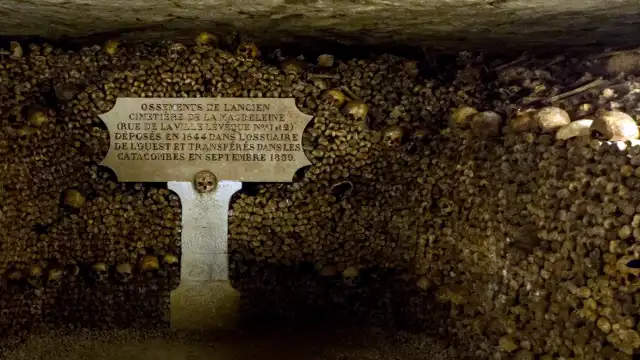
If you book a standard tourist ticket in Paris, you will absolutely see bones. Specifically, you will walk through well-lit, safely mapped corridors lined with millions of human skulls. Nevertheless, that official museum represents merely a tiny fraction of the underground world.
From roman quarries to a city of bones
Long before Paris became a modern, sprawling metropolis, it was a humble Roman settlement. Naturally, the ancient builders needed vast amounts of stone. Thus, they began mining Lutetian limestone right beneath their own feet. Over centuries, these modest quarries expanded into a massive, 200-mile subterranean spiderweb.
Eventually, the city above grew dangerously heavy. Meanwhile, the tunnels below had been entirely forgotten. Consequently, disaster struck hard in the late 18th century. Massive sinkholes abruptly swallowed entire Parisian streets, dropping houses directly into the earth. People were undeniably terrified. Therefore, King Louis XVI quickly established the General Inspectorate of Quarries (IGC) to map and reinforce the crumbling, unmapped tunnels.
Simultaneously, Paris faced a gruesome public health crisis. The city’s graveyards were overflowing. Honestly, it was a literal, stomach-churning nightmare. Heavy rains frequently caused rotting corpses to spill directly into the muddy streets. Disease ran rampant. Ultimately, officials devised a morbidly brilliant solution. They decided to move the bones underground. Under the cover of total darkness, priests led solemn, nightly processions. Wagons hauled the remains of over six million Parisians into the reinforced quarries. Today, while the official museum showcases a tiny mapped fraction, the rest remains wild, highly illegal, and incredibly dangerous.

Tragic tale of Philibert Aspairt (1793)
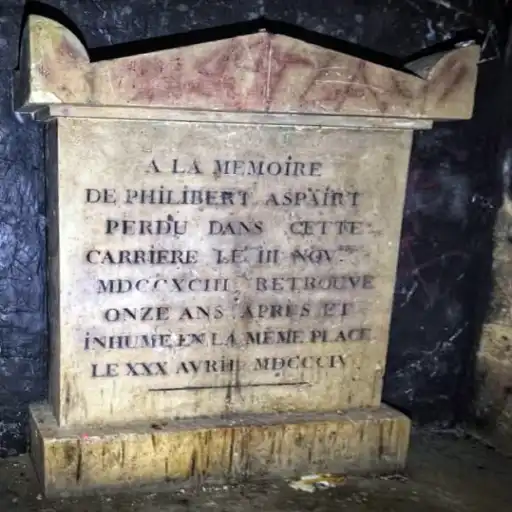
History proves that wandering into the unmapped tunnels is a massive gamble. Sadly, not everyone wins that bet. Enter Philibert Aspairt, a man whose horrific fate still haunts the underground today.
A Quest for liquor turns fatal
Back in November 1793, the bloody French Revolution was raging furiously above ground. Conversely, a quiet, different kind of tragedy was unfolding below. Philibert worked as a doorkeeper at the Val-de-Grâce military hospital. According to historical records, he deliberately entered the sprawling labyrinth via a hidden hospital staircase. His supposed motive? He was likely searching for abandoned, highly valuable Chartreuse liquor left behind by fleeing monks. Unfortunately, this simple quest sealed his doom.
Once inside, Philibert wandered deep into the complex, unmapped tunnels. Eventually, his single, fragile candle blew out. Instantly, he was plunged into absolute, crushing darkness. Can you imagine that sheer, spine-tingling panic? Desperately, he tried to feel his way back. However, the endless maze of identical, freezing limestone walls offered absolutely no exit. There was no light. There was no hope. Ultimately, Philibert died completely alone in the freezing blackness.
Discovered eleven years later
Fast forward eleven agonizing years. In 1804, a crew of government quarry inspectors finally stumbled upon his naturally mummified remains. Interestingly, they easily identified him by the hospital key ring still hanging tightly from his leather belt. Today, his lonely tomb remains exactly where his body fell in the dirt. Unsurprisingly, modern urban explorers actually consider him their patron saint. They regularly light candles at his grave every year on November 3rd to honor his terrifying final moments.
The 2017 Miracle: Teenagers lost for three days
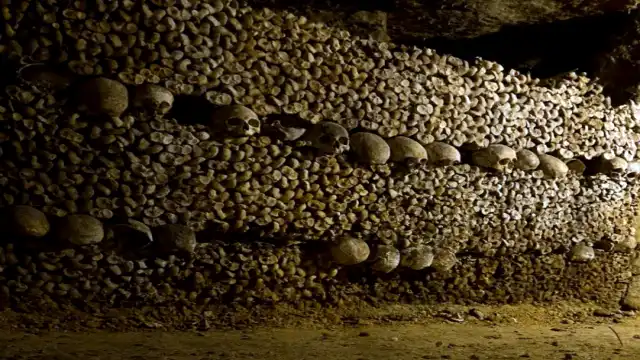
Now, let’s jump away from ancient history to a highly modern miracle. You might think smartphones and modern technology make it impossible to get lost. Unfortunately, the underground doesn’t care about your iPhone.
A wrong turn into darkness
In June 2017, two teenagers aged 16 and 17 decided to sneak down into the off-limits sections. Unquestionably, they thought it would be a fun, edgy weekend adventure. Initially, everything seemed perfectly fine. They explored the spooky corridors. They laughed. Then, they took a very wrong turn. Suddenly, they were completely lost inside the sprawling, 200-mile labyrinth.
For three agonizingly long days, they wandered the freezing, pitch-black corridors. Typically, the temperature down there hovers constantly around a chilling 57°F (14°C) year-round. Therefore, severe hypothermia quickly became a deadly, immediate threat. Furthermore, there is absolutely zero cell phone reception 65 feet underground. They simply couldn’t call their parents for help. Moreover, sensory deprivation began playing brutal, mind-bending tricks on their exhausted brains.

Rescue operation
Thankfully, panicked friends alerted the authorities. A massive, frantic search operation instantly launched. Specially trained tracking dogs rigorously scoured the unmapped tunnels. Rescue teams worked around the clock. Eventually, firefighters successfully located the terrified boys, as detailed in reports by The Guardian.
Although they were suffering heavily from severe hypothermia, they were incredibly, miraculously alive. Without a doubt, they narrowly escaped becoming modern day Philibert Aspairts. The rescue served as a massive, global wake up call regarding the sheer lethality of the underground.
Psychological horror of complete darkness
What exactly happens to the human brain when the lights go out permanently? Frankly, the psychological breakdown is just as dangerous as the physical cold.
Sensory deprivation and Hallucinations
First, extreme sensory deprivation rapidly kicks in. Ordinarily, our eyes and ears feed us a comforting, constant stream of data. Down in the unmapped tunnels, that vital data drops entirely to zero. Consequently, your frantic mind desperately tries to fill the terrifying void.
Many lost explorers openly report experiencing intense auditory hallucinations. For instance, the simple sound of water dripping echoes exactly like approaching, heavy footsteps. Furthermore, the absolute silence eventually becomes physically deafening. You can literally hear your own heartbeat roaring loudly in your ears. Next comes the total loss of time. Without sunlight, your internal circadian rhythm completely shatters into pieces. Within a few short hours, you cannot tell if you have been walking for twenty minutes or two entire days.
Moreover, panic sets in extremely fast. Once you start running blindly through the dark, you make fatal, clumsy mistakes. You trip. You hit your head. You break a leg. That is exactly how a simple session of urban exploration turns into a horrific fight for survival.
Secret society of cataphiles
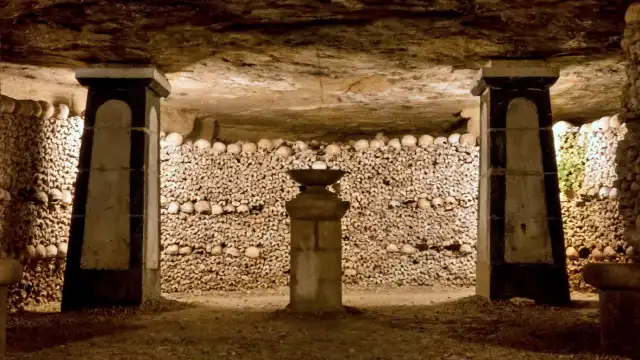
So, who exactly explores these dangerous depths on purpose? Enter the mysterious “cataphiles.” Essentially, these are highly dedicated urban explorers deeply obsessed with the illegal Paris catacombs. For decades, this secret underground society has actively thrived right beneath the feet of oblivious tourists.

Underground cinemas and swimming pools
These adrenaline junkies don’t just walk around aimlessly. Actually, they host massive, secret underground parties. They construct elaborate spaces. For example, in 2004, police were utterly shocked to discover a fully functioning secret cinema. Surprisingly, it featured a giant movie screen, carved stone seats, and a fully stocked bar.
Additionally, some ambitious cataphiles build secret, glowing swimming pools inside flooded ancient chambers. They meticulously map the unmapped tunnels. They create stunning, vibrant underground street art. Essentially, they have built a completely hidden, rebellious city underneath the official city.
Evading the “Cataflics”
However, the French authorities actively fight back against this illegal culture. A special, highly trained police unit nicknamed the “cataflics” constantly patrols the pitch-black tunnels. Consequently, it is a perpetual, high-stakes game of cat-and-mouse.
If you get caught sneaking around, you face immediate fines (usually around €60) and a highly embarrassing police escort back to the surface. Furthermore, the police regularly seal off illegal entrances with heavy concrete. Nevertheless, the intoxicating allure of the forbidden continually keeps the die-hard cataphiles coming back for more.
Why you should never explore unmapped tunnels
If you are feeling suddenly tempted to bypass the tourist line, please critically reconsider. The illegal sections are strictly forbidden for extremely valid reasons. Here is a clear breakdown of the extreme risks you face:
- Total Communication Blackout: At 65 feet underground, your fancy smartphone is completely, utterly useless. Consequently, you cannot use GPS, call emergency services, or text a friend. If you break an ankle down there, you are stuck until someone randomly stumbles across you.
- Labyrinthine Layout: The tunnels are absolutely not a straight, simple line. Instead, they form a chaotic, mind-bending spiderweb. Countless dead ends, circular loops, and identically carved walls make navigation nearly impossible without highly specialized, illegal maps.
- Lethal Hypothermia Risk: The subterranean temperature sits constantly around a brisk 57°F. While that might briefly feel refreshing on a hot July afternoon, it quickly becomes incredibly deadly. If you accidentally fall into a flooded corridor, your core body temperature will inevitably plummet.
- Structural Collapses: These are certainly not modern, steel-reinforced concrete bunkers. Actually, they are centuries-old, decaying limestone mines. Therefore, sudden roof cave-ins remain a constant, highly unpredictable threat to your life.
- Legal Consequences: Getting caught by the tough cataflics will instantly ruin your vacation. You will definitely face annoying fines, stern warnings, and potential trespassing charges.
Respect the darkness
In conclusion, the hidden underground world of Paris is undeniably, intensely fascinating. It holds centuries of dark history, brilliant hidden artwork, and incredible tales of human endurance. However, it is fundamentally merciless. The unmapped tunnels do not care who you are. The freezing, crushing darkness will swallow the unprepared without a single second of hesitation.
What do you think? Have you ever explored a spooky underground cave, or would you ever dare to visit the legal sections of the Paris catacombs? Drop your thoughts, theories, and experiences in the comments below! Furthermore, if you absolutely loved this deep dive into historical urban exploration, please share this article with your adventure-seeking friends. Stay curious, stay safe, and always respect the darkness!

