

Scaphism: The Ancient Persian “Boats” Torture Method Explained
Humans possess a deeply dark and twisted imagination. When you look back at the annals of human history, it becomes painfully obvious that our ancestors had a terrifying knack for inventing cruel punishments. From the medieval rack to the iron maiden, historical execution methods were designed to inflict maximum pain. However, one specific practice stands out as the absolute worst ancient torture method ever recorded.
Welcome to the horrifying world of Scaphism.
Often referred to simply as “the boats torture,” this supposed ancient Persian execution method didn’t rely on sharp blades, heavy stones, or blazing fires. Instead, it weaponized nature itself against a completely helpless victim. By combining two seemingly innocent ingredients milk and honey with the unrelenting forces of time and insects, executioners created a nightmare scenario.
But was this gruesome practice actually real? Let’s cut through the historical myths and explore the terrifying reality of the Scaphism torture method.
Key takeaways
- The Method: Scaphism involved trapping a victim between two hollowed out boats, leaving only their head, hands, and feet exposed.
- The Diet: Executioners force fed the victim a mixture of milk and honey to induce severe, uncontrollable diarrhea.
- The Cause of Death: Insects, attracted to the sweet mixture and bodily waste, would literally eat the victim alive from the inside out over a period of weeks.
- The Only Known Victim: A young Persian soldier named Mithridates allegedly suffered this fate for 17 days around 401 BC.
- The Historical Debate: Many modern historians believe Scaphism might be a gruesome piece of ancient Greek propaganda rather than a factual Persian practice.
What exactly was scaphism?
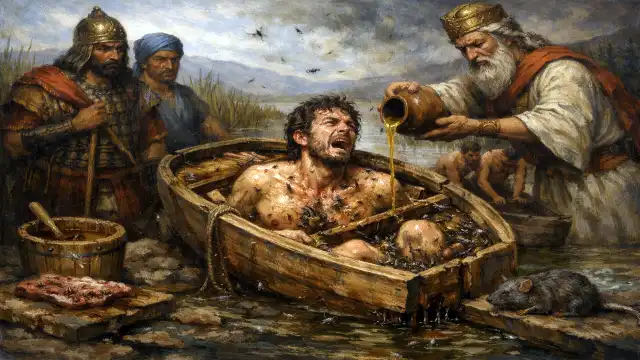
To understand why this is considered the most brutal ancient Persian torture milk and honey could ever produce, we need to break down the mechanics. The word “Scaphism” comes from the ancient Greek word skaphe, which translates roughly to “hollowed vessel” or “boat”.
Frankly, the sheer creativity behind this execution method is exactly what makes it so chilling. The process involved several meticulously planned phases designed to prolong suffering for as long as humanly possible.
1. Twisted setup
First, the executioners would locate a stagnant pond or a blistering hot desert area. Next, they took two small wooden boats (or hollowed out tree trunks) that were carved to fit perfectly together. They placed the condemned person on their back inside the bottom boat.
Then, they placed the second boat directly on top of the victim. Consequently, the person was completely sealed inside a tight wooden shell. Only their head, hands, and feet dangled outside. To put it simply, they were locked in a claustrophobic wooden coffin while still breathing.
2. Milk and Honey trap
Once the victim was secured, the true psychological and physical torture began. Guards forcefully poured a rich mixture of milk and honey down the victim’s throat. They didn’t just give them a little sip, either. They force fed the person until their stomach was painfully distended and they physically couldn’t swallow anymore.

Afterward, the executioners took that same sweet, sticky concoction and smeared it all over the victim’s exposed face, eyes, arms, and legs. Furthermore, they intentionally angled the person’s face directly toward the blazing sun. Why go through all this trouble? Because this sugary glaze was a dinner bell for the local wildlife.
3. Insect invasion
Predictably, massive swarms of flies, bees, and wasps quickly descended upon the victim’s sweet coated skin. Initially, the victim would suffer through hundreds of painful stings and bites. Yet, the external bugs were only half the problem.
Inside the boats, a biological nightmare was unfolding. Due to the massive quantities of forced dairy and sugar, the victim’s digestive system violently rebelled. Severe, uncontrollable diarrhea quickly filled the enclosed wooden space. As a result, the souring milk, sweet honey, and pooling bodily waste created a toxic, rotting environment.
Soon, the insects did more than just bite. They laid eggs inside the human waste and directly into the victim’s exposed orifices. Maggots hatched within days. Subsequently, these ravenous larvae burrowed into the victim’s bowels, slowly devouring their living flesh from the inside out. Ultimately, the victim died a lingering, agonizing death caused by a combination of septic shock, dehydration, starvation, and internal organ damage.
Story of mithridates
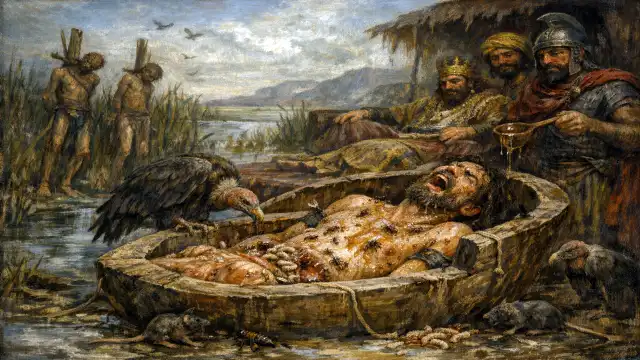
You are probably wondering if anyone actually endured this unspeakable horror. According to historical texts, there is one famous victim: a young Persian soldier named Mithridates.
His tragic story comes to us from the Greek historian and philosopher Plutarch, who wrote heavily about the ancient world in his work Life of Artaxerxes. Around 401 BC, the mighty Persian Empire was split by a bitter family feud. King Artaxerxes II was defending his throne against his rebellious younger brother, Cyrus the Younger.
Royal lie
During the massive Battle of Cunaxa, Cyrus the Younger was killed. King Artaxerxes desperately wanted his troops and enemies to believe that he, the powerful king, had personally slain his brother in single combat. In reality, a regular soldier named Mithridates had actually delivered the fatal blow.
Artaxerxes rewarded Mithridates handsomely for his service. However, the king demanded one crucial condition: Mithridates must keep his mouth shut and let the king take all the credit.
Drunken mistake
For a while, the secret remained safe. Unfortunately, people do stupid things when they drink. During a lavish royal banquet, a heavily intoxicated Mithridates began bragging to the other guests. He proudly announced that he was the true slayer of Cyrus the Younger.

Naturally, word quickly reached the king. Artaxerxes was utterly humiliated and enraged by this public betrayal. As a result, he ordered Mithridates to suffer the absolute worst punishment imaginable: the boats torture.
17 Days of agony
According to Plutarch’s gruesome account, Mithridates did not die quickly. The human body is remarkably resilient, which was a massive disadvantage in this scenario. Mithridates floated in his wooden prison, baking in the sun and being eaten alive by vermin, for an astounding 17 days before finally passing away.
When executioners finally lifted the top boat to check on him, they found his flesh thoroughly consumed and swarms of insects literally growing into his internal organs. It is a mental image that is almost impossible to shake off.
Fact or Fiction: Did scaphism actually happen?
Here is where the story takes a fascinating turn. While the legend of Scaphism is undeniably terrifying, modern historians have some serious doubts about its authenticity. Did the ancient Persians really execute people with dairy and bugs? The short answer is: we aren’t entirely sure, but probably not.
Problem with plutarch
The biggest red flag for historians is the source material. Almost everything we know about the Scaphism torture method comes from a single writer: Plutarch.
Here is the catch. Plutarch wrote his biography of Artaxerxes around 100 AD. That is over 400 years after Mithridates supposedly died! Obviously, Plutarch wasn’t an eyewitness. Instead, he based his writings on the works of Ctesias, an ancient Greek physician who lived closer to the time of the Persian Empire.
The problem? Ctesias was basically the ancient world’s equivalent of a tabloid journalist. He had a notorious reputation for exaggerating facts, fabricating wild tales, and twisting the truth to entertain his readers. Therefore, taking his word as absolute historical fact requires a very large grain of salt.
Ancient greek smear campaign
To understand why Ctesias and Plutarch might make this up, we have to look at ancient geopolitics. The Greeks and the Persians fiercely hated each other. They fought massive, bloody wars for decades (think of the movie 300).
During times of war, propaganda is a powerful weapon. The Greeks constantly tried to portray themselves as civilized, rational, and honorable. Conversely, they painted the Persians as bizarre, decadent, and exceptionally cruel barbarians.

What better way to prove Persian decadence than inventing a torture method that wastes expensive luxury items like milk and honey? Scaphism sounds exactly like the kind of exaggerated horror story a Greek soldier would tell around a campfire to scare his friends. In fact, scholars suggest this story used a Greek literary trick called enargeia using intensely vivid, sensory details to make a fictional event feel overwhelmingly real to the reader.
Missing evidence
Furthermore, there is a glaring lack of hard evidence. The Achaemenid Persian Empire was incredibly advanced. They kept meticulous administrative records and carved thousands of detailed inscriptions into stone. Yet, archaeologists and historians have never found a single Persian document, artwork, or law code that mentions Scaphism.
If it was a standard legal punishment, someone would have written it down. The absolute silence from actual Persian sources strongly suggests that “the boats torture” was a terrifying myth born from the minds of rival Greeks.
About “Boats torture”
Even if Scaphism was completely fabricated by ancient gossips, it has survived in our collective memory for over two millennia. Why do we still care about a potentially fake torture method?
The answer lies in human psychology. Scaphism hits on some of our deepest, most primal fears. It preys on claustrophobia the terrifying thought of being completely paralyzed and trapped. It taps into our deep seated disgust of insects, rot, and bodily waste. Moreover, it removes the immediate, physical violence of a sword, replacing it with the slow, agonizing dread of being consumed by nature.
Whether it was a historical reality or a brilliant piece of ancient political propaganda, Scaphism remains a masterclass in psychological horror. It serves as a dark reminder of the stories we tell to demonize our enemies, and the boundless limits of human cruelty even if that cruelty only exists on paper.
Conclusion
The story of Scaphism is a fascinating blend of ancient history, political rivalry, and gruesome true crime. While poor Mithridates may or may not have spent 17 days locked in a feces filled boat, the legend itself has absolutely stood the test of time. It forces us to look back at the ancient world and realize that propaganda, misinformation, and sensationalism aren’t just modern internet problems. They have existed for thousands of years.
What do you think? Was Scaphism a real, twisted punishment carried out by a vengeful Persian king, or was it just a wildly successful piece of ancient Greek fake news? We would love to hear your theories! Drop your thoughts in the comments below, and if you found this deep dive into history fascinating, please share this article with your fellow history buffs!
References:
- https://en.wikipedia.org/wiki/Scaphism
- https://talesoftimesforgotten.com/2020/05/23/was-scaphism-a-real-thing/
- https://medium.com/lessons-from-history/the-worst-form-of-persian-torture-f7bcf42256c4

