

The Sweating Sickness: The Mysterious Tudor Epidemic That Killed Thousands
It is August 1485. Henry Tudor just seized the English crown at the chaotic Battle of Bosworth Field. Naturally, his monumental victory should spark massive, joyous celebrations. Instead, a terrifying new nightmare sweeps rapidly across the entire nation.
People abruptly started dropping dead. Perfectly healthy individuals would suddenly feel freezing shivers, immediately followed by a profuse, drenching sweat. By sunset, many victims were simply gone. Medical professionals stood absolutely powerless. Furthermore, nobody knew how this invisible killer spread.
They called it the English sweating sickness. Historians often refer to it by its formal Latin name, Sudor Anglicus. Unlike the notorious bubonic plague, this bizarre pathogen did not leave gruesome boils. Rather, it struck with frightening speed, killed rapidly, and then vanished completely after 1551.
What exactly was this devastating bug? How did it wipe out tens of thousands of citizens? Let get into one of history’s greatest unsolved medical mysteries.
Key takeaways
- Sudden Onset: Victims experienced violent chills followed by intense perspiration, often dying within a mere 24 hours.
- Five Major Epidemics: The fatal illness ravaged England in specific, terrifying waves between 1485 and 1551.
- Targeted the Rich: Bizarrely, the disease disproportionately killed noblemen and middle aged men rather than infants or impoverished peasants.
- Modern Suspects: Contemporary scientists suspect a rare variant of the hantavirus might have actually caused these outbreaks.
- Unsolved Mystery: Despite highly advanced medical technology, the exact pathogen remains frustratingly unidentified today.
What Was the English Sweating Sickness?
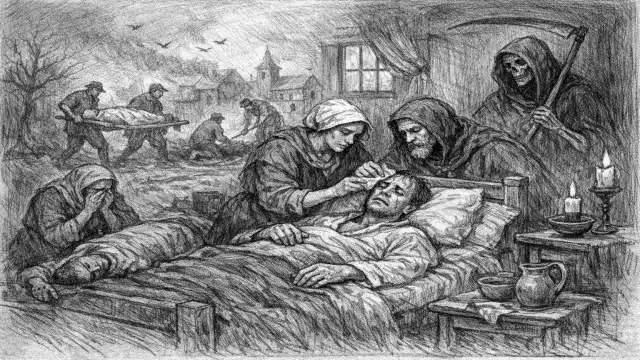
Imagine a highly contagious fever that specifically targets robust, wealthy adults. The sweating sickness was an infectious, deadly disease of totally unknown origin. It primarily confined itself to English soil, causing massive societal panic during the Tudor period.
During that era, folks were somewhat used to tragic pestilence. The Black Death had previously decimated Europe decades prior. Yet, this new biological killer felt entirely different. It moved incredibly fast. Bustling towns would appear perfectly clear one week, then become absolutely decimated the next. Afterward, the pathogen would mysteriously retreat without any logical explanation.
Consequently, terrified rumors ran wild. Did foreign mercenaries bring the plague over? Some modern historians still strongly think so. Henry Tudor hired hardened French troops to help win his royal throne. Shortly after their boots landed, the mysterious sickness exploded. However, an earlier undocumented outbreak might have hit York just before those troops arrived. Thus, the mercenary origin theory remains fiercely debated among scholars.
The terrifying symptoms
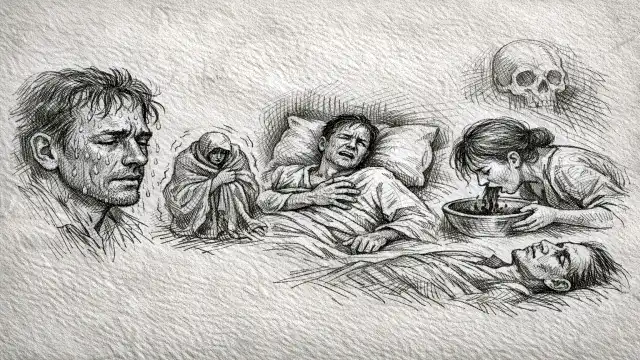
How exactly did it feel to catch this vicious bug? Frankly, it was completely horrific.
We know the terrifying specifics thanks to Dr. John Caius. He was a prominent, highly educated physician practicing in Shrewsbury. In 1552, Caius published a detailed medical book titled A Boke or Counseill Against the Disease Commonly Called the Sweate. His firsthand clinical account offers truly chilling insights.
According to historical records, the fatal illness progressed in brutal, rapid stages:
- The Cold Stage: Victims suddenly felt an intense, overwhelming sense of doom. Violent freezing shivers violently racked their bodies. Dizziness, agonizing neck pain, and severe physical exhaustion quickly followed. This miserable phase lasted anywhere from thirty short minutes to three agonizing hours.
- The Sweating Stage: Suddenly, the freezing chills magically transformed into burning, unbearable heat. Patients broke out in a drenching, terribly foul smelling sweat. Delirium quickly set in. Heart palpitations became extremely severe, causing chest pain.
- The Lethargic Stage: Finally, exhausted sufferers felt an overwhelming urge to sleep. If they successfully closed their eyes, they usually never woke up again.
“This disease is the easiest in the world to die of,” reported French ambassador Cardinal du Bellay back in 1528. He explicitly noted that victims were taken away without any prolonged suffering. You essentially caught a bad headache, started sweating profusely, and perished almost immediately.
If a sick person managed to survive the first 24 hours, they typically recovered completely. Unfortunately, surviving once did not miraculously grant biological immunity. Several unlucky souls caught the terrible sickness multiple times before finally succumbing.

Why were tudor doctors helpless?
During the 16th century, academic medicine relied heavily on the flawed concept of four bodily humors. Physicians genuinely believed internal imbalances involving blood, phlegm, yellow bile, and black bile caused human illness. Treatments usually included dangerous bloodletting or applying hungry leeches. Naturally, bleeding a fragile patient who is already suffering from severe dehydration merely hastened their tragic death.
Dr. Caius actually profited off the widespread panic. In his famous text, he offered specific, albeit totally useless, survival tips. He told panicked citizens to avoid evil mists and completely abstain from eating rotten fruit. If the dread sweat struck, patients were instructed to consume warm herbal concoctions. More importantly, he sternly warned victims absolutely not to fall asleep. Caretakers literally stayed awake for hours, violently shaking their sick relatives to keep their tired eyes open.
Timeline: 5 deadly outbreaks
The English sweating sickness did not stick around permanently. Instead, it struck in five distinct, incredibly devastating waves. Let us break down the historical timeline.
1485: The first wave
The initial terrifying epidemic kicked off right after the bloody Wars of the Roses. It ravaged populous London extremely quickly. Within just six short weeks, roughly 15,000 citizens tragically died. King Henry VII actually delayed his own lavish coronation to avoid catching the dreaded fever himself. By late autumn, the invisible threat vanished almost like dark magic.
1508 and 1517: The middle strikes
Decades happily passed without incident. Then, the horrific terror returned in 1508. This second bout was somewhat milder, though still quite lethal. But the subsequent 1517 outbreak proved absolutely catastrophic. University towns like Oxford and Cambridge suffered incredibly heavy casualties. In certain rural areas, half the local population reportedly perished within days.
1528: The great epidemic
This was unequivocally the big one. It struck with unparalleled, frightening ferocity. King Henry VIII went into a wild, paranoid panic. Naturally, the cowardly monarch fled London immediately. He essentially invented modern self isolation, sleeping in a different royal bed every single night to outrun the plague.
Even his famous romantic mistress, Anne Boleyn, caught the horrible sweat. She was nervously isolating at Hever Castle when the fever unexpectedly hit. Henry quickly dispatched his second best physician to save her life. Fortunately, she miraculously pulled through the ordeal.
Fans of historical fiction might recognize this specific era from Hilary Mantel’s phenomenal book Wolf Hall. The television adaptation dramatically depicts the sudden, heartbreaking tragedy. In real life, Thomas Cromwell, Henry’s powerful chief minister, lost his beloved wife Elizabeth to the 1528 outbreak. This brutal reality clearly shows that immense wealth offered absolutely zero protection.
Unlike previous waves, this specific contagion jumped the English Channel. It violently arrived in Hamburg, Germany, wiping out a thousand innocent people in just one month. From there, it traveled swiftly to Switzerland, Poland, and Russia. France and Italy, however, inexplicably escaped completely unharmed.
1551: The final curtain
The mysterious disease flared up one last time. Dr. Caius documented this specific occurrence meticulously for future generations. Afterward, the lethal pathogen entirely disappeared. Nobody knew exactly why it left. It simply faded quietly into the history books.
Did the disease discriminate?
Interestingly, yes it did. Normal epidemics typically ravage the poor, the very young, and the frail elderly. Yet, the sweating sickness behaved incredibly weirdly. It primarily targeted wealthy, robust, middle aged men.
Dr. Caius bluntly blamed the rich for their idle lifestyles and excessively heavy ale consumption. He firmly thought their daily gluttony made them biologically susceptible. Today, scientists heavily suspect the wealthy simply had far more exposure to whatever environmental vector carried the lethal bug.

The Picardy Sweat: french cousin?
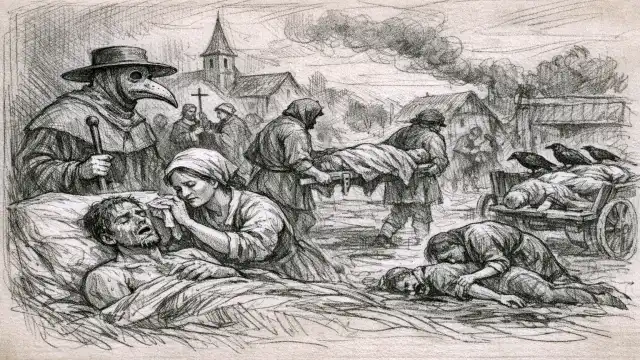
Just when Europe confidently thought the sweating sickness was gone, a bizarre copycat suddenly emerged. Over 150 years later, a remarkably similar illness popped up in France. Locals creatively called it the Picardy sweat.
Between 1718 and 1861, nearly 200 localized epidemics struck the northern Picardy region. Was it the exact same disease? Not quite exactly.
While both medical conditions caused intense perspiration, the French variant featured a distinct red rash. Furthermore, it lasted up to a full week rather than 24 hours. The overall mortality rate was significantly lower, too.
Medical experts remain deeply divided on the historical connection. Some professionals think they are totally unrelated viruses. Others strongly believe the original Tudor virus merely mutated over the intervening centuries.
When analyzing the Picardy sweat, fascinating historical footnotes frequently emerge. For instance, some medical historians theorize that legendary composer Wolfgang Amadeus Mozart may have succumbed to a related strain. When Mozart tragically died in Vienna in 1791, early records described his cause of death as hitziges Frieselfieber or severe miliary fever. This deadly fever shares numerous clinical traits with the Picardy sickness. Later, a 1906 French commission actually investigated a modern Picardy outbreak, concluding that tiny fleas from local field mice likely spread the infection.
Modern medical theories: what actually caused it?
Since 1551, brilliant epidemiologists have been scratching their heads collectively. We can sequence ancient DNA from medieval plague victims today effortlessly. However, the sweat sadly left no physical traces behind. Human bones do not show visual evidence of rapid viral infections. Therefore, we only have educated theories.
The hantavirus hypothesis
Currently, the most popular scientific theory points directly to a hantavirus. Normally, wild rodents carry these specific microscopic pathogens. Humans catch them accidentally by inhaling aerosolized mouse droppings or dried urine.
Why does this particular theory fit so well? In 1993, a terrifying modern outbreak hit the Navajo Nation in the United States. It was clinically called Hantavirus Pulmonary Syndrome (HPS). Victims experienced sudden flu like symptoms, spiking fever, and severe lung fluid accumulation. Many young adults died incredibly fast. The clinical picture perfectly mirrors ancient Tudor accounts.
Furthermore, hantavirus outbreaks rely heavily on specific weather patterns. Heavy rainfall naturally causes rodent populations to explode exponentially. The English epidemics often immediately followed unusually wet, mild summers. This strong ecological link makes a rodent borne virus highly probable.
Anthrax, Relapsing fever, or Something else?
Not everyone eagerly buys the hantavirus idea. HPS rarely spreads effectively from human to human. Meanwhile, the Tudor disease seemingly ripped through crowded households quite rapidly.
Consequently, alternative historical suspects exist:
- Anthrax Poisoning: Microbiologist Edward McSweegan suggested inhalation anthrax could be responsible. Lethal spores could have hidden secretly inside raw wool. The resulting symptoms extreme exhaustion, sweating, and rapid death match the historical records perfectly.
- Relapsing Fever: Ticks and lice usually spread this specific bacterial infection. It frequently peaks during warm summer months. Still, it usually causes dark black scabs, which Tudor doctors never explicitly mentioned.
- Influenza: A hyper virulent, mutated strain of the flu could definitely cause rapid mortality. However, the extreme, foul smelling sweating remains quite uniquely out of place for influenza.
The ME/CFS evolution theory
Recently, researchers proposed a genuinely fascinating new angle regarding the illness. Could the Tudor pathogen have slowly evolved into modern Myalgic Encephalomyelitis/Chronic Fatigue Syndrome (ME/CFS)? A 2025 medical hypothesis suggests a potential viral link between the two. Both complex conditions involve severe exhaustion, nervous system disruption, and debilitating post exertional malaise.
Perhaps the deadly Tudor virus simply lost its extreme lethality over time. Instead of killing hosts instantly, it mutated into a chronic, debilitating illness. This concept remains strictly theoretical, but it beautifully highlights how ancient diseases continuously reshape modern medical landscapes.

Why did It vanish so suddenly?
Dangerous pathogens rarely just pack up their bags and voluntarily leave. Why did this specific one vanish?
Viruses naturally mutate to ensure their own survival. Killing your host in 12 hours is ultimately terrible for viral business. If a microscopic virus kills everyone too fast, it effectively stops spreading. Therefore, the Tudor sweat might have successfully evolved into a milder, totally unrecognizable common cold.
Alternatively, the local climate changed drastically. If a specific breed of rodent carried the bug, environmental shifts might have wiped out that particular animal population. Widespread deforestation, changing agricultural practices, or significantly colder winters could have severed the dangerous human animal link. Without the animal vector, the terrifying disease permanently died out.
Could the sweating sickness return today?
Reading about rapid, 24 hour plagues understandably triggers massive anxiety. Especially after living through recent global pandemics, we worry. Could this historical nightmare realistically strike us again?
The short, comforting answer: It is highly unlikely.
If a novel hantavirus originally caused the outbreaks, modern sanitation gives us a massive, life saving advantage. We no longer live inside drafty, rat infested Tudor manors alongside our livestock. Our modern trash collection and urban pest control systems actively break the vital transmission chain.
Moreover, medical science has evolved dramatically since 1551. According to research databases like Google Scholar, modern critical care can effectively manage severe respiratory distress. Mechanical ventilators, broad spectrum antibiotics, and advanced antiviral protocols simply did not exist in Henry VIII’s time. If an individual walked into an emergency room today presenting with extreme sweating and pulmonary edema, triage doctors would immediately stabilize their airway.
That being said, the ancient mystery serves as a stark, humbling reminder. Mother Nature constantly brews up new microscopic threats in the wild. The World Health Organization (WHO) continuously monitors dangerous zoonotic spillover events across the globe. Wild animals still harbor countless undiscovered viruses. Therefore, we must remain ever vigilant.
Verdict on the Tudor Terror
The English sweating sickness undeniably remains a chilling, fascinating chapter in human history. It arrived violently alongside a brand new king, terrorized a wealthy nation for seven decades, and vanished like a silent ghost in the night. From John Caius’s desperate herbal remedies to King Henry VIII’s frantic bed hopping, the resulting societal panic was overwhelmingly real.
Will we ever successfully find the true biological culprit? Perhaps someday. If modern archaeologists ever identify the definitive graves of specific sweat victims, advanced DNA sequencing might finally unmask the pathogen. Until then, the Sudor Anglicus stubbornly keeps its dark, deadly secrets.
What do you personally think caused this terrifying Tudor disease? Could it have been an ancient mutated hantavirus, or something we haven’t even discovered yet? Share this article with your favorite history buff and dive into the fascinating debate!
Sources help:
- wikipedia.org
- https://www.britannica.com/science/sweating-sickness
- https://www.historyextra.com/period/tudor/sweating-sickness-what-symptoms-spread-effects-henry-viii-anne-boleyn/
- https://www.wikidoc.org/index.php/Sweating_sickness
- https://www.researchgate.net/publication/259630360_Were_the_English_Sweating_Sickness_and_the_Picardy_Sweat_Caused_by_Hantaviruses
- https://www.semanticscholar.org/paper/Were-the-English-Sweating-Sickness-and-the-Picardy-Heyman-Simons/9ce16e7a2fb7794712dea241174cba550c6ffb30
- https://pmc.ncbi.nlm.nih.gov/articles/PMC3917436/
- https://en.wikipedia.org/wiki/Picardy_sweat
- https://en.wikisource.org/wiki/1911_Encyclop%C3%A6dia_Britannica/Sweating-Sickness
- https://pharmaceutical-journal.com/article/opinion/just-what-was-english-sweating-sickness
- https://www.pastmedicalhistory.co.uk/the-mysterious-sweating-sickness/

