

The Abingdon Riot of 1327: When a Medieval Town Fought the Abbey
Imagine living in a town where your local church controls everything. Not just your Sunday mornings, but your money, your job, and your daily shopping. Sounds frustrating, right? Consequently, the people of Abingdon in 1327 thought so, too.
Back then, Abingdon Abbey wasn’t just a peaceful place for quiet prayer. Instead, it was a massive medieval corporation. The monks held tight control over the local economy. Naturally, the working-class townspeople got tired of paying sky-high taxes. Eventually, they snapped. What followed was the Abingdon Riot of 1327 a wild, fiery rebellion that shook medieval England.
Key takeaways:
- The Cause: Townspeople grew angry over the Abbey’s total control of market stalls, tolls, and local taxes.
- The Spark: On April 20, 1327, locals gathered at St. Helen’s Church to plan a strike against the monks.
- The Reinforcements: A few days later, the Mayor of Oxford, angry scholars, and merchants marched in to help the Abingdon rebels.
- The Climax: Rioters burned buildings, looted treasure, and forced monks to flee across the River Thames.
- The Result: The King’s army crushed the rebellion. Twelve men were hanged at Wallingford Castle.
Why was everyone so angry?
To understand this riot, you need to know what England looked like in early 1327. Honestly, the whole country was a mess. King Edward II had just been forced off the throne by his own wife, Queen Isabella, and her lover, Roger Mortimer. Because national leadership was falling apart, everyday people felt bold enough to challenge local authorities. Similar uprisings were already happening at St. Albans and Bury St. Edmunds.
Yet, the tension in Abingdon was deeply personal. For years, the Abbot of Abingdon acted like a strict, unforgiving landlord. He did not just run a religious site. He collected local taxes and enforced rigid rules on trade.
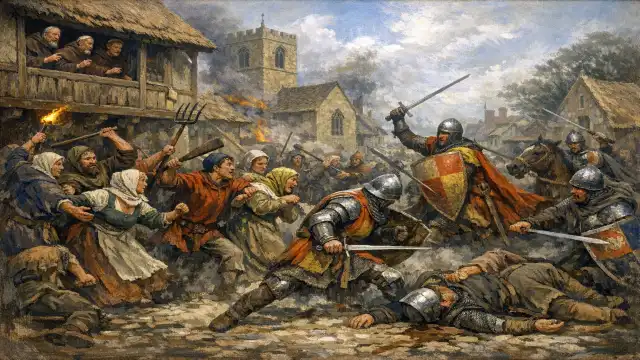
Monopoly of the monks
Picture the town square. Local merchants just wanted to sell their bread, fish, and leather. However, the Abbey built a new Market House directly in the middle of the square. Monks stood there, demanding tolls and fines from anyone trying to make a living. Basically, they ran a monopoly.
The townsfolk felt suffocated. Why should men of God control the local vegetable stand? Furthermore, the Abbey controlled the local courts. If a baker complained, he had to argue his case before the very monks he was suing. It was a rigged game. So, the pot slowly boiled until it exploded.
Spark that lit the powder keg
Rebellions rarely start quietly. On Monday, April 20, 1327, the heavy bell of St. Helen’s Church began to toll. This wasn’t a peaceful call for evening prayer. Actually, it was a medieval alarm bell.
Bell ringing and Broken stalls
A massive crowd of townspeople gathered. They were furious, loud, and ready to fight. Their first target? The hated market stalls. The mob surged out of the church, marching straight for the Abbey.

But the monks were not clueless. Someone had tipped them off. Consequently, the Abbey doors were locked tight, and the first attack failed.
Did the townsfolk give up? Absolutely not. Two days later, at midnight, the St. Helen’s bell rang again. This time, they meant business. They organized into specific groups with designated captains. At dawn, they smashed into the Abbey grounds near St. Nicolas Church.
A violent brawl broke out. The monks actually fought back hard, alongside hired guards. During the chaos, two townsmen died. Many more were dragged inside the Abbey as prisoners. At this point, the Abbot, John de Cannynges, returned from a trip out of town. Seeking peace, he released the prisoners. Still, this tiny gesture of goodwill was too little, too late. The blood was already spilled.
Oxford reinforcements arrive
Realizing they needed more muscle, the Abingdon rebels sent a desperate message to the nearby city of Oxford. They basically said, “We are fighting the monks, and we need backup.”
Oxford hated the Abbey just as much as Abingdon did. As a result, they answered the call in a big way.
A midnight march
On the night of April 25, a massive army of Oxfordians marched through Bagley Wood. This wasn’t just a handful of angry peasants. The Mayor of Oxford himself led the charge. He brought butchers, bakers, fishmongers, and even university scholars. Instead of the usual “Town and Gown” fights, this became a unified “Town and Cowl” riot against the monks.
When they reached the outskirts of Abingdon, they didn’t hold back. First, they torched the Abbey’s rental houses at Northcourt and Barton. Fire lit up the night sky. Then, this combined mega-mob stormed the Abbey walls.
Looting and Chaos
This time, the monks stood no chance. The massive crowd smashed down the heavy gates. Panic swept through the religious compound.
Imagine being a monk in that terrifying moment. Hundreds of armed, screaming tradesmen are breaking down your door. Therefore, survival instincts kicked in. The Abbot and several brothers ran for their lives. They scrambled toward the River Thames, desperate to escape. Sadly, in the frantic rush to cross the dark water, several monks actually drowned.
Meanwhile, back at the Abbey, the rioters threw a wild, destructive party. They didn’t just break things; they completely looted the place.
They stole:
- Gold and silver chalices.
- Expensive silk church vestments.
- Food and supplies from the kitchens.
More importantly, they attacked the Abbey’s paperwork. The crowd dragged out ancient deeds, charters, and financial records. They tossed them into massive bonfires. By burning the documents, the peasants believed they were wiping away their debts and the Abbey’s legal control over them. It was a brilliant, although highly illegal, strategy.
Aftermath
For a brief moment, the rebels won. The terrified Prior (the second-in-command monk) met with the mob. He quickly agreed to sign away all the Abbey’s market rights. The townspeople cheered, thinking they had finally earned their freedom.
Unfortunately, medieval justice was brutal and swift. You simply could not attack a powerful church and expect to get away with it.
The escaped Abbot, John de Cannynges, didn’t accept defeat. Instead, he went straight to the King’s government. The royal leaders were terrified of uprisings spreading. So, they sent armed lords and heavily armored archers straight to Abingdon. The fun was officially over.
Cost of rebellion
The King’s men locked down the town. Over 80 rioters were formally named and hunted down. Many ringleaders packed their bags and fled the county. However, dozens of others were captured.
The punishment was severe. Twelve men were dragged to Wallingford Castle and hanged by the neck until dead. It was a gruesome warning to anyone else thinking of starting a riot. Interestingly, Abbot John stepped in to show a bit of mercy. He personally intervened to save 60 other prisoners from the hangman’s noose.

Even though lives were spared, the town ultimately lost its fight. The Abbey kept its iron grip on the local market for another two centuries. They remained in power until King Henry VIII finally destroyed the monasteries in the 1530s.
What the Abingdon Riot teaches us today
You might be wondering, why should we care about a dusty riot from 1327?
First, human nature rarely changes. When people feel trapped by an unfair economic system, they push back. The monks of Abingdon acted like a modern corporate monopoly. They cornered the market, raised prices, and punished the little guy. Today, we argue about giant tech companies and unfair wages. Back then, they argued about fish stalls and grain taxes.
Second, the Abingdon Riot highlights the intense friction between working-class citizens and elite institutions. This event wasn’t mindless violence. The rioters specifically targeted financial records to erase unfair debts. It was a highly organized strike against a broken system.
Lastly, it shows the power of community. The fact that scholars and merchants from Oxford marched through the night to help their neighbors in Abingdon is incredible. They risked everything to fight a common bully.
Ready to explore more history?
The Abingdon Riot of 1327 wasn’t just a random medieval brawl. Truly, it was a desperate fight for survival, fairness, and economic freedom. The townsfolk lost the battle, and many paid with their lives. Yet, their bravery remains a fascinating chapter in history. They proved that even in the darkest periods of the Middle Ages, everyday people were willing to stand up to absolute power.
Have you ever felt like the system was completely stacked against you? How would you have reacted if you lived in Abingdon back in 1327? Drop a comment below and let us know your thoughts! If you enjoyed this deep dive into medieval history, don’t forget to share this article with your fellow history buffs. Keep questioning the past!
Sources help:
- https://www.abingdonabbeybuildings.co.uk/history/the-1327-riots/
- https://www.oxoniensia.org/volumes/1964-5/lambrick.pdf
- https://www.berkshirehistory.gowerweb.co.uk/villages/abingdon.html
- https://www.aaahs.org.uk/files/1327%20riots.pdf
- https://www.oxfordmail.co.uk/news/1388484.abbey-life-far-one-solitude/

