

From Artifact to Afterlife: The Spiritual Significance of Gold Foil Figures Among Germanic Tribes
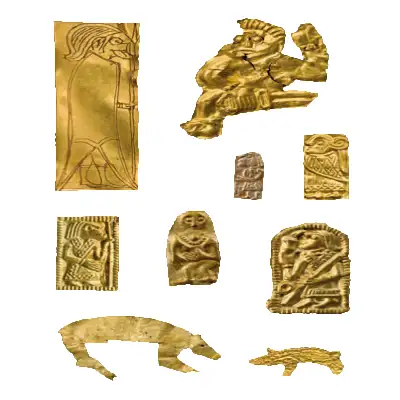
Forget treasure chests overflowing with Viking gold. Let’s talk about something far more intriguing. Tiny, wafer-thin pieces of gold, some no bigger than your thumbnail, stamped with enigmatic figures. These are the guldgubber—a name from modern Danish and Swedish meaning, charmingly, “little gold old men.”
Found scattered across Scandinavia and England, dating primarily from the Migration Period to the early Viking Age (roughly 500-800 CE), these foils are a profound puzzle. They weren’t currency. They weren’t exactly jewelry. So what in the world were they for?
The answer, it seems, lies at the very heart of Germanic cosmology: ritual, magic, and the desperate need to maintain order in a chaotic universe. Let’s dive in.
What Exactly Are Guldgubber?
Before we get into the spiritual deep end, let’s establish what we’re looking at. These aren’t just random scraps.
- Material: Almost always gold, a metal associated with the sun, divinity, and incorruptibility.
- Size & Thickness: They are incredibly delicate. Most are between 1-2 cm squared and are as thin as paper or foil. This fragility suggests they weren’t meant for daily handling.
- Creation: They were mass-produced, in a way. Artisans would carve a design into a bronze stamp, called a patrix. They would then press a small piece of gold foil onto the patrix, creating the embossed image.
- Imagery: This is where it gets good. The designs fall into a few key categories: a single male figure, a single female figure, an animal, or—most famously—an embracing couple. This “embrace” is the key to unlocking their most likely purpose.
The Heart of the Mystery: Where We Find Them
You can’t understand an artifact without its context. And with guldgubber, the context is everything. They weren’t just found randomly in a field. The vast majority have been discovered at two types of locations:
- Inside Great Halls: Archaeologists have found hundreds, sometimes thousands, of these foils in the post-holes of massive Iron Age halls. Think of the great mead halls from Beowulf. The most famous sites are Sorte Muld on the Danish island of Bornholm and Uppåkra in southern Sweden, which was a major political and religious center for centuries.
- At Offering Sites: Some are found at wetlands or other locations known to be places of sacrifice and offering to the gods.
Why is this significant? Placing them in the post-holes means they were deposited during the construction of the most important building in the community—the seat of the chieftain, the center of religious and social life. They were literally built into the foundations of power.
Peeling Back the Foil: The Leading Theories
So, we have fragile gold foils, often showing an embracing couple, placed into the foundations of great halls. What does it all mean? There isn’t one single answer, but the leading theory is powerful and deeply tied to Norse mythology.
Theory 1: The Sacred Marriage (Hieros Gamos)
This is the big one. The most widely accepted theory is that the guldgubber depict a hieros gamos, or sacred marriage, between a god and a giantess. Specifically, the marriage of the fertility god Freyr and the beautiful giantess Gerðr.
You might ask, “Who?”
In Norse mythology, their story is told in the poem Skírnismál. Long story short: Freyr, a god of sunshine, rain, and bountiful harvests, falls desperately in love with Gerðr. He sends his servant to woo her, and after many threats and promises, she agrees to meet him in a grove after nine nights.

This isn’t just a love story. It’s a cosmic event.
- Freyr represents the civilized, cultivated lands (Ásgarðr).
- Gerðr represents the wild, untamed, and fertile earth of the giants (Jötunheimr).
Their union symbolizes the taming of the wild and the fertilization of the earth. It ensures the sun will shine, the rains will fall, and the crops will grow. It guarantees the survival and prosperity of the community.
By stamping this sacred marriage onto a piece of divine gold and placing it into the foundation of the hall, the chieftain was performing a powerful act of sympathetic magic. They were perpetually enacting this divine wedding at the heart of their settlement, ensuring cosmic stability and a good harvest year after year. It was a spiritual battery, charging the community with divine energy.
Theory 2: Simple Votive Offerings
A simpler, though related, theory is that they were just votive offerings—a gift to the gods. A person might offer a guldgubber to ask for a child, a good harvest, victory in battle, or simply to remain in the gods’ good graces. Leaving a depiction of a god or a divine act was a direct and potent form of prayer.
Theory 3: Symbolic Contracts and Alliances
Think about where they were found: the chieftain’s hall. Another perspective is that these foils were used to seal earthly pacts with a divine blessing.
- Marriage Pacts: A guldgubber showing an embracing couple could have been a symbolic marker for the wedding of a powerful human couple, placed in the hall to ask the gods to bless the union.
- Oaths of Allegiance: A chieftain and his warrior might deposit a foil when swearing an oath, binding their promise not just to each other, but to the gods and the very structure of the hall.
Theory 4: A Passport to the Afterlife?
While most are found in settlements, some have been found in burial contexts. This opens another door. Gold, being incorruptible, was a powerful symbol of eternity. A guldgubber placed with the dead could have served as a marker of status in the afterlife or as a magical amulet to protect the soul on its journey. It connected the deceased to the divine powers that governed life, death, and rebirth.
The End of an Era: Why Did They Vanish?
Guldgubber production seems to fall off a cliff around the 9th and 10th centuries. Why? The answer is almost certainly the arrival of a new faith: Christianity.
The entire belief system that gave the guldgubber their power—the sacred marriage of Freyr and Gerðr, the pantheon of Norse gods, the practice of foundation rituals—was systematically replaced. The new power symbol wasn’t a gold foil embrace; it was the cross. The new foundational ritual wasn’t a deposit in a post-hole; it was the blessing of a priest. The guldgubber simply became obsolete, their magic replaced by a new theology.
More Than Gold, More Than Art
It’s easy to look at these tiny foils in a museum case and see them as just pretty objects. That’s a mistake. They aren’t passive art. They were active.
They were prayers, contracts, and cosmic insurance policies. They were a technology for interacting with the divine. Each tiny foil represents a moment of hope or fear, a plea for fertility, a sealing of a bond, or an attempt to bring the order of the gods down into the messy, uncertain world of humans.
These little gold figures show us that for the Germanic tribes, religion wasn’t something you did for an hour once a week. It was woven into the very timber of their homes and the foundations of their society.
Call to Action:
The evidence points strongly toward the sacred marriage theory, but the truth is likely a mix of all these ideas. Which theory do you find most compelling? Was it a cosmic ritual, a personal prayer, or a legal seal? Let me know your thoughts in the comments below.

