

The Voynich Manuscript: Is the World’s Greatest Mystery Finally Cracking?
Imagine finding a book that no one on Earth can read. Not the smartest linguists, not the most powerful AI, not even the people who crack military codes for a living. It sits there, staring back at you with alien looking letters and drawings of plants that don’t exist.
This isn’t a sci-fi movie plot. It’s Beinecke MS 408, better known as the Voynich Manuscript.
For over a century, this small, unassuming book has driven smart people absolutely bonkers. It has been called the “Mount Everest of crpytography.” But recently, the winds have shifted. From a scandalous 2024 theory about “women’s secrets” to a brand new 2026 breakthrough involving medieval gambling tools, we are getting closer to the truth than ever before.
Let’s cut through the noise and break down exactly what this thing is, why it’s so weird, and what the absolute latest research says.
What on Earth is the Voynich Manuscript?
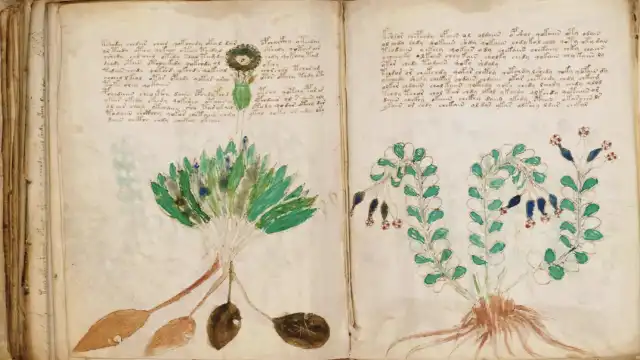
At first glance, it looks like a typical medieval science textbook. It’s about the size of a modern paperback, measuring roughly 9 by 6 inches. Inside, you’ll find 240 vellum (calfskin) pages packed with handwriting that flows beautifully from left to right.
But look closer, and things get strange.
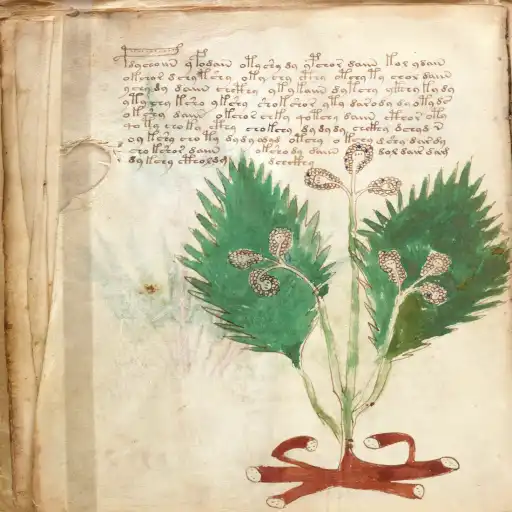
The script, nicknamed “Voynichese,” uses an alphabet of about 20 to 30 unique characters that don’t match any known human language. The illustrations are even wilder:
- Botanical: Detailed drawings of plants that are almost recognizable but have weird roots or leaves that don’t match reality.
- Astronomical: Zodiac charts where the symbols are often slightly wrong (like a Sagittarius archer with the wrong outfit).
- Biological: This is the trippy part. Scores of naked women bathing in green pools, sliding through strange organic “tubes” that look like a medieval water park.
The Cold Hard Facts (Verified by Science)
Before we get into the wild theories, here is what science knows for sure.
- Carbon Dating: In 2009, researchers at the University of Arizona carbon dated the vellum pages. The animal whose skin was used died sometime between 1404 and 1438. This puts the book right in the early Renaissance.
- Ink & Paint: The ink is iron gall, standard for the time. The colors (greens, blues, reds) are made from ground minerals consistent with 15th century Europe.
- Location: Based on the castle architecture drawn in the book (specifically the “swallowtail” battlements), experts pinpoint its origin to Northern Italy or the Alpine region.
- Current Home: It lives in the vault of Yale University’s Beinecke Rare Book & Manuscript Library, where it is cataloged as MS 408.
A Brief History of “The Ugly Duckling”
The manuscript is named after Wilfrid Voynich, a Polish antique book dealer who stumbled upon it in 1912. He found it at a Jesuit college near Rome, hidden in a chest of books being sold off.

Voynich knew he had something special. A letter tucked inside the book, written by a 17th century Prague physician named Johannes Marcus Marci, claimed the book once belonged to Holy Roman Emperor Rudolf II. Rudolf, a lover of the occult, apparently paid 600 gold ducats for it a fortune back then believing it was the work of the famous 13th century friar Roger Bacon.
Spoiler alert: It wasn’t Roger Bacon. Carbon dating ruled him out by about 200 years.
After Wilfrid died, the book bounced around until it landed at Yale in 1969. Since then, it has defeated everyone. The NSA’s founding cryptographers, William and Elizebeth Friedman, spent decades on it. They cracked Japan’s “Purple” code in WWII but couldn’t scratch the Voynich.
The Leading Theories: Madness, Medicine, or Hoax?
If the NSA couldn’t read it, what chance do we have? Well, modern researchers are approaching it differently. Instead of just trying to “decode” letter for letter, they are looking at context.
1. The “Women’s Secrets” Theory (2024)
This is one of the most compelling recent breakthroughs. In 2024, researchers Keegan Brewer and Michelle L. Lewis published a study in Social History of Medicine that flips the script.
They argue the manuscript isn’t about magic or aliens it’s about sex, conception, and gynecology.
In the Middle Ages, writing openly about “women’s secrets” (gynecology) was considered taboo or even dangerous. Physicians often used codes or euphemisms to discuss menstruation, childbirth, and abortion.
The Evidence:
- The Naked Bathers: Those weird drawings of women in pools? Brewer and Lewis suggest they represent the female reproductive system. The “tubes” aren’t plumbing; they are anatomical structures like fallopian tubes or the birth canal.
- Specific Imagery: They point to illustrations of women holding objects near their genitalia, mimicking how medieval doctors depicted self examination or the application of treatments.
- The “Rosettes” Foldout: The most complex drawing in the book (a huge 9 panel foldout) is interpreted not as a map of the world, but a diagram of the uterus and the “seven chambers” medieval medicine believed it had.
If this theory holds, the “code” was a safety measure a way to protect sensitive medical knowledge from church censors.
2. The “Naibbe Cipher” (Latest 2026 Research)
Fast forward to early 2026. Science journalist and researcher Michael Greshko dropped a bombshell study in the journal Cryptologia that might explain how the book was written, even if it doesn’t translate it yet.
Greshko looked at the statistical weirdness of “Voynichese.” The text has repetitive patterns that don’t look like normal human language (e.g., words repeating three times in a row).
The Breakdown:
- The Method: Greshko demonstrated that a medieval scribe could generate Voynich like text using a multi step cipher involving playing cards (specifically the 14th century game Naibbe) and dice.
- How It Works: You take a normal sentence in Latin or Italian. You use a “substitution table” where one letter (like ‘A’) can be written as five different symbols. You roll dice or draw a card to decide which symbol to use.
- The Result: This creates a text that looks complex and repetitive (high “burstiness”) but is actually just simple Latin underneath.
This is huge because it proves the text could be meaningful. It strikes a blow against the “gibberish” theory. It suggests the manuscript is a real book, encrypted with a very clever, low tech system.
3. The Hoax Theory
We have to mention the skeptics. Some experts, like computer scientist Gordon Rugg, have argued the whole thing is a fraud.
The idea? Wilfrid Voynich (or an earlier owner) created a fake mysterious book to sell to a gullible emperor for 600 gold ducats. If you use a grid tool (called a Cardan grille), you can generate nonsense words that look like a language but mean absolutely nothing.
- Why it fits: It explains why no one can crack it there’s nothing to crack.
- Why it fails: The carbon dating places the materials in the 1400s, long before Voynich was born. Creating a fake this complex, with unique “grammar” rules that hold up to computer analysis 600 years later, would be an insane amount of work for a scam.
Debunked: What It Definitely Isn’t
Every few years, someone claims they’ve “solved” the Voynich Manuscript. Usually, they are wrong.
- The Proto Romance Theory (2019): Academic Gerard Cheshire claimed the book was written in a lost “Proto Romance” language. The media went wild. But linguists immediately tore it apart. His “translation” relied on cherry picking words from dozens of different languages and ignoring grammar entirely. It was basically “Scrabble logic.”
- The Hebrew/AI Theory (2018): An AI program analyzed the text and decided it was encrypted Hebrew. However, the translation it spit out was incoherent nonsense. As experts pointed out, if you torture the data enough, it will confess to anything.
Why Does It Matter?
Why do we care about a 600 year old book of bad drawings?
Because it represents the limit of human understanding. We have mapped the human genome, discovered the Higgs boson, and sent telescopes to the dawn of time. Yet, we cannot read a book written by a guy with a quill pen in 1420.
It challenges our arrogance. It reminds us that history is full of lost knowledge. Whether it’s a censored medical guide for women or a genius medieval encryption experiment, the Voynich Manuscript is a time capsule waiting to be opened.
Are We Close?
Yes. The combination of the 2024 “Women’s Secrets” context and the 2026 “Naibbe Cipher” mechanics gives us a two pronged attack. We now have a likely subject (gynecology) and a likely method (card based encryption).
It’s no longer just a “weird alien book.” It’s a puzzle with edges.
Want to Crack It Yourself?
You don’t need a PhD. You just need patience and an internet connection.
- See the Book: Yale has digitized every single page in high resolution. View the Voynich Manuscript at Beinecke Library.
- Join the Hunt: Communities on Reddit (r/voynich) and dedicated forums are constantly testing new theories.
Who knows? The eyes that finally see the pattern might be yours.
Frequently Asked Questions (FAQ)
Is the Voynich Manuscript finally solved in 2026?
Not entirely, but we are closer than ever. The groundbreaking 2026 “Naibbe Cipher” study suggests the text was generated using a medieval card-game encryption method. This proves the text isn’t gibberish, but a complex puzzle waiting for the right key. Our article details exactly how this gambling cipher works.
What is the “Women’s Secrets” theory regarding the manuscript?
Proposed in 2024, this theory argues the book is a censored medical guide. Researchers believe the strange “tubes” and bathing women are actually coded diagrams of the female reproductive system and gynecological treatments, hidden to avoid religious persecution.
Why can’t AI crack the Voynich Manuscript?
AI struggles because “Voynichese” doesn’t follow the statistical rules of modern languages. If the new 2026 theory is correct, the text uses a “multi-step” substitution based on dice rolls and cards, creating a randomness that confuses standard AI translation models.
How much is the Voynich Manuscript worth today?
While considered priceless by historians, it was famously purchased by Emperor Rudolf II for 600 gold ducats (a small fortune). In today’s market, a unique medieval artifact of this fame would likely command over $50 million, though Yale University has no plans to sell.
Are the plants in the Voynich Manuscript real?
Most are “chimeras” mashups of different species. A drawing might have the root of one plant, the leaves of another, and the flower of a third. This supports the theory that the book was designed to be difficult to interpret without a specific “teacher” or key.
Disclaimer: This article explores historical theories and recent academic studies. While the “Naibbe Cipher” and “Women’s Secrets” theories are current leaders in the field, the Voynich Manuscript remains officially undeciphered.
Sources help:
- https://voynich.nu/extra/carbon.html
- https://www.rarebookhub.com/articles/2636
- https://www.reddit.com/r/UnresolvedMysteries/comments/1evn7os/new_2024_voynich_manuscript_theory_renaissance/

