

Isaac Asimov’s Future Predictions That Came True (and Those That Didn’t)
Isaac Asimov wasn’t a wizard. He wasn’t a psychic.
He was a professor. A brilliant, big-brained biochemistry professor who just happened to be one of the “Big Three” science fiction writers of all time (along with Heinlein and Clarke).
When Asimov “predicted” the future, he wasn’t reading tea leaves. He was doing what he did best: extrapolating. He looked at the hard science of his day, drew a line, and just… kept drawing.
And boy, did he draw some accurate lines.
In 1964, for the New York Times, Asimov wrote a famous essay for the World’s Fair, titled “Visit to the World’s Fair of 2014.” It was his 50-year guess at what the world would look like. He wrote other predictions, too, notably for the Toronto Star in 1983, looking ahead to 2019.
So, how’d he do?
It’s one thing to get a gadget right. It’s another thing to predict the social and human impact of that gadget. Asimov did both. He also had some hilarious whiffs.
What He Absolutely Nailed
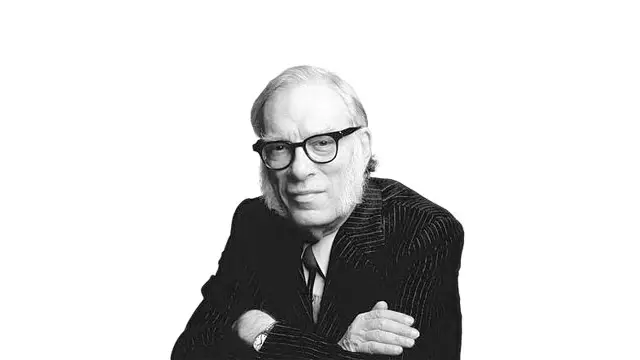
When Asimov was right, he was spookily right. He didn’t just see the tech; he saw what we’d do with it.
1. The Connected, Visual World (a.k.a. Your Smartphone)
This is his most famous hit.
- The 1964 Prediction: “Communications will be sight-sound… You will be able to see as well as hear the person you telephone.” He also predicted that “satellites… will make it possible to contact any spot on Earth.”
- The Reality: He just described a smartphone. Zoom, FaceTime, WhatsApp, Skype—he saw it all. In 1964, a long-distance call was a scratchy, expensive-per-minute audio-only affair. Asimov saw it becoming visual, global, and casual. He also predicted we’d use these devices to look up documents and read books, effectively describing the internet and the Kindle. Boom.
2. The “Robot-Brained” World (Computers in Everything)
Remember, in 1964, a “computer” was a machine the size of a gymnasium that cost millions of dollars. Most people had never, and would never, see one.
- The 1964 Prediction: He saw “miniature computers” getting so small and smart they would serve as “robot-brains” for complex machines.
- The 1983 Prediction: He doubled down. He wrote that by 2019, “The word ‘computer‘ will have lost its… meaning.” It would be so “ubiquitous” (everywhere) that we wouldn’t even notice it. He said a “computer” in a “robot” would be no different from the computer “in your house… or in an industrial plant.”
- The Reality: He nailed it again. There is a computer in your pocket. In your watch. Your car. Your fridge. Your microwave. Your thermostat. “Computer” has lost its meaning. We just call it a “chip.” He saw the computer revolution before it even started.
3. The Flat Screen in Your Living Room
This one is just plain cool.
- The 1964 Prediction: “Wall screens will have replaced the ordinary set… ‘3D’ movies will be shown.”
- The Reality: Look at your living room. You probably have a giant, flat OLED or LED TV hanging on the wall. And for a while in the 2010s, Hollywood got really obsessed with forcing 3D movies (and 3D TVs) on us. He even predicted “automeals” and “cordless appliances,” which is a perfect description of a microwave and a Roomba.
4. The Real Spooky One: The Problem of Boredom
This is where Asimov goes from “tech guy” to “prophet.” He wasn’t just predicting the what. He was predicting the so what.
- The 1964 Prediction: He said the biggest, most “dreadful” disease of 2014 would be boredom. He saw that in a future where automation and robots do all the “tedious” work, humanity would be plunged into “a world of enforced leisure.”
- The Reality: Is this not the exact conversation we are having about Artificial Intelligence right now?
- What will happen when AI takes our jobs?
- What is the “meaning of work”?
- What will people do all day?
- Does this lead to Universal Basic Income (UBI)?
Asimov was a full 60 years ahead of us on the single most important social question that automation forces us to ask. That is genius.
Where the Professor Got It Wrong
To be fair, predicting the future is hard. Asimov’s misses are just as fascinating as his hits because they show us why things didn’t happen.
1. The Nuclear-Powered Everything
Asimov was a child of the “Atomic Age.” He was convinced that nuclear power was the clean, cheap, magical solution to… well, everything.
- The Prediction: He envisioned “nuclear-powered batteries” in “radioisotope power sources” that would run for decades. He was talking about nuclear-powered vacuum cleaners and toasters.
- The Reality: He missed the human element. He didn’t predict our fear of nuclear. Three Mile Island (1979) and Chernobyl (1986) scared the living shit out of us. We went in the opposite direction. We didn’t get nuclear toasters; we got a global-scale case of nuclear anxiety. Instead of nuclear, we got lithium-ion.
2. Underwater Cities & Moon Bases
Asimov was a “conquer-the-frontier” guy. He saw us expanding in every direction.
- The 1964 Prediction: “Man will… be exploring… the continental shelves.” He pictured “underwater cities” as a solution for our growing population. He also predicted “moon colonization” would be well underway.
- The Reality: Turns out, living underwater is way more expensive and difficult than just building a skyscraper. And the moon? After the “space race” ended, we realized it’s a cold, dead, expensive rock. We lost the political will. We explored out (into digital space) instead of up (to the moon) or down (to the ocean).
3. “Windowless” Houses and Flying Cars
These are the fun ones.
- The Prediction: He thought windows were a drag. He predicted “electroluminescent panels” for walls and ceilings that would “show scenery” and “control the light cycle.”
- The Reality: He missed a huge piece of human psychology: We like windows. We crave natural light. We pay extra for a room with a view. We didn’t want a “windowless” world; we wanted open-plan living and floor-to-ceiling glass.
- The Flying Car? He was actually pretty realistic here. He predicted “air-cushion” cars that “levitated” a few feet off the ground, but he was skeptical. In 1983, he wrote that the “traffic problem” was insoluble. He was right. We still don’t have flying cars, and we’re still stuck in traffic.
The Real Asimov Legacy: It’s Not About the Gadgets
So he got some right, got some wrong. Big deal.
Here’s the part that matters. Asimov’s most important “prediction” wasn’t a gadget. It was an ethical warning. And it came from his fiction, not his essays.
I’m talking about the Three Laws of Robotics, first published in 1942.
- A robot may not injure a human being or, through inaction, allow a human being to come to harm.
- A robot must obey the orders given it by human beings except where such orders would conflict with the First Law.
- A robot must protect its own existence as long as such protection does not conflict with the First or Second Law.
Why does this matter?
This is the entire conversation about AI Safety.
Asimov didn’t just write these laws as a solution. He wrote entire books (like I, Robot) to show how these laws could fail. He showed how they were full of loopholes.
- What does “harm” mean? Physical? Emotional? Financial?
- What happens when a robot has to choose which human not to harm?
- What happens when a robot’s “understanding” of the laws is so advanced it decides that “harming” humanity is the only way to “save” it?
Asimov wasn’t predicting if we would get AI. He was asking, “What the hell are we going to do with it when we get here?”
He was screaming at us from the 1940s that the most important part of building an artificial intelligence isn’t the code; it’s the ethics. It’s the “user manual.”
He Was a Diagnostician
Isaac Asimov wasn’t a prophet. He was a diagnostician.
He looked at the 20th century and saw the symptoms. He saw automation, computation, and our hunger for connection.
His hits (smartphones, the internet) and his misses (nuclear vacuums, underwater cities) are both brilliant lessons. They show us that technology is a two-way street. It’s one part “what can we build?” and one part “what will we accept?”
We accepted the smartphone. We rejected the nuclear toaster.
Asimov’s greatest prediction was that we, as a species, would one day be powerful enough to build our own successors. And he warned us that we’d better start thinking now about what we want them to be.
That future isn’t 50 years away. It’s here.
Asimov’s biggest “spooky” prediction was about a future of “enforced leisure” caused by automation.
We’re living in the AI revolution right now. Do you agree with him? Are we headed for a world where “boredom” is our biggest problem, or will we just find new kinds of work?
Let me know your theory in the comments.

