

The Rabbit Queen of Godalming: How One Woman Fooled an Empire
Picture this: It’s 1726. The Enlightenment is in full swing. Science is supposedly triumphing over superstition. Isaac Newton is still alive. Yet, in a small town in Surrey, a group of England’s most prestigious doctors are standing around a bed, seriously debating whether a peasant woman is giving birth to a litter of bunnies.
This isn’t a Monty Python sketch. This is the Mary Toft Rabbit Hoax, and it is, without a doubt, one of the wildest, weirdest, and most embarrassing moments in medical history.
How did an illiterate servant from Godalming manage to hoodwink the Royal Court? Why did educated men of science believe a human uterus could function like a magician’s hat? And what happened when the trick finally ran out of rabbits?
Grab a drink. We’re going deep into the rabbit hole.
The Set-Up: A Weird Time for Medicine
To understand how this happened, you have to understand the vibe of 1726. Medicine was in a weird teenage phase-awkward, confident, but still prone to making terrible decisions.
Doctors were moving away from ancient mysticism and trying to be “scientific,” but they still held onto some absolutely bonkers theories. The big one? Maternal Impression.
The Theory That Made It Plausible
“Maternal Impression” was the widely accepted belief that a pregnant woman’s thoughts, shocks, or strong desires could physically alter the fetus.
- Saw a scary fire? Your baby might be born with a red birthmark.
- Craved strawberries? The kid might have a berry-shaped blemish.
- Startled by a rabbit? Well… you see where this is going.
This wasn’t fringe science; it was textbook knowledge. It was the loophole Mary Toft-and her accomplices-needed.
The “Miracle” Begins in Godalming

Mary Toft was a 25-year-old field worker, married to a journeyman clothier named Joshua. She was poor, struggling, and pregnant. In August 1726, she reportedly miscarried. But a month later, things got strange.
Mary went into labor again. But she didn’t deliver a baby.
According to her neighbor and later her mother-in-law, Ann Toft, Mary birthed a “monster”-a liverless cat.
Enter John Howard
The family called in John Howard, a local surgeon and man-midwife with 30 years of experience. You’d think a veteran doctor would take one look at a dead cat and say, “Nice try.”

Nope.
Over the next few weeks, Howard “delivered” more parts:
- Rabbit heads
- Cat legs
- A hog’s bladder (we’ll get to that later)
- And eventually, nine dead baby rabbits.
Howard was hooked. He was witnessing a medical miracle! He did what any excited scientist would do: he started writing letters to England’s greatest minds. He preserved the bunny parts in jars of alcohol and invited the big leagues to come see the “Wonder of Godalming.”
The King Gets Curious
News traveled fast. It reached London, buzzing through coffee houses and eventually landing in the ear of King George I.
The King, intrigued but cautious, dispatched two men to investigate:
- Nathanael St. André: The Swiss surgeon-anatomist to the Royal Household. A bit of a social climber and very eager to be part of a breakthrough.
- Samuel Molyneux: Secretary to the Prince of Wales.
The Investigation
St. André arrived in Godalming and walked straight into a performance. He watched Mary “labor” and saw a piece of a rabbit delivered. He checked the rabbit’s lungs. They floated in water, which meant the animal had breathed air-impossible if it had just been born inside a fluid-filled womb.
Red flag? Yes.
Did St. André care? No.
He was convinced. He bought the “Maternal Impression” story hook, line, and sinker. Mary told him that while working in the fields, she’d been startled by a rabbit and had chased it, developing an intense craving for rabbit meat that she couldn’t afford. The “shock” had clearly turned her unborn child into a warren.
St. André rushed back to the King with samples, declaring the case supernatural and genuine. He even published a pamphlet, A Short Narrative of an Extraordinary Delivery of Rabbets, cementing his reputation to the hoax.
The Skeptic Arrives: Cyriacus Ahlers
Not everyone was buying it. The King, perhaps wondering why his Royal Surgeon was carrying jars of dead bunnies, sent a second opinion: Cyriacus Ahlers, surgeon to the German royal household.
Ahlers was sharp. He went to Godalming, observed Mary, and noticed some suspicious behavior:
- Mary kept her knees pressed tight together.
- She seemed to be in pain only when people were watching.
- The Smoking Gun: Ahlers examined the “newborn” rabbits and found dung pellets in their rectums. Inside the dung? Corn, hay, and straw.
Unless Mary Toft had a miniature farm inside her uterus, these rabbits had been eating lunch in a field recently.
Ahlers reported back to the King that it was a fraud. St. André, furious, accused Ahlers of jealousy. The medical community was now split: Team Miracle vs. Team Hoax.

The Showdown in London
To settle the debate, the King ordered Mary Toft to be brought to London. On November 29, she was moved to Lacy’s Bagnio (a bathhouse/boarding house) in Leicester Fields.
This was the 18th-century equivalent of going viral. Crowds gathered. Wagers were placed. The press went wild.
But there was a problem. Now that Mary was under strict surveillance by skeptical doctors-including the famous Dr. James Douglas and Sir Richard Manningham—the rabbits stopped coming.
The Unraveling
Mary tried to keep the ruse up. She would go into “labor,” writhe in pain, and… nothing.
The pressure mounted.
- The Porter: A porter at the bathhouse was caught trying to sneak a small rabbit into Mary’s room. When grilled, he admitted Mary’s sister-in-law had bribed him to find “the smallest rabbit I could.”
- The Medical Threat: Sir Richard Manningham, tired of the charade, played the bad cop. He told Mary that since her case was so unique, he needed to perform a painfully invasive surgery to see how her uterus was constructed.
Basically: Confess, or we start cutting.
The Confession (December 7, 1726)
The threat worked. Mary Toft broke.
She confessed that she had been manually inserting dead rabbits-and parts of other animals-into her vagina. She had done this with the help of accomplices, forcing the parts inside and then “birthing” them hours later.
Why?
Mary claimed she was put up to it by her family (specifically her mother-in-law) to make money. They hoped the King would grant her a pension for being a medical marvel. Instead, she got a one-way ticket to prison.
The Aftermath: Who Looked the Fool?
You might think Mary Toft suffered the most, but the real damage was to the ego of the medical establishment.
1. The Doctors
Nathanael St. André was ruined. He had publicly staked his reputation on the rabbits being real. He never recovered socially or professionally and died in poverty. The court mocked him relentlessly.
John Howard, the initial believer, faced fines but largely slipped back into obscurity in Surrey.

2. The Satire
The press had a field day. The hoax was the perfect fuel for political and social satire.
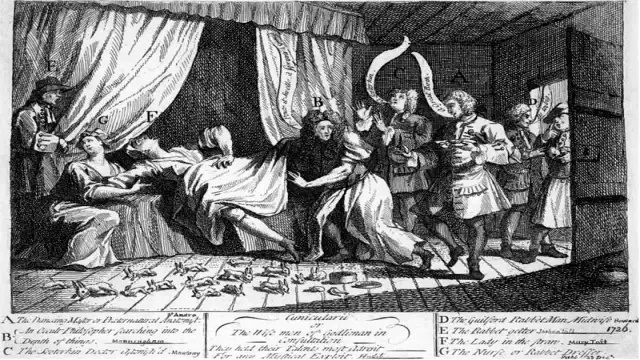
- William Hogarth, the famous artist, published a print titled Cunicularii, or The Wise Men of Godliman in Consultation. It depicted the doctors peering intently at Mary’s nether regions while rabbits scampered about-a biting critique of learned men being fooled by a peasant.
- Newspapers published ballads and cartoons. “Rabbit” became a slang term for a while.
3. Mary Toft
Mary was sent to Tothill Fields Bridewell prison. She was charged with being a “Notorious and Vile Cheat.” Crowds flocked to the prison just to stare at her.
However, the legal system was baffled. There was no precedent for “faking rabbit births.” Eventually, the case was dropped. Mary was released after a few months.
She returned to Godalming, where she lived a relatively quiet life. Interestingly, the parish records show she gave birth to a (human) daughter, Elizabeth, in 1728-noted as her “first child after her pretended Rabbit-breeding.”
Mary Toft died in January 1763. Her death notice in the London papers referred to her simply as “the Rabbit-woman.”
Why This Story Matters Today
It’s easy to laugh at 18th-century doctors, but the Mary Toft hoax reveals something timeless about human nature.
1. Confirmation Bias is a Drug
St. André wanted to believe. He wanted to be the discoverer of a new medical phenomenon. Once he bought into the “Maternal Impression” theory, he ignored the obvious red flags (like the hay in the rabbit poop). Smart people are often the easiest to fool because they are good at rationalizing their beliefs.
2. The Power of “Fake News”
This was one of the first major media sensations. The story spread via pamphlets and word-of-mouth faster than the truth could catch up. It shows that sensationalism often travels further than facts.
3. The Limits of Expertise
The hoax exposed that “experts” aren’t infallible. It forced the medical community to be more skeptical and reliant on empirical evidence rather than theory.
The Final Verdict
The Mary Toft rabbit hoax wasn’t just a fraud; it was a performance piece that exposed the gullibility of the elite. It brings up a hilarious and uncomfortable question: How much evidence do you need to believe the impossible?
For King George’s doctors, a few dead bunnies and a good story were enough.
Quick Summary: The Key Players
| Name | Role | Believer or Skeptic? | Fate |
| Mary Toft | The Hoaxer | N/A | Imprisoned, then released. Died 1763. |
| John Howard | Local Surgeon | Believer | Fined, reputation damaged. |
| Nathanael St. André | Royal Surgeon | Super Believer | Career ruined, public laughingstock. |
| Cyriacus Ahlers | King’s Surgeon | Skeptic | Found the corn in the dung. Vindicated. |
| Sir Richard Manningham | Famous Obstetrician | Skeptic | Forced the confession. |
Enjoyed this dive into history’s weirdest fraud?
Don’t let the past stay buried. Share this article with a friend who thinks they’ve heard it all-because trust me, they haven’t heard about the woman who birthed bunnies for the King.
Subscribe to our newsletter for more bizarre history and true crime deep dives!

