

UVB-76 “The Buzzer”: A Log of Every Major Voice Message Broadcast Since 2010
Imagine a radio station that has been broadcasting a monotonous, maddening buzz for over 40 years. It doesn’t play music. It doesn’t broadcast news. It just buzzes. 25 times a minute, 24 hours a day, on the frequency 4625 kHz.
Then, suddenly, the buzzing stops. The static rises. A cold, distorted Russian voice cuts through the noise to recite a string of names and numbers.
“Nikolai. Zhenya. Tatyana. Ivan.”
And then? The buzzing returns, as if nothing happened.
This is UVB-76, also known as “The Buzzer” (or Zhuzhzhalka to the Russians). It is the world’s most famous “numbers station,” a ghost of the Cold War that refuses to die. For decades, it was relatively quiet, a boring channel marker keeping a frequency warm. But everything changed in 2010.
Since then, the station has become a hive of activity, broadcasting commands, changing callsigns, and seemingly reacting to global geopolitical nightmares. As of late 2025, the activity has reached a fever pitch.
You want to know what it’s been saying? You’ve come to the right place. We’ve compiled the most comprehensive log of significant voice messages from the station’s “awakening” in 2010 to the present day.
What the Hell is UVB-76?
Before we dive into the logs, let’s cut the fluff. What are we actually listening to?

- Frequency: 4625 kHz (Shortwave AM).
- Location: Originally near Povarovo (Moscow), now triangulated to the Western Military District (likely near St. Petersburg or the Kerro Massiv).
- The Sound: A repeating buzz tone, approximately 1.2 seconds long, followed by a pause.
- The Purpose: The million-dollar question.
The Leading Theories:
- Channel Marker: The buzzing is just a placeholder to stop other stations from using the frequency. The “voice” messages are the real point—encrypted military orders.
- “The Dead Hand”: A doomsday fail-safe. If the buzzing stops, it triggers an automated nuclear retaliation. (Spoiler: The buzzing has stopped before, and we’re still here. So, probably not this.)
- Ionospheric Research: Boring, but plausible. Scientists measuring how radio waves bounce off the atmosphere.
Most experts agree it’s Theory #1: A military communication network for the Russian Western Military District. The voice messages are likely coded orders for specific military units.

The Great Awakening: The 2010 Breakdown
For years, UVB-76 was boring. It used the callsign UZB-76. Voice messages were years apart. Then came 2010, the year the station seemingly “broke.”
August 2010: The Silence
- August 25, 2010: The unthinkable happens. The buzzing stops. For the first time in recorded history, the station falls silent. Panic erupts in the listener community. Is this the end? Is the “Dead Hand” broken?
- August 26, 2010: The buzzing returns, but it sounds wrong. Distorted. Weak.
The “BROMAL” & “NAIMINA” Transmissions
Following the silence, the station spat out its first clear voice messages in years, marking the start of a new era.
- August 23, 2010 (13:35 UTC):Message:UVB-76, UVB-76. 93 882 NAIMINA 74 14 35 74.
- Significance: This was a shock. The clarity was high, and it used the classic “Monolith” format (Callsign + Codeword + Numbers).
- September 7, 2010 (The Name Change):Message:Mikhail Dmitri Zhenya Boris (MDZhB). 04 979 D-R-E-N-D-O-U-T. T-R-E-N-E-R-S-K-I-Y.
- Significance: Historic moment. The station dropped the UZB-76 callsign and adopted MDZhB. It would keep this name for the next five years.
The MDZhB Era (2010 – 2015)
Under the new callsign, the station settled into a routine. Messages became more frequent but still felt “special.”
- January 25, 2013: The infamous “Command 135” broadcast. Message:MDZhB. T-E-R-K-A. 0254. MDZhB. T-E-R-K-A. 0254. OBYAVLENA KOMANDA 135.
- Translation: “Command 135 announced.”
- Context: This terrified listeners. “Command 135” sounds like a specific readiness state. To this day, nobody in the public sphere knows what Command 135 actually triggers.
- March 18, 2014: Activity spike coinciding with the annexation of Crimea. The station broadcast heavily distorted signals, confirming the link between geopolitical tension and buzzer activity.
The ZhUOZ Transition (2015 – 2019)
Just as we got used to MDZhB, the station evolved again.
- December 2015: The callsign changes to ZhUOZ (Zhenya, Ulyana, Olga, Zinaida).
- October 17, 2016: A rare terrifying moment. The station broadcast not a code, but a frantic voice screaming simply: “SBOY” (Failure/Breakdown), followed by frantic shuffling.
- Vibe Check: This sounded less like a military order and more like a technician realizing they screwed up.
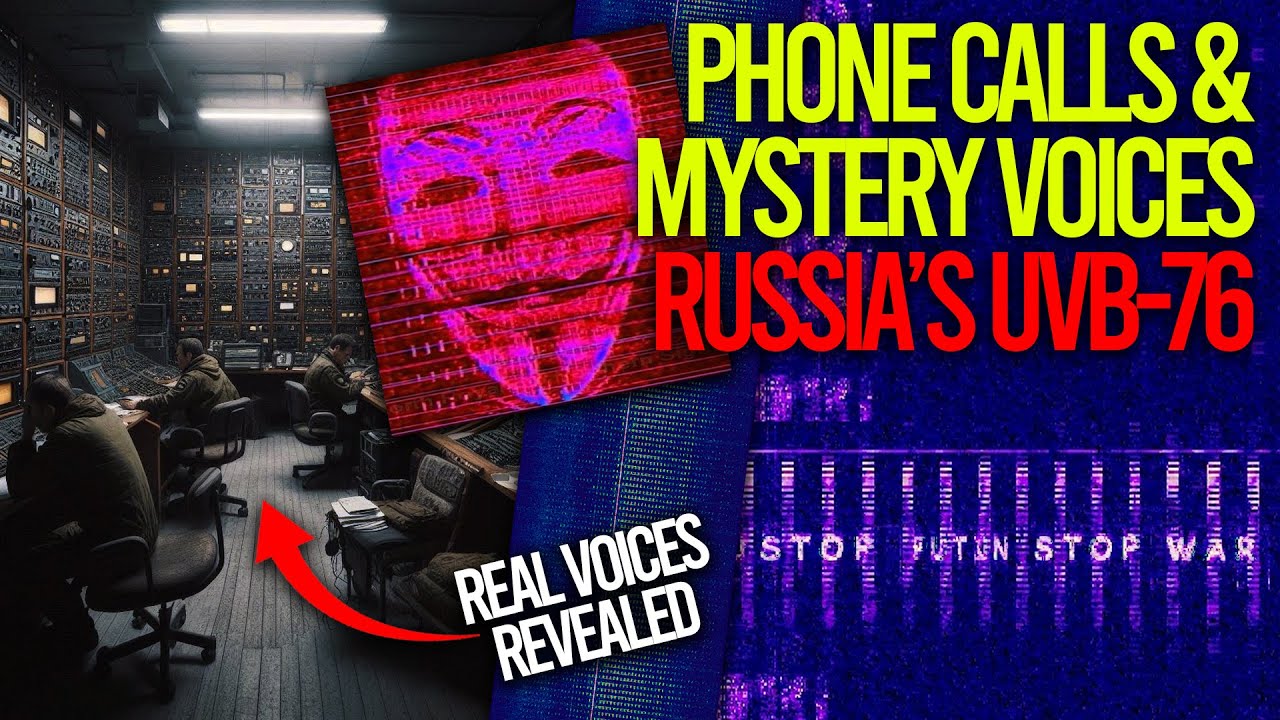
The Modern Era: NZhTI & The War (2020 – Present)
This is where things get dark. In 2020, the station shifted to the callsign NZhTI (Nikolai, Zhenya, Tatyana, Ivan) and occasionally ANVF. The volume of messages exploded.
2022: The Invasion Warning
UVB-76 – “The Buzzer”, recorded on 24 March 2022
UVB-76 – “The Buzzer”, recorded on 10 August 2022

In the months leading up to Russia’s full-scale invasion of Ukraine, UVB-76 went from a dormant volcano to an active eruption.
- January – February 2022: A massive spike in messages.
- Keywords: ORLENOK (Eaglet), VOLK (Wolf), BURAN (Blizzard).
- February 24, 2022 (Invasion Day):
- Status: Silence.
- Insight: Paradoxically, on the actual day of the invasion, the station went quiet on voice channels. Military logic suggests the orders had already been given. The “channel marker” did its job.
December 11, 2024: The Record Breaker
Fast forward to late 2024. The war drags on. Suddenly, the Buzzer goes berserk.
- The Event: In a single day, the station broadcast 24 separate voice messages.
- The Content: A mix of standard codes and bizarre, almost poetic words.
- AZBUKA (Alphabet)
- NANAYKA (Nanai – a Siberian indigenous group)
- PANKOSVOD (Punk compilation? Likely a phonetic code)
- GEENNA (Gehenna/Hell)
- Why? Analysts believe this was a massive training exercise or a recalibration of the encryption keys used by the Western Military District.
2025: Escalation & Drones
We are now in the current year, and UVB-76 is more relevant than ever.
- June 4, 2025:Message:NZhTI. 83 294. A-Z-O-T-O-B-A-K. O-S-H-O-L-I-N.
- Context: These codes (“Nitrogen Tank” and a nonsense pharmaceutical term) aired mere hours before high-stakes diplomatic calls regarding the Eastern European theater.
- September 8, 2025:Message:Nikolai, Zhenya, Tatyana, Ivan. 38 965. 78 588. HOTEL. SOFT SIGN.
- Significance: The use of “Hotel” (a NATO alphabet term, oddly) and “Soft Sign” (a Russian grammatical letter) suggests a complex new encryption layer.
- November 14, 2025: The Drone Strike
- Event: Broadcasting abruptly cuts.
- Report: RIA Novosti (Russian state media) reports a drone strike on a power substation near the transmitter site.
- Result: The signal returned 4 hours later, humming on backup power. This was the first time kinetic warfare directly silenced the Buzzer.
Deciphering the “Monolith” Code
You hear these messages, but what do they mean? While we can’t crack the daily encryption (that requires a “One-Time Pad” only the receiver has), we can understand the format.
Most messages follow the “Monolith” structure:
- Callsign: (e.g., NZhTI) – “Hey, this message is for unit NZhTI.”
- Groups: (e.g., 93 882) – Likely the priority or format identifier.
- Codeword: (e.g., BROMAL) – The “Instruction.” One word might mean “Move to location X” or “Switch to frequency Y.”
- Data Block: (e.g., 74 14 35 74) – The specific variables for that instruction (coordinates, time, frequencies).
Think of it like a pizza delivery:
- Callsign: “Domino’s Driver.”
- Codeword: “DELIVER.”
- Data Block: “123 Main Street.”
Without the codebook, we just hear “Driver. DELIVER. 12345.” We know something is moving, but not what.
The Pirate Wars
We can’t talk about UVB-76 without mentioning the trolls. Because the station uses an antiquated analog transmitter, it is susceptible to hijacking.
Tech-savvy enthusiasts with high-powered transmitters (Software Defined Radios) often blast their own audio over the buzzer.
- Notable Hijacks:
- Gangnam Style: Yes, they played Psy.
- Rickrolling: Obviously.
- Spectral Art: Pirates transmitted audio that, when viewed on a spectrogram (a visual graph of sound), drew shapes like memes and symbols.
While funny, this annoys the Russian operators. You can often hear them turning the power way up to drown out the pirates, resulting in a deafeningly loud buzzer for a few hours.
Why Does It Still Exist?
In an age of satellite comms, quantum encryption, and stealth drones, why use a buzzing radio station from the 1970s?
1. Reliability: Shortwave radio bounces off the sky (the ionosphere). You don’t need satellites. You don’t need the internet. Even if the entire power grid goes down, a shortwave signal can travel thousands of miles.
2. Unstoppable: You can’t “hack” a radio wave in the traditional sense. You can jam it, but you can’t insert a virus into it.
3. Dead Man’s Switch: It’s a terrifyingly simple way to say “We are still here.”
Conclusion: The Ghost is Alive
UVB-76 is more than just a spooky noise on the internet. It is a living, breathing fossil of military history that is actively participating in modern warfare. From the silence of 2010 to the frantic codes of 2025, the log of messages paints a picture of a world on edge.
Next time you’re up late, search for a WebSDR (a radio receiver you can control via browser), tune to 4625 kHz, and listen.
You might just hear the buzzer stop. And if you hear a voice… write it down.
How to Listen Live
Want to tune in yourself? You don’t need a radio.
- Go to a WebSDR site (like websdr.org).
- Set the frequency to 4625 kHz.
- Set the mode to USB (Upper Side Band).
- Wait for the buzz.
Stay curious. Stay tuned. And hope the buzzing never stops for good.

