

Deadly Green Legends: The Myth of Man-Eating Plants
“Feed me, Seymour!”
That line from Little Shop of Horrors is a pop culture icon. It’s the perfect blend of camp, comedy, and a truly primal fear. The idea of a plant something that’s supposed to be passive, rooted, and part of the scenery – turning the tables and making us the food is deeply unsettling.

It’s an inversion of the natural order. We’re the apex predators. They’re… salad.
But this fear didn’t start with a musical. For centuries, travelers’ tales, sensationalist newspapers, and folklore have whispered about deadly flora. We’ve heard of jungle vines that constrict explorers, flowers that lure victims with a hypnotic scent, and colossal trees that consume human sacrifices.
But are any of these stories true? Did a 19th-century explorer really see a woman devoured in Madagascar? Is there a vine in South America that whispers “I see you” before it strikes?
No, there has never been a verified case of a plant eating a human being.
But that’s not the interesting part. The interesting part is why we tell these stories. The legends are a tangled mess of hoaxes, exaggerations, and a few shockingly real-world seeds of truth. So let’s grab a machete, hack through the vines of myth, and find out where these deadly green legends came from.
The Roots of the Myth: Why Are We So Obsessed?
Before we get to the monstars, we have to ask: why do we want to believe this?
It’s not that complicated. Our brains are wired to be wary of the unknown. For early explorers, a new, uncharted jungle was the very definition of “the unknown.”
- “Here Be Monsters”: When you step into a totally alien environment—a dense jungle in a land you don’t know – your imagination fills in the gaps. If there are snakes that can swallow a deer and spiders the size of your hand, why not a plant that can eat a person?
- The Seed of Truth: This is the big one. Carnivorous plants are real. We know this. Explorers saw Venus flytraps snap shut on flies and pitcher plants with their bellies full of drowned insects. It’s not a huge leap for a sensationalist journalist or a freaked-out traveler to ask, “If it can eat a fly… what if a bigger one could eat a rat? Or a dog? Or a man?“
- The Ultimate “Other”: A plant predator is the perfect monster. It has no face, no eyes to reason with, no legs to outrun. It’s an unthinking, unfeeling, vegetable hunger. That’s pure nightmare fuel.
These three factors created the perfect, fertile soil for some of the greatest hoaxes and legends in botanical history.
Legend #1: The Man-Eating Tree of Madagascar (The Great Hoax)

This is the “Patient Zero” of man-eating plant stories. It’s the one that started it all, a tale so vivid and terrifying that people believed it (and some still want to) for decades.
The Story:
It all began with an article published in the New York World newspaper on April 26, 1874. The piece, written by an “Edmund Spencer,” described a letter from a supposed German explorer named “Karl Liche” (or Carl Liche).
Liche claimed to have witnessed a horrifying ritual performed by the “Mkodo” tribe in Madagascar.
- The “tree” was described as being like a giant, 8-foot-tall pineapple, with long, hairy, “snake-like” tendrils and “huge, green, and thorny leaves.”
- In the “ceremony,” the tribe forced a woman to climb the trunk.
- The plant’s tendrils, “like gigantic serpents,” suddenly snapped to life, wrapping around her “with the furious energy of hungry pythons.”
- The leaves then slowly closed in, crushing her. Liche claimed he could hear her “fearful screams” as the plant’s “greenish, glutinous” sap dripped onto her.
The Debunking:

It’s a horrifying story. It’s also 100% fake.
It was a 19th-century clickbait article, a piece of sensationalist fiction written to sell newspapers. There was no Edmund Spencer. There was no Karl Liche. There was no Mkodo tribe. And there was no tree.
But the story was too good to die. It was reprinted in newspapers across the globe. It even got a second life in 1924 when Chase Osborn, a former governor of Michigan who actually believed the story, wrote a book called Madagascar, Land of the Man-Eating Tree. He claimed the tribe and tree were real, giving the hoax a new, “authoritative”-sounding source.
To this day, the Madagascar Man-Eating Tree remains the most famous, detailed, and utterly fictitious killer plant in history.
Legend #2: The Ya-te-veo (The Sequel)
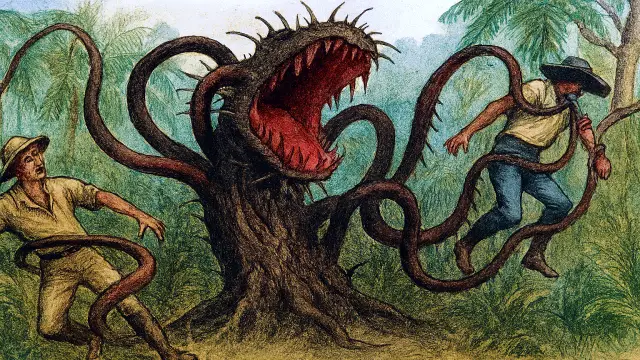
If the Madagascar Tree was the blockbuster, the “Ya-te-veo” was the direct-to-video knockoff.
The Story:
In 1887, J.W. Buel published a book called Sea and Land, which was basically a collection of the 19th century’s most outrageous tall tales. In it, he described a man-eating plant from South and Central America.
He claimed it had a thick, “stump-like” trunk and long, “serpent-like” appendages that it used to “seize and crush… any living thing” that came near it. In one infamous (and clearly fabricated) story, the plant grabs a native, crushing him until a “mass of shapeless pulp” is all that remains.
The name? Ya-te-veo. It supposedly means, “I see you.” Creepy.
The Debunking:
This was even less believable than the Madagascar story. Buel was a known sensationalist. His book also featured “discoveries” of mermaids and other nonsense. The Ya-te-veo was almost certainly a cheap imitation of the 1874 Madagascar hoax, designed to cash in on the same public fascination.
The legend persists, but it has no basis in botany.
Legend #3: The Upas Tree of Java (The Real Killer)

our first two legends were pure fiction. But this one is different.
This tree is real. It is deadly. And the myth surrounding it is a perfect example of how a real biological fact can be wildly exaggerated.
The Myth:

For centuries, travelers to Java (now part of Indonesia) told of the dreaded Upas Tree. The legend, first widely circulated in Europe in the 18th century, claimed the tree, Antiaris toxicaria, was so poisonous that it created a 15-mile radius of death.
- No other plant could grow near it.
- Birds that flew over it would drop dead from the sky.
- The ground was littered with the bones of animals and humans foolish enough to rest in its shade.
- It was said that criminals were offered a choice: execution, or a “suicide mission” to retrieve the tree’s sap for use in poison darts.
Here’s the thing: Antiaris toxicaria is a real tree, and it is violently toxic.
The tree produces a milky-white sap (a latex) that is loaded with a powerful cardiac glycoside poison called antiarin.
According to authoritative botanical sources like the Royal Botanic Gardens, Kew, this sap was absolutely used by indigenous people to envenom their blowgun darts. A dart tipped in Upas sap, if it breaks the skin, can cause paralysis, convulsions, and death by cardiac arrest.
It is a killer tree.
The Debunking of the Myth:
So, the sap is deadly. But what about the 15-mile death zone? That part is a fascinating case of mistaken identity.
The “Valley of Death” is also a real place in Java. But it’s not a forest. It’s a volcanic depression, a natural vent (a fumarole) that leaks dense, unbreathable gases like carbon dioxide.
This heavy gas hugs the ground, and it does kill animals. Birds, small mammals, and even humans who wander into the bottom of this valley can suffocate and die.
Early explorers saw two different things:
- A real tree whose sap was used for poison darts.
- A real valley where animals mysteriously dropped dead.
…and they mashed the two stories together. The result? The legend of the Upas Tree, a single, magical tree so toxic it poisoned the very air around it. The reality is two separate, and equally interesting, scientific phenomena.
Meet the Actual Carnivorous Plants
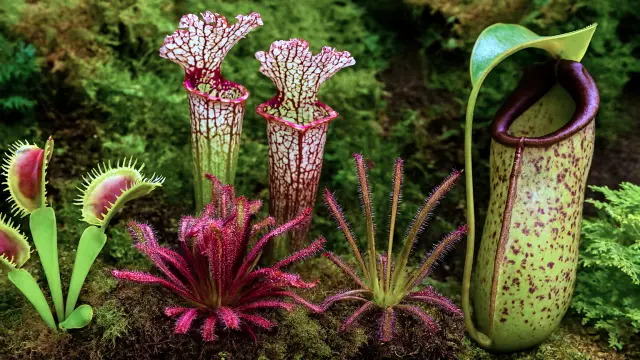
So the man-eaters are myths. But the real carnivores are, in many ways, much weirder.
Why do they even exist? It’s not for “hunger.” It’s for fertilizer. Carnivorous plants evolved in places with terrible, nutrient-poor soil, like acidic bogs. They can’t get nitrogen or phosphorus from the ground, so they evolved ingenious ways to get it from somewhere else: insects.
They’re not monsters. They’re just brilliant survivalists. Here are their main “trap” types.
- Snap Traps (The Venus Flytrap): This is the one everyone knows. It has “trigger hairs” inside its leaf-jaws. When a fly bumps two different hairs (a way to prevent false alarms from raindrops), an electrical signal causes the trap to snap shut in a fraction of a in a second. It then seals, secretes digestive enzymes, and absorbs its nutrient-rich soup.
- Flypaper Traps (Sundews): These are beautiful but deadly. Their leaves are covered in tentacles (trichomes) that glisten with a sticky, sweet-smelling “dew.” When a gnat gets stuck, the surrounding tentacles slowly curl in, suffocating it and digesting it.
- Pitfall Traps (Pitcher Plants): These are the ones that get closest to our legends. Pitcher plants form a “pitfall” of modified leaves, creating a deep “pitcher” filled with digestive juices. Insects are lured in by bright colors and nectar. The rim is waxy and slippery, and they fall in… and can’t get out.
- Bladder Traps (Bladderworts): These are the fastest predators on Earth. They live in water and have tiny, submerged “bladders.” When a tiny organism (like a water flea) touches a trigger hair, the bladder door bursts open, sucking in the water and the prey in less than a millisecond. It’s a natural vacuum.
The Closest We’ll Ever Get: The “Rat-Eating” Pitcher Plant
so they eat bugs. Big deal.

…But in 2009, a new species of pitcher plant was discovered in the Philippines. It was so large, so mind-blowing, that its discoverers named it after the king of nature documentaries: Nepenthes attenboroughii.
This is not your average pitcher plant. It’s one of the largest in the world, with a “pitcher” over a foot long. It’s big enough to hold liters of fluid.
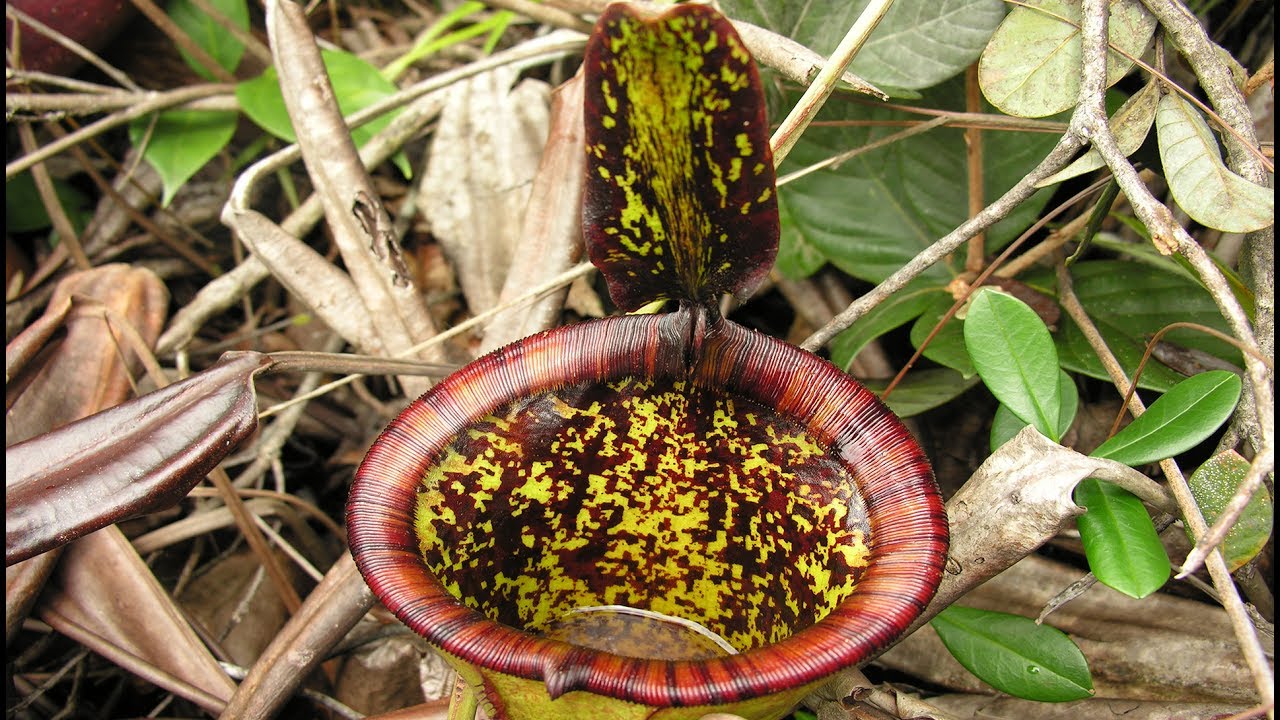
And it doesn’t just eat bugs.
Scientists studying the plant have found drowned shrews and even small RATS in its digestive fluid.
Let me repeat that: There is a plant, on Earth, right now, that eats rodents.
This is the “seed of truth” we were looking for. This is the real-life inspiration. It’s not a leap to see how a story of a rat-eating plant, passed from one person to another, could eventually become a man-eating one.
Could a Man-Eating Plant Ever Exist?
This is the final question. We know they don’t now. But could they?
The laws of biology say no. And the reasons are simple.
- Metabolism: Plants are slow. Their whole system is based on the slow, passive energy of sunlight. Digesting a fly takes a Venus flytrap days. Digesting a 150-pound human would be so slow, the body would rot and turn toxic long before the plant got any nutrients. It’s just not efficient.
- Energy Cost: To trap a human, a plant would need to move fast. That requires muscles. Muscles require a massive amount of energy. A plant would have to spend a year’s worth of solar energy for one chance at catching a person. It’s a terrible evolutionary bet. The calories gained would never be worth the calories spent.
A plant that evolved the size, speed, muscles, nerves, and digestive system to hunt humans wouldn’t be a plant. It would be an animal.
The Green Legends We Create
The man-eating plant is a monster of the human mind. But it’s a powerful one.
It’s a tangled legend, born from the fear of the unknown, fed by sensationalist hoaxes, and rooted in the tiny, terrifying truth of real-world carnivores.
We love the story because it flips our world upside down. But the truth is, you’re safe in the jungle. At least, from the trees.
The reality of botany – from the heart-stopping poison of the Upas Tree to the rodent-devouring Nepenthes attenboroughii – is already so much stranger and more fascinating than any myth we could invent.
What’s your favorite deadly plant story? Did a local legend about a “killer” patch of ivy or a sinister-looking moss scare you as a kid?
Drop your own “deadly green legends” in the comments below!

