

If you’ve been scrolling through #GhostTok lately, you’ve probably seen the videos: a shaky camera panning over an antique mirror, a girl checking her ears in a panic, and the caption, “Chloe took it.”
The Myrtles Plantation in St. Francisville, Louisiana, has long been crowned “America’s Most Haunted Home,” but a new wave of digital detectives is asking a different question: Is any of this actually real?
For decades, the story of Chloe a vengeful enslaved woman who poisoned her master’s family has drawn thousands of thrill-seekers. But if you dig into the archives (and look past the smudge marks on the mirror), the cracks in the story start to show.
So, grab your EMF readers and hold onto your earrings. We’re going to peel back the layers of the Myrtles Plantation legend, analyze that famous ghost photo, and reveal the historical truth that might be scarier than the fiction.
The Legend of Chloe: Fact vs Fiction
The story goes like this: In the early 1800s, a house slave named Chloe was caught eavesdropping on her master, Clark Woodruff. To punish her, Woodruff cut off her ear. Ashamed, Chloe wore a green turban to hide the scar. In a twisted attempt to win back the family’s favor, she baked a birthday cake laced with poisonous oleander leaves not to kill them, but to make them sick so she could nurse them back to health.
The plan backfired. Woodruff’s wife, Sara, and her two daughters ate the cake and died in agony. Chloe was then dragged out by her fellow enslaved workers and hanged from a nearby oak tree to avoid punishment from the master.
It’s a chilling tale. It’s dramatic. It’s also almost entirely made up.

The Historical Reality Check
When you leave the ghost tour and hit the library, the “Chloe” narrative falls apart faster than a cheap Halloween costume.
- No Record of Chloe: Historical archives for the plantation show no record of an enslaved woman named Chloe.
- The Real Cause of Death: Sara Woodruff and her children didn’t die from a poisoned cake. They died of Yellow Fever during the outbreaks of 1823 and 1824.
- The Timeline Doesn’t Add Up: The family members didn’t die all at once over a birthday dinner. Sara died in July 1823. Her daughter Cornelia died in July 1824, and her son James died in September 1824.
So, where did the story come from?
Most paranormal historians point to Marjorie Munson, who bought the plantation in the 1950s. Locals had long whispered about a “ghost in a green bonnet,” and over time, this vague figure evolved into the specific, tragic character of Chloe to sell tickets and spice up the property’s history.
“History is not in total agreement with this salacious tale… Burial records indicate that the cause of these premature deaths wasn’t poison but rather yellow fever.”
I Analyzed the Myrtles Plantation Ghost Photos (So You Don’t Have To)
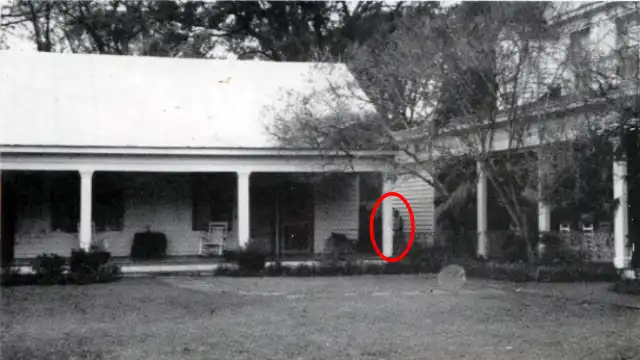
If the history is fake, what about the photos? The Myrtles is famous for two specific images that circulate endlessly on Reddit and Pinterest. Let’s break them down.
1. The “Breezeway” Ghost
You know the one. A grainy black-and-white shot showing a shadowy figure standing between two buildings. It looks remarkably like a woman in a long dress.
- The Skeptic’s View: Look closer at the “skirt.” It doesn’t hang like fabric; it has a rigid, conical shape.
- The Explanation: Analysis suggests this is a classic case of Pareidolia (our brain’s tendency to see patterns). The “ghost” is likely a distortion caused by a lamp reflection or a physical object (like a stand-up heater or plant) that was blurred during a long exposure or low-quality scan. When researchers tried to recreate it, they found that a person standing in that spot blocked the light differently than the translucent “spirit” in the photo.
2. The Haunted Mirror
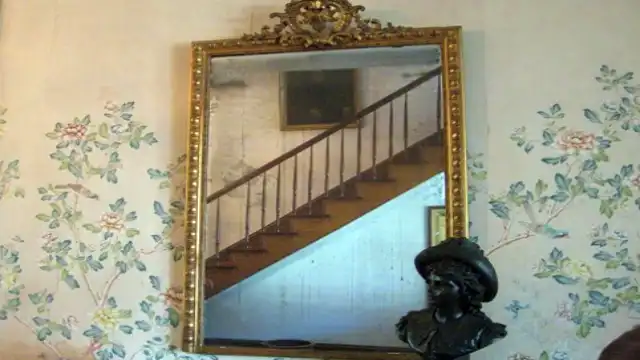
This is the big one. The mirror in the hallway is said to hold the trapped spirits of Sara and her children. Visitors claim to see handprints, faces, and “drip marks” that refuse to be cleaned.
- The Science of “Haunted” Glass: Mirrors, especially antique ones, are silvered on the back. Over centuries, that silvering oxidizes and degrades, creating black spots, swirls, and “smudges” that exist behind the glass, not on the surface. No amount of Windex will remove them because the damage is internal.
- The “Faces”: When you take a flash photo of a degradation spot, the light bounces off the uneven silvering. Your brain, desperate to make sense of the chaos, turns a random splotch of oxidation into a “screaming face” or a “soldier.”
The “Stolen Earring” Phenomenon: A Modern Myth?
This is where things get weirdly specific. A current trend on TikTok involves visitors specifically women claiming they lost a single earring while touring the home.
The legend says Chloe is jealous of pretty women and takes “shiny things” to punish them.

Is it paranormal, or is it physics?
Think about it. You are walking through a humid, Southern house. You are sweating. You are constantly turning your head to look at paintings, mirrors, and “orbs.” You are taking headphones on and off to listen to the audio tour.
- The Verdict: Loose backings + humidity + physical activity = lost earrings.
It’s a brilliant example of confirmation bias. If you lose an earring at Walmart, you’re annoyed. If you lose one at the Myrtles, it’s Chloe.
Why We Still Believe (Even When We Know the Truth)
If we know the cake wasn’t poisoned and the mirror is just old, why do thousands of people still visit? Why does the “Chloe” search term get thousands of hits a month?
Because we want the mystery. The truth that a mother and her children died slowly of mosquito-borne illness is tragic, but it’s just sad. A story about revenge, poison, and trapped souls? That’s entertainment.
The Myrtles Plantation is a masterclass in storytelling. It blends a real, painful history of slavery and disease with the thrill of a campfire ghost story.
The Final Verdict
Is the Myrtles Plantation haunted? Maybe. The energy of the place is undeniably heavy, and the history of the enslaved people who lived and died there is real and harrowing.
But is the “Legend of Chloe” a factual account? Absolutely not.
It is a 1950s marketing invention that took on a life of its own, fueled by blurry Polaroids and our collective desire to believe in something beyond the grave.
Frequently Asked Questions
We know you still have questions, specifically the ones you’re Googling at 2 A.M. Here are the honest answers to the most common mysteries surrounding the Myrtles Plantation, backed by historical records and science.

1. Was Chloe a real person at the Myrtles Plantation?
No, there is no historical record of an enslaved woman named Chloe.
Researchers have combed through property records, wills, and census data from the 1800s. While the Woodruffs did enslave people, the name “Chloe” never appears. The character was likely an invention of Marjorie Munson in the 1950s or a composite of local folklore created to romanticize the plantation’s history for tourists.
2. Did the Woodruff family really die from a poisoned cake?
False. The “Oleander Cake” story is a myth.
Official death records confirm that Sara Woodruff and her two children, Cornelia and James, died during the Yellow Fever epidemics of 1823 and 1824. They did not die simultaneously over a birthday dinner; their deaths were spread out over roughly a year, which rules out acute poisoning.
3. Is the Myrtles Plantation mirror photo real?
The photo is real, but the “ghost” probably isn’t.
The famous image showing a “face” or “figures” in the hallway mirror is widely considered to be a result of silvering oxidation. Antique mirrors were backed with silver, which degrades over time, creating black spots, swirls, and “drip” marks behind the glass. Our brains use pareidolia to interpret these random decay patterns as human faces.
4. Why do people lose earrings at the Myrtles Plantation?
While the legend claims Chloe steals earrings (specifically one from a pair) to cope with her own mutilation, the reality is likely environmental.
The combination of high Louisiana humidity (which makes skin slippery) and the physical activity of touring the grounds often causes loose earring backs to slip off. It is a psychological phenomenon: you only notice the lost earring because you’ve been told the story beforehand.
5. Can you actually stay at the Myrtles Plantation?
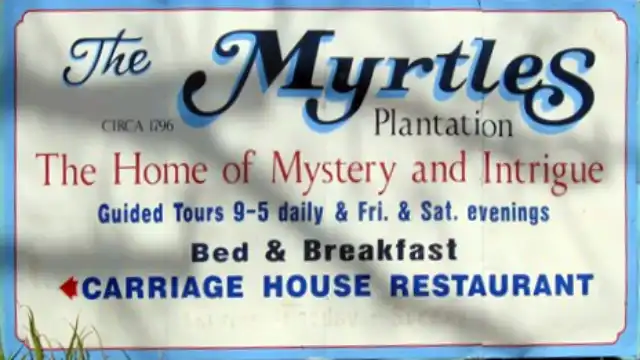
Yes. The Myrtles Plantation operates as a Bed & Breakfast.
Guests can book rooms in the main house (including the “haunted” bedrooms) or the garden cottages. While the “Chloe” story is historically debunked, many guests still report hearing footsteps, seeing doorknobs turn, or feeling cold spots, suggesting that while the names in the stories might be wrong, the property’s atmospheric creepiness is very real.
Have you ever spotted a “glitch” in a ghost photo? Or did you lose an earring in St. Francisville? Drop a comment below—I want to hear your theories!
Sources help,
- https://en.wikipedia.org/wiki/Legends_of_Myrtles_Plantation
- https://www.reddit.com/r/Ghosts/comments/141yrpv/myrtles_plantation_st_francisville_la/

