

Have you ever walked into work or school on March 21 and noticed everyone wearing wildly mismatched, brightly colored socks? Maybe you saw neon polka dots clashing with zigzag stripes. Naturally, you probably wondered what was going on.
Well, it isn’t a fashion mistake. Actually, it is a powerful global statement. Every year on March 21, millions of people intentionally wear crazy socks to celebrate World Down Syndrome Day (WDSD).
But why socks? And why that specific date? Honestly, the story behind this tradition is both scientifically clever and deeply heartwarming. We are going to explore the unique origins of this day. Furthermore, we will dive into the official 2026 global theme. Ultimately, you will discover exactly how you can get involved without spending a fortune. Grab your favorite wacky socks, and let’s get down to it.
What Exactly is World Down Syndrome Day (WDSD)?
Before we talk about fashion choices, let’s look at the calendar. World Down Syndrome Day always falls on March 21st. Unquestionably, this date was not chosen at random.
In the medical world, Down syndrome is most commonly known as Trisomy 21. Typically, a human is born with 46 chromosomes, which are neatly arranged in 23 pairs. However, a person with Down syndrome has an extra partial or whole copy of the 21st chromosome. So, instead of two copies, they have three.
Consequently, the calendar date translates beautifully to 3/21. Three copies of the 21st chromosome. Brilliant, right?
The main goal of this holiday is massive. It exists to advocate for the rights, true inclusion, and overall well being of people with Down syndrome. Historically, people with this condition have faced intense discrimination. Often, they are denied quality education, blocked from healthcare, or shut out of the workforce. Therefore, having a dedicated day to shout about their worth is absolutely vital.
The History: From Grassroots to the United Nations
This celebration did not happen overnight. Interestingly, the movement started as a grassroots effort. In 2006, the Down Syndrome Association in Singapore launched the very first WDSD website on behalf of Down Syndrome International (DSi).
Quickly, the idea caught fire. People loved it. Subsequently, advocates began pushing for global recognition. Their hard work paid off massively in December 2011. TheUnited Nations General Assembly officially declared March 21 as World Down Syndrome Day, effective starting in 2012.
Today, it is an absolute phenomenon. In fact, every single year on March 21, self advocates travel to the United Nations headquarters in New York and Geneva. There, they speak directly to world leaders about policy changes and human rights.
The Big Question: Why Do We Wear Mismatched Socks?
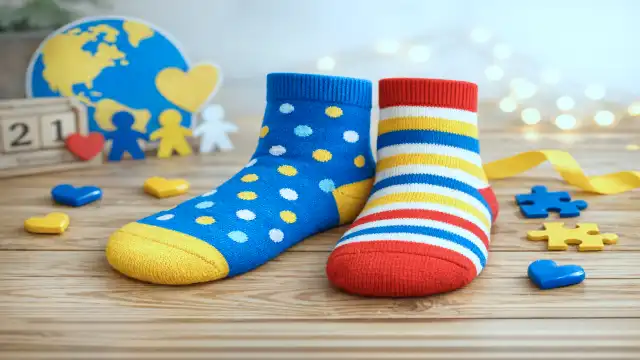
Alright, let’s get to the fun part. How did socks become the international symbol for genetic diversity?
It all comes down to microscopes and visual similarities. When scientists look at a karyotype which is basically a zoomed in picture of our chromosomes they notice something funny. The little chromosomes literally look like paired socks! Furthermore, the scientific staining process makes them look distinctly striped.
Since people with Down syndrome have an extra chromosome, advocates decided to use an extra, brightly colored sock to represent that uniqueness. Thus, the global “Lots of Socks” (sometimes called “Rock Your Socks”) campaign was born.
Here is why rocking mismatched socks works so perfectly:
- They spark instant conversations: If you walk into a grocery store wearing a bright pink striped sock on your left foot and a green taco print sock on your right, someone will ask about it. Suddenly, you have the perfect opening to talk about Down syndrome awareness.
- They celebrate beautiful differences: Mismatched socks boldly highlight that being different is a good thing. They show that uniqueness makes the world infinitely more colorful.
- They are completely accessible: Almost everyone has a drawer full of lonely, mismatched socks. Therefore, anyone can participate in this holiday without spending a single dime.
Siblings, parents, and friends of individuals with Down syndrome especially love this tradition. It is a visual, joyful way to say, “I see you, I support you, and I celebrate exactly who you are.”
The 2026 Global Theme: Together Against Loneliness
Every single year, Down Syndrome International picks a specific theme to focus the world’s attention. For 2026, the theme hits incredibly close to home: “Together Against Loneliness”.

Loneliness isn’t just a fleeting feeling of sadness. Scientifically speaking, it is a serious health crisis. Prolonged isolation can lead to intense anxiety, severe depression, and even rapid physical health decline. Unfortunately, loneliness disproportionately impacts people with intellectual disabilities.
In fact, recent studies show that nearly 39% of people with intellectual disabilities frequently feel lonely, compared to just 14% of the general population. That statistic is completely unacceptable.
Why Loneliness is a Human Rights Issue
Often, individuals with Down syndrome experience isolation because society excludes them from mainstream social circles, schools, and workplaces. Sometimes, they are physically present in a classroom or an office, but they aren’t truly included.
True inclusion means having genuine friendships. It means getting invited to the weekend birthday party. It means getting hired for the job and eating lunch with coworkers. Ultimately, it is the feeling of being deeply valued by the community.
Consequently, the 2026 campaign urges everyone governments, schools, employers, and everyday citizens to take actionable steps. We must build welcoming spaces where people with Down syndrome can forge deep, meaningful relationships.
Mind-Blowing Facts About Down Syndrome You Should Know
How much do you actually know about this condition? Let’s bust some common myths and look at the real facts.
- It is widely common: Down syndrome is the most common chromosomal condition on the planet. Around 1 in every 700 to 1,000 babies is born with it. Globally, there are over 6 million incredible individuals living with Down syndrome today!
- Life expectancy has skyrocketed: Back in the 1980s, the average life expectancy for someone with Down syndrome was a heartbreaking 25 years. Today? Thanks to huge advancements in medical care and early intervention, many people live healthy lives well into their 60s and beyond.
- It is a condition, not a disease: You cannot “catch” Down syndrome. Also, people do not “suffer” from it. They simply have a genetic variation that affects their learning style and physical characteristics.
- There are three different types: While Trisomy 21 accounts for 95% of cases, there are two other rare forms. Translocation occurs when an extra piece of chromosome 21 attaches to another chromosome. Mosaicism happens when only some cells have the extra chromosome, while others do not.
- Age plays a role, but isn’t the whole story: While the chance of having a baby with Down syndrome increases as a mother gets older, a massive 80% of children with the condition are actually born to women under 35. Why? Because younger women simply have more babies overall.
Actionable Ways to Celebrate on March 21
You don’t need a massive budget to make a difference on WDSD. Actually, the best celebrations are often the simplest. Here is how you can easily get involved and show your support.
1. Raid Your Sock Drawer
Obviously, this is step one. Grab your brightest, most ridiculous socks. Wear three socks if you want to be scientifically accurate! When people ask why you are dressed like that, tell them about Trisomy 21. Snap a quick picture of your feet and post it on social media. Be sure to use hashtags like #WorldDownSyndromeDay, #LotsOfSocks, and #TogetherAgainstLoneliness to join the global conversation.

2. Educate the Next Generation
Children are naturally curious. When they see someone who looks or talks differently, they might stare or ask blunt questions. Use WDSD as a powerful teaching moment. Sit down with your teens or kindergartener and explain what Down syndrome is in simple terms. Teach them that kids with Down syndrome love to play, learn, and make friends just like they do.
3. Take the 3-2-1 Donation Challenge
If you have a few extra dollars, consider putting your money where your heart is. Many local organizations host a “3-2-1 Challenge” on March 21. You can donate $3.21, $32.10, or $321 to a Down syndrome resource center. These local charities provide critical services like speech therapy, job placement, and social clubs. Even a tiny donation helps fund programs that directly combat the loneliness epidemic.
4. Support Inclusive Employers
Employment gives people purpose. Many coffee shops, bakeries, and retail stores actively hire adults with intellectual disabilities. Do a little research in your local area. Next, make a conscious point to spend your money at these inclusive businesses. Economic empowerment is undeniably one of the best ways to fight isolation and build confidence.
5. Be a Genuine Friend
This aligns perfectly with the 2026 theme. Look around your school, your workplace, or your neighborhood. Is there someone with a disability sitting by themselves? Go say hello. Start a conversation about their favorite movie or sports team. Real inclusion doesn’t happen in corporate boardrooms; it happens in cafeterias, breakrooms, and living rooms.
Let’s Make a Colorful Impact
Ultimately, World Down Syndrome Day is a brilliant celebration of humanity. It is a day to recognize that our genetic differences do not divide us. Rather, they make our global community richer, more vibrant, and infinitely more beautiful.
When you slip on those mismatched socks on March 21, you are doing way more than making a silly fashion statement. You are actively advocating for a world where everyone belongs. You are telling millions of people that they are seen, valued, and loved.
Are you ready to rock your socks?
Go dig through your laundry basket right now! Share this article with your friends, family, and coworkers so they can join the fun too. Let’s paint the town in neon polka dots and stripes. Happy World Down Syndrome Day!
Sources help:
- https://www.worlddownsyndromeday.org/
- https://dsachieves.org/2024/03/06/find-out-what-world-down-syndrome-day-is-and-how-to-help/
- https://www.un.org/en/observances/down-syndrome-day
- https://www.dsalowcountry.org/world-down-syndrome-day.html

