

Cube (1997) Explained: The Prime Number Puzzle & Ending Breakdown
Have you ever watched a movie that completely melted your brain? Cube (1997), directed by Vincenzo Natali, is undeniably one of those films. Specifically, it is a masterclass in claustrophobic sci-fi horror. A group of absolute strangers wakes up inside a giant, deadly mechanical puzzle. Consequently, they must use intense math to survive.
However, the math gets incredibly complicated. most of us probably zoned out during high school algebra. Therefore, trying to understand Cartesian coordinates and prime factorizations while people are getting sliced by lasers is a massive headache. do not worry, though. We will explore the traps, decode the numbers, and finally explain that deeply unsettling ending.
Key takeaways
- The Trap System: The deadly rooms are entirely determined by complex mathematical codes.
- The Big Twist: The initial prime number theory was completely wrong, leading to near fatal mistakes.
- The Actual Math: Traps are actually marked by powers of prime numbers, requiring savant level calculation.
- The Real Enemy: Paranoia and human nature ultimately kill more characters than the actual maze.
- The Survivor: Only Kazan, the innocent savant, escapes because he lacks the toxic flaws of the others.
Plot summary
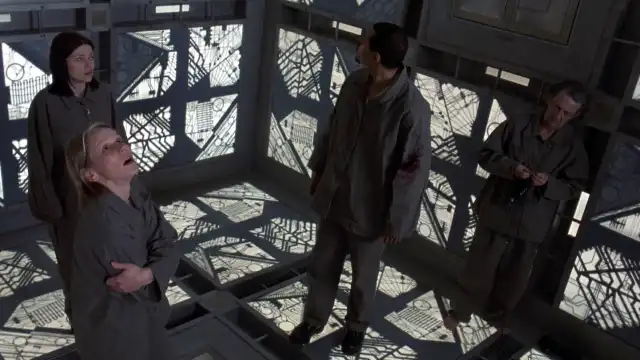
The movie opens with a man named Alderson waking up in a strange, brightly lit, cube shaped room. There is a heavy metal hatch on each of the six walls, including the floor and ceiling. He opens a hatch, climbs into the next identical room, and is instantly sliced to pieces by a wire trap.
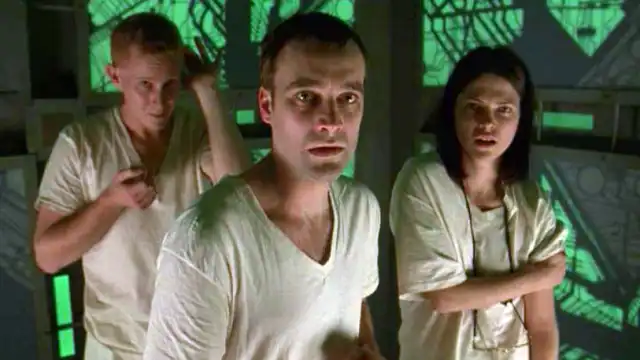
Next, we meet our main cast. They have all mysteriously woken up in this bizarre maze. The group includes Quentin (a tough police officer), Leaven (a young math student), Holloway (a paranoid doctor), Worth (a cynical architect), Rennes (a famous prison escape artist), and eventually Kazan (an autistic savant).
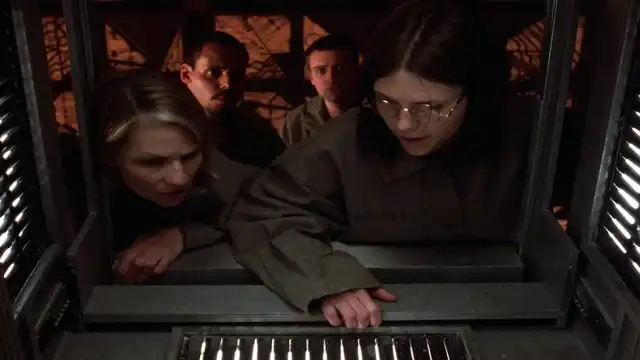
Initially, they try to throw their boots into rooms to trigger the traps. Unfortunately, Rennes gets killed by an acid trap that completely ignores the boot. Consequently, the remaining survivors realize they need a much smarter strategy. Suddenly, Leaven notices that the crawlspaces between the rooms have metal plates engraved with numbers. Ultimately, these numbers are the absolute key to their survival.
What do the numbers mean?
So, what exactly do those random nine digit numbers mean? When Leaven first looks at the plates, she sees three sets of three digit numbers (for example, 517 478 565). At first glance, it just looks like total gibberish.
However, Worth eventually confesses a massive secret. Surprisingly, he actually helped design the outer shell of the structure. He reveals that the entire facility is a massive cube containing tens of thousands of smaller cube rooms. Armed with this architectural knowledge, Leaven has a major epiphany.
Specifically, she realizes the numbers are encoded Cartesian coordinates. Essentially, they act exactly like a GPS system. If you add the digits of each three number set together, you get an X, Y, and Z coordinate. This tells the group exactly where they are sitting within the gigantic 17,576 room grid. Furthermore, the numbers also act as a roadmap, showing the group exactly where the edge of the maze is located.
Prime number theory (simple explanation)
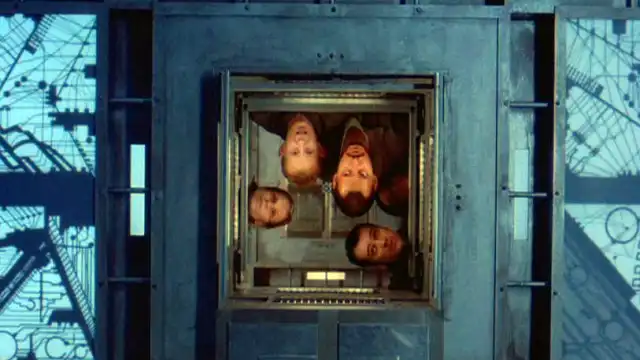
Now, knowing where you are is great. However, it does not keep you from getting incinerated. Luckily, Leaven notices another distinct pattern regarding the numbers. This is where the famous prime number theory comes into play.
Basically, Leaven hypothesizes that if any of the three numbers on a door is a prime number, that specific room contains a deadly trap. What is a prime number? In simple terms, it is a number that can only be divided by 1 and itself. For instance, 2, 3, 5, 7, and 11 are all prime.
Therefore, Leaven simply looks at the room numbers. If she spots a prime, they avoid that room. If none of the numbers are prime, they assume the room is completely safe to enter. Initially, this brilliant strategy works flawlessly. The group makes solid progress through the maze, completely avoiding the gruesome traps.
Why the Prime number theory was wrong (Twist explained)
Just when you think they have it all figured out, the movie pulls the rug right out from under you. Eventually, Quentin confidently jumps into a room that Leaven declared safe. Suddenly, a razor wire trap almost kills him.
Wait, what happened? None of the numbers on the door were prime! Consequently, Leaven realizes she made a horrifying mistake. The prime number theory was fundamentally wrong. It was just a dangerous coincidence that it worked for a while.
Here is the brilliant twist. The rooms are not trapped based on prime numbers. Instead, they are trapped based on powers of prime numbers.
What does that mean? A power of a prime is a prime number multiplied by itself. For example, 7 is a prime number. If you multiply 7 by 7, you get 49. Therefore, 49 is a power of a prime. To make matters worse, any number can be a power. So, 3 (a prime) to the power of 3 (3x3x3) is 27. Suddenly, the math becomes incredibly difficult. Leaven cannot possibly calculate the prime factorizations of huge three digit numbers in her head. They are utterly stuck.
How they escaped the cube
So, how do they get out if the math is impossible? Enter Kazan. Throughout the movie, Kazan is mostly quiet and heavily reliant on the others due to his autism. However, when Leaven starts panicking about factoring prime powers, Kazan randomly blurts out the answer.
Amazingly, Kazan is a mathematical savant. He can instantly calculate complex prime factorizations in his brain. Leaven reads the numbers off the wall, and Kazan quickly tells her how many prime factors they have. Therefore, they finally have a foolproof way to detect the traps.
Additionally, Leaven figures out one final, crucial puzzle piece. The rooms are physically moving. The numbers do not just indicate coordinates; they are permutations dictating exactly how the rooms shift around like a giant Rubik’s Cube. By tracking these movements, she realizes that the “bridge” room the very first room they met in will eventually cycle back to the outer shell. They just have to wait for it to align with the exit door.
Is the math accurate?
Naturally, you might be wondering if the math in this movie is actually real. Could someone genuinely use these equations? Surprisingly, yes!
The director, Vincenzo Natali, actually hired a real mathematician named David W. Pravica to be the film’s official math consultant. According to production notes, Pravica designed the entire coordinate and permutation system to be logically consistent. The math actually works out beautifully on paper.
However, there is a slight, funny flaw in the movie’s logic. Any first year college math student can easily memorize or quickly calculate the prime powers for three digit numbers. Specifically, there are only 998 possible numbers on those doors. A smart student like Leaven should have realistically figured it out without Kazan’s help. Nevertheless, Hollywood needs high stakes! Thus, the writers made it seem absolutely impossible for dramatic effect. Honestly, we can forgive this tiny scientific mistake because the movie is so incredibly entertaining.
Ending explained
Finally, we arrive at the most debated, heavily discussed part of the entire film. The brutal, unforgiving ending.
Eventually, the surviving trio Worth, Leaven, and Kazan make it back to the bridge room. The heavy door slowly opens, revealing a blindingly bright, white light. It is the exit! Freedom is literally right in front of them.
However, things take a very dark turn. Worth looks into the light and decides to sit down on the floor. He refuses to leave. When Leaven asks him why, he depressingly states that there is “nothing out there” but boundless human stupidity. Suddenly, a blood soaked Quentin violently ambushes them. He had secretly survived a previous fall and stalked them through the maze.
Final confrontation
Quentin savagely stabs Leaven to death with a broken door handle. Next, he brutally stabs Worth. Quentin then tries to scramble out into the white light to escape. Unfortunately for him, a dying Worth grabs Quentin’s leg, pinning him in the doorway. As the massive cube shifts again, Quentin is horrifyingly crushed to death between the moving walls. Worth slowly bleeds out next to Leaven.
Ultimately, Kazan is the only person who walks out into the white light. The movie ends abruptly, leaving us with a million questions.
What does the ending actually mean?
Why did only Kazan survive? To answer this, we have to look at what the giant structure truly represents. Worth tells the group earlier that the maze has no grand purpose. It is just a massive, headless bureaucracy. It is a machine built by humanity that got entirely out of control.
Therefore, the characters’ deaths are deeply symbolic. Quentin dies because his aggressive, violent desire for control entirely consumes him. Holloway dies because her paranoia completely blinds her. Worth dies because of his extreme apathy; he gave up on life long before he ever entered the maze. Leaven dies because she relies purely on cold, hard logic, ignoring basic human intuition.
Consequently, Kazan is the only one who can escape. He possesses zero malice, zero ego, and zero cynicism. He doesn’t try to outsmart the system aggressively, nor does he despair over its meaninglessness. He simply exists. Ultimately, the film argues that the toxic flaws of human nature are far more dangerous than any mechanical trap. The maze didn’t kill them; their own humanity did.
Legacy of the cube
Almost three decades later, this sci-fi thriller still holds up perfectly. It is a terrifying, mind-bending mirror held up to society. Are we all just rats in a giant, pointless maze? Do our societal systems trap us just like these horrific, shifting rooms? It is undeniably a lot to think about.
So, what do you think? Would you have figured out the prime numbers, or would you have been the first one sliced by a wire trap? Drop a comment below with your honest thoughts on the ending! Also, if you loved this breakdown, please share this article with your favorite movie buddy so you can debate the math together!

