

What Is Nakba Day? The Palestinian History of 1948 Explained
You have probably seen the news headlines. You might have noticed massive protests happening in major cities around the world every May. But what exactly is Nakba Day?
History can feel like a tangled web of dates, treaties, and political talking points. This is especially true when we discuss the Middle East. Let’s untangle the knot together. We are going to look past the political noise and break down the raw, human history of 1948.
Quick read
- The Meaning: Nakba is an Arabic word translating directly to “catastrophe.”
- The Event: It marks the forced displacement of over 750,000 Palestinians during the creation of Israel in 1948.
- The Date: Palestinians and allies observe Nakba Day annually on May 15.
- The Impact: This historical trauma created a massive refugee crisis that actively shapes global politics today.
What exactly does “Nakba” mean?
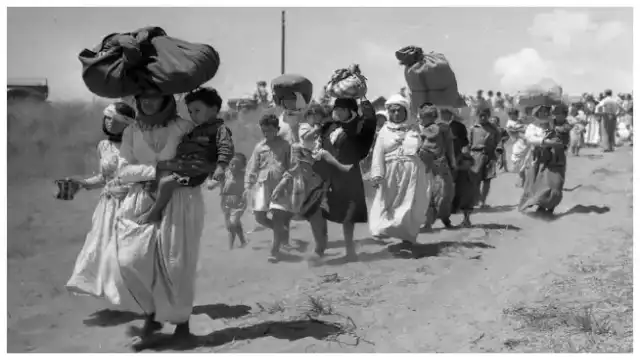
Let’s keep it simple. People gather every year on May 15 to remember a seismic shift that altered the Middle East forever. For Palestinians, the word Nakba captures the catastrophic loss of their homeland, personal property, and entire society.
This is not just a symbolic anniversary found in dusty textbooks. Over 750,000 Palestinians were expelled or forced to flee their homes during the 1948 Arab-Israeli War. To put that massive number in perspective, that was roughly half of the native Arab population living in historic Palestine at the time.
Entire neighborhoods vanished overnight. Hundreds of villages were completely emptied. Families locked their front doors, pocketed their brass house keys, and expected to return once the fighting stopped. Most never saw those homes again.
What sparked the 1948 crisis?
How did things escalate to such a breaking point? We have to rewind a few decades before 1948 to understand the buildup.
At the dawn of the 20th century, Palestine was a diverse region. Muslims, Christians, and a smaller population of Jews lived largely as neighbors. The local culture thrived on agriculture, deep-rooted traditions, and regional trade.
Things changed dramatically after World War I. Britain took control of the territory, kicking off an era known as the British Mandate. In 1917, the British government issued the Balfour Declaration. This document boldly promised to establish a “national home for the Jewish people” in Palestine. The declaration completely disregarded the political rights of the existing Arab majority.
During the following decades, the Zionist movement gained massive traction in Europe. Following the unspeakable horrors of the Holocaust, Jewish immigration to Palestine surged. Arab residents felt their homeland slipping through their fingers. Tensions boiled over. Riots and localized violence became painfully common.

The UN Partition Plan
By 1947, the British realized they could not maintain peace. They handed the mess over to the newly formed United Nations. In November of that year, the UN drafted Resolution 181. They decided to carve the land into two distinct pieces.
- The Jewish State: Allocated roughly 55% of the land.
- The Arab State: Allocated roughly 45% of the land.
- Jerusalem: Designated as an internationally administered zone.
Here is the massive catch. At that exact moment, Arabs made up nearly two-thirds of the total population and owned about 90% of the private land.
Zionist leaders accepted the UN proposal. Palestinian Arabs and surrounding Arab nations rejected it flat out. Why should they give up more than half of their country to accommodate European immigrants? The rejection was absolute. Civil war immediately swept through the streets of Jerusalem, Haifa, and Jaffa.
1948: The Year the Map Was Erased
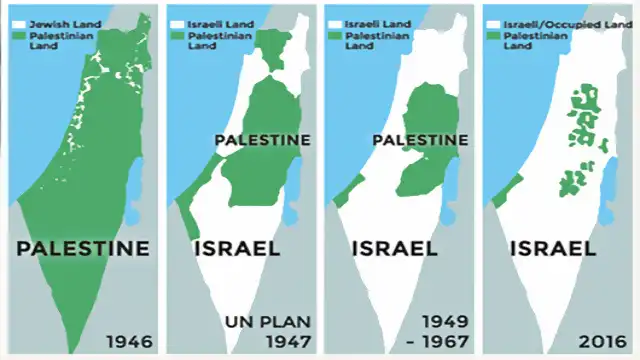
Things officially shattered in May 1948. Britain packed up its military and ended the mandate. On May 14, Zionist leaders officially declared the independence of the State of Israel.
Neighboring Arab armies immediately entered the territory. The ensuing conflict became known as the 1948 Arab-Israeli War. War is always brutal. This specific conflict, however, fundamentally fractured a centuries-old society.
Zionist paramilitary groups — and later the newly formed Israeli Defense Forces (IDF) — launched massive military offensives. According to historians and United Nations records, over 500 Palestinian villages and towns were systematically depopulated.
Let’s look at the hard statistics from this era:
- 750,000+ Palestinians became stateless refugees.
- 15,000 Palestinians lost their lives between 1947 and 1949.
- 78% of historic Palestine came under Israeli control by the end of the conflict.
The Horror of Deir Yassin
Massacres played a grim role in fueling the mass exodus. The most infamous tragedy occurred at Deir Yassin in April 1948. Zionist militias attacked the peaceful village near Jerusalem. They killed more than 100 Palestinian civilians, including women and children.
Word of the slaughter spread rapidly across the region. Panic set in. Fearing they would be targeted next, countless families grabbed whatever they could carry and ran toward the borders.
Bulldozing History
The physical landscape of Palestine was altered permanently. After capturing Arab villages, military bulldozers often flattened the stone houses. Authorities planted non-native pine forests over the ruins to hide the remnants of Arab life. Ancient village names were wiped off official maps and replaced with modern Hebrew names. A massive portion of Palestinian society was quite literally erased from the earth.
The Aftermath and the “Right of Return”
The guns eventually went quiet in 1949. Armistice agreements were signed, drawing a boundary line known as the Green Line. The remaining 22% of the territory was split into the West Bank and the Gaza Strip.
Where did the displaced families go? They crossed into Lebanon, Syria, Jordan, and Egypt. They set up temporary canvas tents. They waited for the global community to help them go home.
In December 1948, the UN General Assembly passed Resolution 194. This document plainly stated that refugees wishing to return to their homes and live at peace with their neighbors should be permitted to do so. Israel refused to allow the mass return of Palestinians. The new government argued that an influx of Arabs would threaten the demographic survival of the Jewish state. Properties left behind were absorbed by the state and given to new immigrants.
Those temporary refugee tents eventually turned into concrete blocks. Today, the United Nations Relief and Works Agency (UNRWA) reports there are over 6 million registered Palestinian refugees. They remain scattered across the Middle East. Many still live in overcrowded, severely underfunded camps.
Keys to Home

If you attend a Nakba Day rally today, you will notice a recurring visual. The key.
When families fled the violence in 1948, they locked their heavy wooden doors. They took their large iron house keys with them. Those keys became sacred family heirlooms. Today, grandmothers pass those rusted keys down to their grandchildren.
The key is not just a piece of metal. It visually represents the “Right of Return.” It stands as a powerful reminder that the legal and moral demand to reclaim stolen property has never been forgotten.
Ongoing Nakba: Why 1948 Never Really Ended
Listen closely to any Palestinian activist, and you will notice a specific phrasing. They rarely talk about the Nakba in the past tense. They call it the Ongoing Nakba.
Displacement did not magically stop when the 1948 war ended. The mechanics of dispossession simply evolved. The core issues of land theft and statelessness remain active today.
Life Under Occupation
In the West Bank, Palestinians live under strict Israeli military occupation. Families regularly face forced evictions. Authorities bulldoze Palestinian homes to make way for illegal settlements. Settler violence frequently forces native farming communities to abandon their ancestral olive groves.
In the Gaza Strip, the situation is drastically worse. Described by human rights groups as an open-air prison, Gaza has endured a crippling blockade for over a decade.
Modern Echoes of Trauma
The recent devastating conflicts in Gaza bring the trauma of 1948 rushing back to the surface. During massive aerial bombardments, over a million Palestinians have been internally displaced. Entire generations are once again fleeing their neighborhoods with nothing but plastic bags. For the elders who actually survived 1948, watching their grandchildren sleep in crowded UN school courtyards feels like a terrifying repetition of history.
How the World Views Nakba Day Now
Global perspectives are finally catching up to the historical reality. For decades, the Palestinian narrative was pushed to the margins of Western media. That is no longer the case.
In a landmark diplomatic move, the United Nations officially commemorated Nakba Day for the very first time in May 2023. The global body held high-level events at its headquarters in New York to acknowledge the 75th anniversary. It signaled that the international community could no longer ignore the foundational trauma of the Palestinian people.
Social media has also democratized the flow of information. You don’t have to rely on filtered television news broadcasts anymore. You can open Instagram and hear directly from a student in Ramallah. This raw, unfiltered connection has mobilized millions of young people worldwide to learn the true history of the region.
History Demands Empathy
To truly understand Nakba Day is to acknowledge a deep, unhealed wound. The events of 1948 are not just historical footnotes. They are the direct root cause of the modern Middle East conflict.
You cannot build lasting peace on top of unacknowledged pain. The 750,000 people who lost their homes were real. Their vibrant culture was real. Their catastrophic loss matters. Until the world fully addresses the rights, dignity, and historical reality of the Palestinian people, the echoes of 1948 will continue to reverberate. History isn’t just about looking backward. It is about understanding exactly how we got here today.
What are your thoughts on how history shapes our modern world? Do you think global education around the events of 1948 is improving? Leave a comment below, share this article with a friend to spark a meaningful conversation, and continue educating yourself on the stories that shape our shared humanity!

