

What Was the Tunguska Event? The 1908 Siberian Explosion Explained
Imagine waking up, pouring your morning coffee, and stepping outside to feel the sun on your face. Suddenly, the sky splits wide open. A blinding flash radiates heat so intense it feels like your shirt is catching fire. A split second later, an invisible shockwave violently throws you off your porch. You survive the tumble. But when you look toward the horizon, the endless forest you’ve known your whole life is just gone. Flattened.
Whether you are a hardcore science enthusiast, an amateur historian, or just someone who occasionally looks up at the night sky with a healthy dose of paranoia, this cosmic cold case will grab your attention.
On June 30, 1908, an unimaginable force unleashed hell upon a remote area of central Siberia. For decades, wild theories circulated about the blast. People blamed everything from rogue black holes and alien spaceships to secret Nikola Tesla experiments gone wrong. The reality? Nature threw a rock at us. A very big, incredibly fast rock.
The terrifying mechanics of the Tunguska event, explore the century-old mystery it left behind, and uncover why this historical disaster still keeps modern astronomers awake at night.
Quick read
- The Blast: In 1908, a massive explosion over the Siberian taiga unleashed energy equivalent to hundreds of Hiroshima atomic bombs.
- The Damage: The shockwave leveled 80 million trees across 830 square miles, yet miraculously caused almost zero human casualties due to the remote location.
- The Mystery: First investigated in 1927, researchers found absolutely no impact crater, leading to decades of scientific debate.
- The Cause: Modern science confirms the culprit was a stony asteroid that triggered a “meteor airburst,” disintegrating completely miles above the ground.
- The Legacy: This catastrophe directly inspired modern planetary defense programs, including NASA’s recent asteroid-deflecting DART mission.
Eyewitness Experience
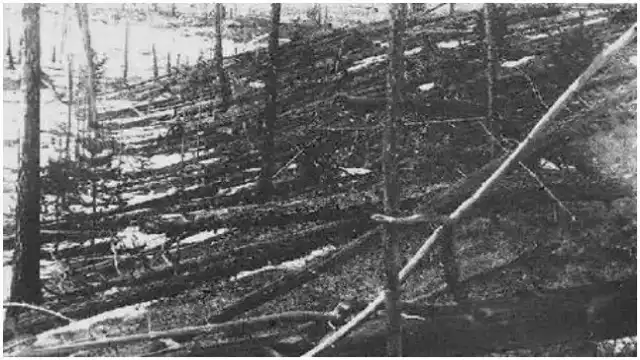
To understand the sheer scale of the Tunguska event 1908, you have to hear from the people who barely survived it.
The epicenter was located near the Podkamennaya Tunguska River, a sprawling, sparsely populated region of forests and peat bogs. A local farmer named S.B. Semenov was sitting on the steps of the Vanavara trading post, roughly 40 miles away from the blast zone. According to historical accounts, he watched the sky rip in two. Fire suddenly covered the northern horizon. The heat washed over him like an open oven door, followed by an explosive boom that hurled him several yards into the dirt.
Semenov was lucky. He lived.
Closer to the blast, local Evenki reindeer herders experienced an apocalypse. Entire herds of reindeer vanished, incinerated by the blistering thermal flash. Tents were blown into the sky. Eyewitnesses reported deafness from the thunderous roar that echoed across the steppes.
The Smithsonian outlines the mind-bending energy released that morning. Scientists estimate the blast yielded anywhere from 3 to 15 megatons of TNT. That packs roughly 1,000 times the destructive force of the atomic bomb dropped on Hiroshima. Had this space rock arrived just four hours and forty-seven minutes later, the Earth’s rotation would have placed Saint Petersburg right in the crosshairs. It would have wiped the Russian capital off the map entirely.
The Midnight Sun
The chaos did not stop at the Russian border. A blast this massive rings the entire planet like a bell.
Barometers in England recorded massive spikes in atmospheric pressure. Seismographs tracking earthquakes jumped off their charts across Europe and Asia. Then came the lights.
For several days following the explosion, the night skies across Europe and Asia practically glowed. In London, the midnight sky was so bright that people could comfortably read newspapers outdoors. Golfers in Scotland played rounds at two in the morning. Why did the sky turn into a giant nightlight? The blast kicked millions of tons of microscopic ice and dust into the mesosphere. Caught in the highest levels of the atmosphere, these tiny particles caught and reflected the sun’s rays long after it had set below the horizon.
Leonid Kulik’s Obsession

You would think an explosion that turned night into day would trigger an immediate scientific investigation. It did not.
Between the brutal Siberian winters, the outbreak of World War I, and the bloody Russian Revolution, scientists had zero resources to go hunting for space rocks. The mystery sat frozen in the permafrost for 19 long years.
Enter Leonid Kulik.
Kulik was a chief curator for the meteorite collection at the St. Petersburg museum. He became obsessed with figuring out what caused the Tunguska event. In 1927, he finally convinced the Soviet government to fund an expedition. He pitched it as a practical mission. He promised officials he would find a mountain of highly valuable “meteoric iron” waiting in a giant crater.
The journey was a nightmare. Kulik and his team battled disease, freezing temperatures, and swarms of mosquitoes. His local Evenki guides eventually refused to go any further. They believed the blast zone was cursed by Ogdy, the god of fire, and wanted no part of his wrath.
Kulik pushed on. When he finally breached the epicenter, his jaw dropped.
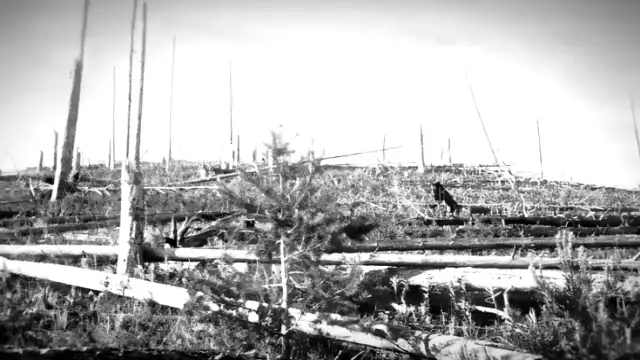
He expected a massive, gaping hole in the earth. He found zero craters. No iron. No giant rock. Instead, he saw 80 million trees knocked flat in a massive “butterfly” shape pointing away from a central hub. At the very center of the destruction, the trees were acting completely bizarre. They were not knocked over. They stood straight up, totally stripped of their branches and bark, resembling an eerie forest of dead telegraph poles.
Why was there no crater?
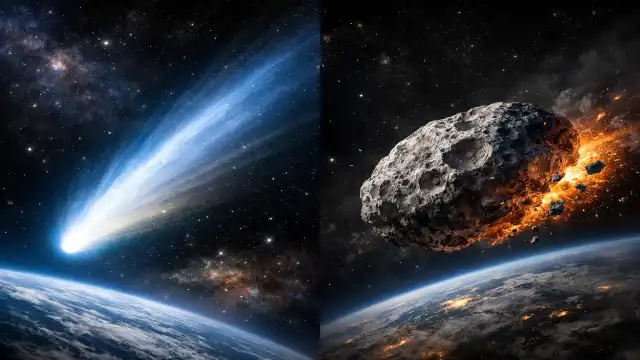
How do you unleash the power of a nuclear weapon without leaving a scratch on the ground? The answer lies in a terrifying atmospheric phenomenon known as a meteor airburst.
Think of a diver doing a belly flop into a swimming pool. From a high dive, the water surface tension hits the human body like a brick wall. The same basic physics apply to space rocks hitting our sky.
When the Tunguska asteroid plunged toward Earth, it was traveling at an estimated 33,500 miles per hour. At that insane velocity, the dense air of Earth’s lower atmosphere could not get out of the way fast enough. The air violently compressed directly in front of the rock. This rapid compression created severe friction, driving temperatures to tens of thousands of degrees.
The asteroid simply could not handle the pressure. The rock fractured, flattening out like a pancake against the invisible wall of air. Once it flattened, the air resistance spiked exponentially. In a fraction of a second, the asteroid dumped all its kinetic energy into the atmosphere. Boom.
The object detonated roughly 3 to 6 miles above the Siberian wilderness. The downward shockwave stripped the branches off the trees directly beneath the blast (creating the weird telegraph poles Kulik saw) while the lateral wave knocked over everything else for dozens of miles. The asteroid vaporized completely. No rock. No crater. Just a massive, invisible hammer smashing the taiga.
Was it a Comet or an Asteroid?
Even after Kulik discovered the butterfly pattern of dead trees, scientists argued bitterly for decades. The Tunguska mystery basically divided the scientific community into two camps: Team Comet and Team Asteroid.
Team Comet had a strong argument. Comets are essentially dirty snowballs made of ice and dust. If a comet hit the atmosphere, it would easily explode mid-air and completely melt, leaving absolutely zero rocky evidence behind. Proponents also pointed to the glowing night skies in Europe, arguing that a comet’s icy tail caused the reflective clouds.
Team Asteroid fired back. A fragile comet would likely burn up much higher in the atmosphere. To penetrate as deeply as the Tunguska object did, the rock needed to be dense. It needed to be stony.
Modern science eventually crowned a winner. According to NASA’s planetary defense researchers, the culprit was almost certainly a rocky asteroid measuring between 150 and 200 feet wide. Researchers revisiting the blast site in recent decades sifted through the peat bogs and tree resin at the epicenter. Under powerful microscopes, they found tiny, glassy spherules. These microscopic beads contained high concentrations of iridium, nickel, and iron — the exact chemical fingerprints of a stony meteorite.
Could another tunguska happen?
You might be thinking: Well, that was 1908. We have better technology now.
We do. But the universe does not care.
In February 2013, the residents of Chelyabinsk, Russia, got a terrifying reminder of our cosmic vulnerability. A 65-foot asteroid slipped past our early warning systems because it approached from the direction of the sun. It exploded 18 miles above the city. The resulting airburst shattered glass across thousands of buildings, injuring roughly 1,500 people.
The Chelyabinsk meteor was a firecracker compared to Tunguska. But it woke the world up.
Scientists realized that small-to-medium asteroids hit us far more frequently than previously thought. A direct hit over a major metropolitan area would be catastrophic. That is exactly why space agencies worldwide are actively preparing for the next big rock.
In 2022, NASA executed the DART (Double Asteroid Redirection Test) mission. They intentionally slammed a spacecraft into an asteroid millions of miles away just to see if they could change its orbit. It worked beautifully. We are no longer sitting ducks waiting for the sky to fall. We are actively learning how to push back. In honor of this ongoing vigilance, the United Nations even declared June 30 — the exact anniversary of the blast — as International Asteroid Day.
Final thoughts
The 1908 Tunguska explosion stands as the ultimate cautionary tale. It is a stark reminder that our planet is floating through a cosmic shooting gallery. We survived 1908 purely by geographical luck. The trees took the hit so humanity didn’t have to.
Today, supercomputers map out asteroid trajectories. Telescopes scan the dark pockets of our solar system. We have solved the mystery of the missing crater, but the real lesson of Tunguska is not about the past. It is about preparing for the future.
What do you think? If a Tunguska-sized asteroid was spotted heading toward Earth tomorrow, do you trust our current technology to knock it off course? Drop your thoughts in the comments below, and share this article with your favorite space geek to keep the conversation going!

