
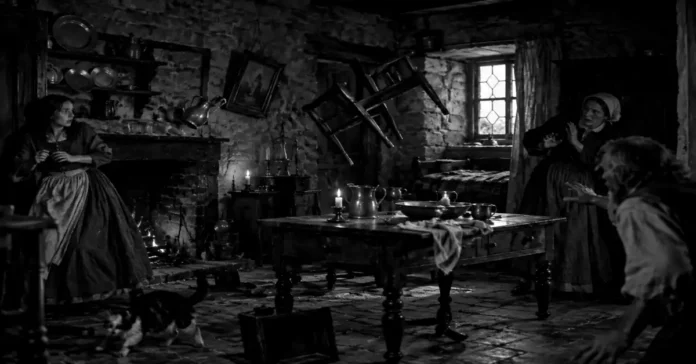
In February 1695, a humble tenant farm named Ring-Croft of Stocking in Rerrick, southwest Scotland, turned into ground zero for a prolonged supernatural siege. Stones rained from ceilings, furniture flew through rooms, and small fires kept erupting out of nowhere. The chaos made Andrew Mackie’s home the epicenter of one of the most meticulously documented poltergeist episodes in history.
What the eyewitnesses reported
Most ghost stories survive purely through loose bar chatter and centuries of fuzzy campfire retellings. The Mackie case is different because the local Presbyterian minister, the Reverend Alexander Telfair, immediately gathered written affidavits and published a blow-by-blow account later that year. Fourteen prominent citizens — including neighboring lairds, local tenants, and fellow ministers — signed their names as sworn witnesses to the mayhem.
The nuisance started small in February 1695. Andrew Mackie discovered that the bindings tethering his livestock in the byre were repeatedly undone and snapped overnight. Suspecting common mischief or unruly cattle, he secured them with tough woven withes, but those broke as well. The situation soon escalated: Mackie found a young cow tied up to the high rafters by a hair-tether so tight its feet barely brushed the floor.
By March, the household was trapped in outright pandemonium:
- The Stoning of Ring-Croft: Stones began pelting down indoors without warning. Observers noted that while the missiles flew fast and frequent, especially during church prayers, they landed with curiously soft impacts — as though stripped of half their natural weight.
- Physical Assaults and Apparitions: Telfair himself was beaten across the shoulders and ribs with a sturdy wooden staff while visiting to pray. Witnesses heard the dull thwack of each strike, yet no physical hand held the club. While leaning against a bedpost in prayer, Telfair also claimed he felt something grasp his sleeve and briefly glimpsed a pale, disembodied arm vanishing into thin air.
- Spontaneous Fire: Piles of dry peat and roofing thatch repeatedly burst into flame on the floor. On one grueling Sunday, the family spent from dawn until dusk dousing fresh fires that ignited faster than they could pour water.
- Voices and Threats: The unseen presence gradually found a voice. It hissed, groaned, barked odd taunts like “Bo, Bo” and “Kick, Cuck”, and finally vowed it would torment them until the first of May.
True to that spoken ultimatum, the entity made a dramatic exit on May 1, 1695. A thick, dark cloud reportedly gathered inside the barn, pelted mud into the eyes of onlookers, leveled stone gables, and vanished for good.
Sifting through the skepticism
How do we unpack an ordeal like this three centuries later? You cannot look at the Ringcroft events in isolation; you have to consider the intense religious climate of late-17th-century Scotland.
Telfair was open about his motive for publishing: he wanted to defeat the “spirit of atheism” sweeping through educated society. If you prove the devil walks the earth, you prove God exists. The kirk sessions held immense power, and the Scottish witch trials were still a grim reality. During the haunting, someone even found animal bones hidden under a threshold stone, triggering a ritual where former tenants had to touch them to prove they had not cursed the dwelling.
EXPLAINING RINGCROFT
| 17th-Century Presbyterian Perspective | Modern Critical Explanations |
|---|---|
| Literal demonic invasion | Adolescent pranks (Mackie children or farmhands) |
| Warning to the ungodly | Mass hysteria and darkness |
| Proof against “atheism” | Clerical confirmation bias |
| Witchcraft or hidden crime |
When you examine the physical patterns, the haunting looks like classic adolescent mischief. Most poltergeist narratives historically center around households with restless teenagers or children. Mackie’s young kids were present throughout the whole ordeal.
Could a bored kid throw stones across a dark, smoky room without getting caught? Absolutely. Peat smoke in a windowless croft makes seeing anything across the room a nightmare. If a child tosses a pebble from the shadows while five nervous adults are kneeling with their eyes shut tight in prayer, every clatter sounds like a demon.
What about the heavy stones crashing through the thatch or the battered walls? Once the community became convinced that Satan had targeted Ring-Croft, contagious panic did the rest. Every shifting roof beam or prank from local farmhands became proof of the supernatural. The gentle landing of the thrown stones reported by Telfair strongly suggests they were tossed underhand by someone close by, not hurled through the air by a spectral hurricane.
The stone walls of Ring-Croft of Stocking collapsed centuries ago, but the case remains a watershed moment in paranormal folklore. It bridges medieval superstition and modern case study. Rather than chalking the story up to second-hand folklore, Telfair left behind a signed, dated timeline that lets us dissect how a community under intense religious pressure reacted to unexplained domestic chaos.
Whether you view it as genuine poltergeist activity or a family prank that spiraled out of control into mass hysteria, the 1695 Rerrick haunting proved that few things spread faster than fear in an isolated Scottish glen.
For a closer look at the local geography and historical analysis of this Galloway case, listen to this Dark Histories Ringcroft of Stocking & The Mackie Poltergeist deep dive. This episode breaks down the original 1695 archival records and analyzes the psychological and historical factors at play during the haunting.

