

Bare Feet, No Worries: Why Kiwis Are Obsessed with Going Shoeless
If you’ve ever visited New Zealand, you’ve seen it.
You’re in a supermarket, grabbing a bottle of L&P. You look down. The person in line ahead of you, paying for their groceries? Barefoot.
You’re at a café, waiting for your flat white. The barista? Barefoot.
You’re walking down a main street in Auckland. The kids walking home from school? You guessed it. Barefoot.
For visitors, it’s a baffling, sometimes “repugnant” sight. For Kiwis, it’s just… normal. It’s a “sweet as” part of the national identity, as iconic as rugby, jandals (flip-flops), or a mince and cheese pie.
But why? What makes an entire nation so collectively averse to shoes?
It’s not just a simple quirk. It’s a deep-seated cultural habit woven from three distinct threads: a foundation of cultural respect, a history of no-nonsense practicality, and a unique, predator-free environment.
Let’s break it down.
It Starts with Respect: The Māori Foundation
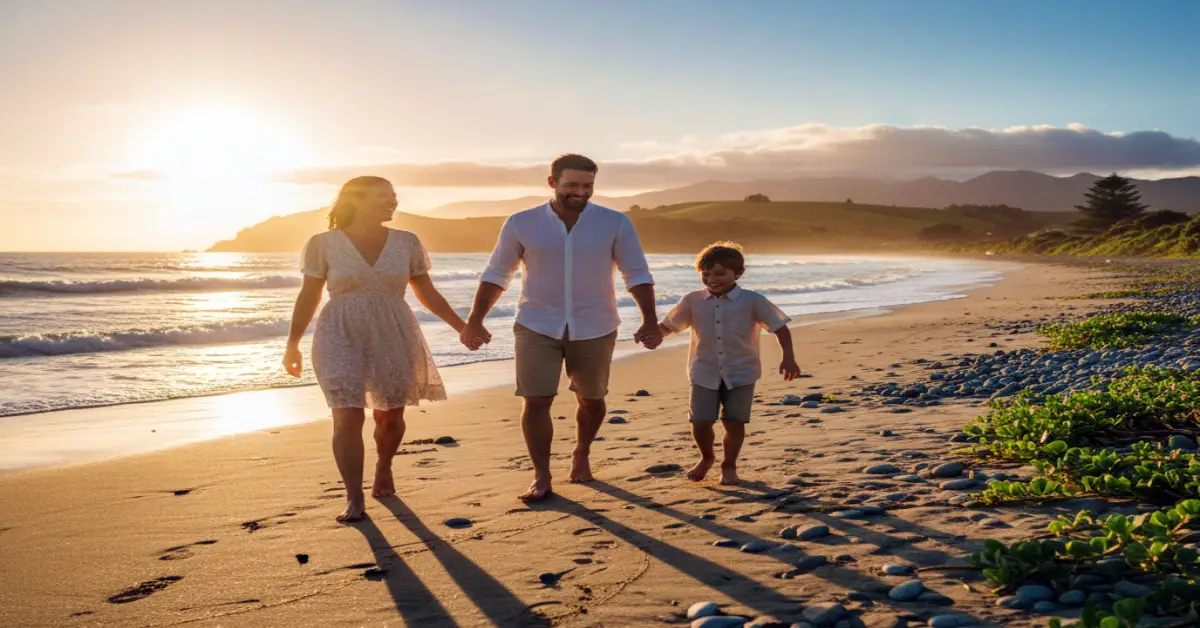
You can’t understand modern Aotearoa (the Māori name for New Zealand) without understanding its bicultural roots. The barefoot tradition isn’t just a Pākehā (New Zealanders of European descent) eccentricity; it has deep, respectful origins in Māori culture.
In Māori tikanga (customs), the wharenui (meeting house) on a marae (meeting ground) is a sacred, or tapu, space. To wear shoes inside is an act of deep disrespect, akin to wearing muddy boots in a cathedral. You are entering a space that connects the living with their ancestors, and you leave the dirt and grime of the outside world… outside.
This custom wasn’t just for the marae. It extended to the home. For generations, Kiwis of all backgrounds have been raised to “take your shoes off at the door.”
- It’s practical (it keeps the house clean).
- It’s respectful (it’s the polite thing to do).
This single habit—removing shoes the second you get home creates a different relationship with footwear. For Kiwis, shoes aren’t a permanent fixture; they’re an “as-needed” accessory. The “default” state, especially for kids, becomes barefoot.

The Great Kiwi Upbringing: “Toughen Up, Your Feet Are Fine”
Ask any Kiwi, and they’ll likely tell you they spent most of their primary school days without shoes.
It’s a rite of passage.
It’s a childhood emblem.
While many schools now have uniform rules, the “barefoot at school” tradition is still alive and well, especially in warmer months or in more rural areas. Kids play tag on grass fields, do sports on the asphalt, and walk home—all barefoot.
What does this do?
- It Normalizes It: When everyone is doing it, it’s not weird. It’s just what you do.
- It Builds “Thick Skin”: Literally. Kiwi kids develop tough, calloused “Hobbit feet” that can handle hot pavement, gravel driveways, and the occasional prickle.
This childhood conditioning means that as adults, the idea of “popping” to the dairy or the supermarket without shoes just doesn’t register as a big deal. It’s easier than finding your jandals.
“I remember the day like a small movie: I was six, and my mum had stopped at the little dairy on the corner for bread and milk. The sky was the clear, sharp blue of late summer and the air smelled faintly of cut grass and hot tar. I’d slipped my sandals off while waiting in the car because the straps had been rubbing my heels, and when Mum locked the car and went inside I padded after her barefoot.
The supermarket tiles were cool and a little sticky where someone had tracked melted ice cream. People glanced — a few half-smiles, one woman tutted — but mostly no one made a fuss. My feet felt every temperature change with exaggerated drama: the shade near the freezers sent surprising, shivery cold up through my toes; the fresh produce aisle smelled of crushed basil and warm tomatoes and the floor there had a faint dampness that made my soles glisten.
On the walk home I chose the long way across the park. The grass was velvet and springy, tickling between my toes, and at the park path the asphalt felt like a warm, sun-baked loaf underfoot – rough and grainy but oddly comforting. I remember the small thrill of speed when I ran: pebbles pressing tiny, brief messages into the pads of my feet, the cool blades of grass slapping my ankles. Mum pretended not to notice my bare feet until a neighbour called out, laughing, “You’ve got no shoes on!” She just shrugged and said, “He likes it.” No real trouble, just a mild, amused scolding and a promise of ice cream if I kept them on next time.
That afternoon stuck because it was a tiny rebellion that felt grown-up — choosing comfort over convention — and because I learned how many textures the world hides under shoes. Even now I can close my eyes and feel the difference between sticky tiles, cool grass, and the warm, grainy hush of asphalt.”
New Zealand Is Just Safer
This is the big one. This is the reason the cultural habit survives.
Kiwis can go barefoot for one simple, glorious reason: almost nothing in New-Zealand can kill you via your feet.

Think about Australia. Go barefoot there, and you’re in a life-or-death gamble with deadly funnel-web spiders, king brown snakes, and paralysis ticks.
Think about parts of North America or Africa. You risk hookworm, chiggers, fire ants, or venomous snakes.
New Zealand? It’s a biological paradise, an isolated ark.
- Zero land snakes.
- Zero deadly spiders (the native Katipō is incredibly rare and shy, and the “white-tail” is no more dangerous than a wasp).
- Zero scorpions.
- Zero major human-disease-bearing parasites in the soil.
The single worst thing that will happen to a barefoot Kiwi is stepping on a bee, a stray piece of glass, or—the ultimate enemy—a patch of Onehunga weed. This tiny, spiky plant is the bane of a Kiwi summer, leaving sharp little prickles in your sole.
That’s it.
When the deadliest thing in your environment is a “prickle,” you don’t develop a culture of fear around your feet.
This unique safety net allows the casual, laid-back “she’ll be right” attitude to flourish. The risk is so low that the convenience of “no shoes” almost always wins.
“But What Are the Rules? Surely There Are Rules!”
Okay, so it’s not a total free-for-all. You won’t see a lawyer arguing a case in the High Court while barefoot (though they probably kicked their shoes off under the desk).
The “barefoot code” is unwritten, but it’s pretty simple:
- Always OK: At home, at the beach, in a park, at a friend’s BBQ, in a dairy (corner store).
- Usually OK: Supermarkets (especially in suburbs or beach towns), casual cafés, walking down the street, at school (depending on the school).
- Getting Sketchy: Malls (some, like Sylvia Park, have famously kicked people out), nicer restaurants, bars and pubs at night (mostly a safety rule for broken glass).
- Never OK: The office (usually), fine dining, weddings (unless it’s on a beach).
It’s a sliding scale of formality. But the key difference is that in NZ, the “baseline” is barefoot, and you add shoes for formality. In most other countries, the “baseline” is shoes, and you remove them for comfort.
That’s a massive cultural flip.
“I was walking down to the beach at dusk when I noticed them: a couple in their sixties, both barefoot, ambling along the promenade like they owned the shoreline. The man had a weathered straw hat and a grin that made his crow’s-feet deepen; the woman carried a plastic bag of fish and chips, the steam fogging in the cooling air. They moved with the slow confidence of people who’d spent whole summers with sand in their toes.
A young tourist — backpack, bright camera, sensible sneakers — stopped dead at the sight. He laughed nervously and asked, “Aren’t you worried about glass or, I dunno, germs?” The woman glanced down at her feet, flexed her toes, and said matter-of-factly, “We grew up doing this. Feet toughen up. You get used to what’s under you.” The man added, “Besides, it’s freeing. You feel the place properly.”
I remember the tourist hesitating, then kneeling to take a photo as if documenting an oddity. The woman waved him off with a conspiratorial smile and offered him a chip. “Try this,” she said. “If you like it, try walking a bit on the sand.” He laughed, gave the chip a tentative nibble, then wandered toward the hard-packed shore. He came back ten minutes later, shoes slung over his shoulder, dust on his soles and a surprised grin. “It’s strange,” he said, “but I can see why you do it.”
The moment wasn’t confrontational — just a small, warm cultural exchange. The Kiwis weren’t trying to convince anyone; they were simply living comfortably. The tourist’s surprise softened into curiosity, then into participation. Watching him pad barefoot along the water, I realized how something as simple as bare feet can be a gentle invitation: try this, feel this place, and you might like it.“
It’s Not Poverty, It’s a Vibe
In many parts of the world, a lack of shoes is a stark, visible sign of poverty and hardship.
This is not the case in New Zealand.
The barefoot person in the supermarket could be a student, a CEO, or a tradesperson. It’s a great social equalizer. It’s a quiet, unconscious statement of the laid-back, “no-nonsense” Kiwi identity. It says:
- “I’m relaxed.”
- “I’m not fussy.”
- “I’m connected to my environment.”
- “I don’t care what you think.”
It’s a vibe. It’s a casual rejection of needless formality. In a world of suits and dress codes, going barefoot is a small, everyday act of freedom.
And in a country that is so deeply connected to its stunning, rugged, and safe natural landscapes—from the beach to the mountains to the “Buzzy Bee” on the living room floor—it just makes sense.
Why would you want to put a layer of rubber between you and home?
So, now you know. It’s a rich mix of Māori respect, a tough-as-nails childhood, and a uniquely safe environment.
Now I want to hear from you.
- For the Kiwis: What’s your best “barefoot” story? Where’s the weirdest place you’ve gone shoeless?
- For the Visitors: What was your first reaction to seeing this? Have you been brave enough to try it?
Leave your comments below!
And if you’re planning a trip, my advice? Ditch the extra shoes. Just pack your jandals and get ready to feel the ground. It’s “sweet as.”

