

Is the Oklahoma Octopus Real? Investigating the Lake Monster Legend (Evidence & Sightings)
Is the Oklahoma Octopus real? Explore the evidence, sightings at Lake Thunderbird & Tenkiller, and the science behind this freshwater monster legend.
Is it possible that a killer cephalopod a creature strictly designed for the ocean – is lurking in the muddy depths of Oklahoma’s man-made lakes?
If you’ve ever dipped a toe into Lake Thunderbird or Lake Tenkiller, you’ve probably heard the whispers. Locals talk about a reddish-brown beast the size of a horse, armed with long, leathery tentacles, waiting to drag unsuspecting swimmers into the abyss. They call it the Oklahoma Octopus.
But before you swear off swimming forever, let’s cut through the noise. We’re going to dive deep (pun intended) into this cryptid legend, examining the “evidence,” the biological realities, and why this story refuses to die.
The Legend of the Oklahoma Octopus
Where Did It Come From?
Unlike Bigfoot or the Loch Ness Monster, the Oklahoma Octopus doesn’t have centuries of documented folklore backing it up. You might hear rumors that this is an ancient Native American legend, but dig a little deeper, and that narrative falls apart.
There are no specific tribal stories from the Caddo, Osage, or other local nations that describe a giant freshwater octopus. In fact, most of the lakes associated with the beast – Lake Thunderbird, Lake Tenkiller, and Lake Oologah – are man-made reservoirs created in the mid-20th century. Lake Thunderbird, for instance, wasn’t even impounded until 1965.

So, how does an “ancient” monster end up in a lake that’s younger than your grandparents?
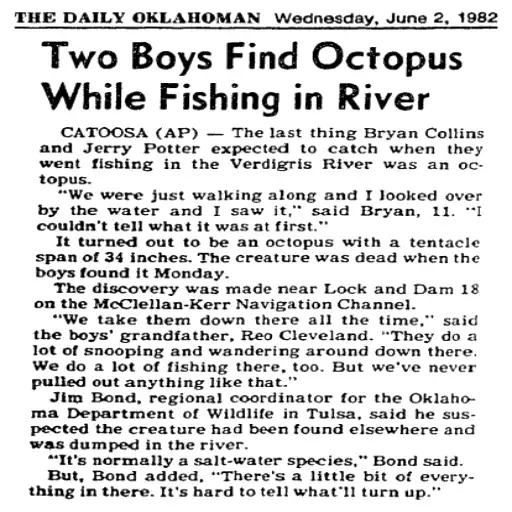
The myth likely exploded in popularity around 2009, thanks to an episode of Animal Planet’s Lost Tapes. The show dramatized the creature, terrifying a generation of viewers and cementing the idea that something was down there. Before that, print references were scarce, with one of the earliest popping up in a 2007 field guide to monsters.
The Description: What Are We Looking For?
Witnesses – if you can call them that – describe a creature that is the stuff of nightmares:
- Size: Roughly the size of a horse or small car.
- Color: Reddish-brown, similar to the relentless Oklahoma red clay.
- Features: Multi-tentacled with powerful suction cups capable of gripping human skin.
The “Evidence”: Sightings and Drownings
Let’s get real for a second. Is there any hard proof?
The Drowning Connection
The biggest argument believers make isn’t a photo or a carcass – it’s the body count. Oklahoma lakes, particularly Lake Thunderbird (colloquially known as “Dirtybird”), have high drowning rates. Believers claim the Oklahoma Octopus is responsible for these tragic deaths, dragging swimmers down and holding them there.
However, officials attribute these statistics to more mundane, albeit tragic, causes:
- Poor Visibility: The water is notoriously murky.
- Hidden Hazards: Submerged debris, old trotlines, and drop-offs.
- Alcohol Consumption: A major factor in recreational water accidents.
It’s a classic case of correlation not implying causation. Just because people drown doesn’t mean a sea monster did it.

Famous “Sightings”
Actual visual confirmation is incredibly rare and usually anecdotal.
- The Arkansas Incident (2003): This is often conflated with the Oklahoma legend. A fisherman in nearby Lake Conway, Arkansas, did pull up a small octopus.
- The Reality Check: It was a dead, marine octopus likely dumped from a home aquarium. It didn’t survive in the freshwater; it was just a misplaced prop in a biological drama.
- The “Suction Cup” Marks: Some swimmers have reported emerging from the water with unexplained bruises resembling suction marks. Doctors and wildlife experts, however, usually point to fungal infections, allergic reactions to lake weeds, or simple trauma from bumping into underwater rocks.

The Science: Why a Freshwater Octopus is Impossible
Here is where the legend hits a brick wall of biological fact.
The Saltwater Barrier
Octopuses are marine cephalopods. They are stenohaline, meaning they can only tolerate a narrow range of salinity. Their bodies rely on the salt content of the ocean to regulate their internal fluids through a process called osmosis.
If you drop an octopus into freshwater:
- Osmotic Shock: Water would rush into its cells to balance the salt concentration.
- Cellular Failure: Its cells would swell and burst (cytolysis).
- Death: The creature would die almost instantly – certainly not live long enough to grow to the size of a horse.
No Fossil Record
There is absolutely no fossil evidence of a freshwater cephalopod in the history of the planet. While animals like bull sharks have adapted to freshwater, cephalopods have never made that evolutionary leap. To think a giant species evolved in a man-made lake in 50 years is scientifically absurd.
“There is simply no biological mechanism for an octopus to survive in freshwater. It would be like a human trying to breathe on the moon without a suit.” – General consensus among Marine Biologists.
Why Do We Believe?
If the science is so clear, why does the legend persist?

The Fear of the Unknown
Lakes like Tenkiller and Thunderbird are dark, deep, and eerie. When something brushes your leg in murky water, your brain instantly jumps to the worst-case scenario. We are hardwired to fear predators, and an octopus – with its alien shape and grasping arms – is the perfect villain for our primal fears.
The “Noodling” Factor
Oklahoma is famous for “noodling” -fishing for giant catfish with your bare hands. Catfish in these lakes can grow to massive sizes (some nearing 100 pounds). A giant catfish thrashing against a swimmer could easily be mistaken for a wrestling match with a tentacled beast.
The Verdict: Myth or Monster?
Is the Oklahoma Octopus real? No.
Does that make the story any less fun? Absolutely not.
The Oklahoma Octopus serves as a modern piece of folklore, a warning to respect the water, and a great campfire story to scare your friends. It’s a reminder that even in a landlocked state, we can still dream of monsters in the deep.
So, next time you’re at Lake Thunderbird, go ahead and swim. But if you feel something grab your ankle… maybe don’t wait to find out if it’s a catfish.
Key Takeaways
- Origin: Modern legend (approx. 1982-2009), not ancient folklore.
- Location: Man-made reservoirs like Lake Thunderbird and Lake Tenkiller.
- Biology: Freshwater octopuses are biologically impossible due to osmosis.
- Evidence: No physical proof; drownings are explained by natural hazards.
Have you ever seen something strange in an Oklahoma lake? Share your story in the comments below!

