

Nuckelavee Explained – The Skinless Sea Demon of Orkney: Origins, Famous Encounters & Meanings
Imagine walking along a desolate, mist choked coastline in the dead of winter. The wind howls like a banshee, and the salt spray stings your eyes. Suddenly, you smell it not the fresh scent of the ocean, but a stench of rotting decay and burning sulfur. Out of the surf rises a nightmare that makes vampires look like choirboys.
Meet the Nuckelavee (pronounced nuck-la-vee).
Originating from the windswept Orkney Islands off the north coast of Scotland, this isn’t your garden variety fairy or mischievous sprite. This is a skinless, horse human hybrid of pure malevolence, widely considered the most terrifying creature in all of Scottish folklore.
So, what exactly is this skinless horror? Why did it hate the smell of burning seaweed? And how did one lucky islander named Tammas live to tell the tale? Let’s dive into the dark, briny depths of this legend.
What on Earth is a Nuckelavee?

If you think you’ve seen weird, you haven’t seen the Nuckelavee.
Unlike the kelpie, which disguises itself as a beautiful horse to lure victims, the Nuckelavee makes no attempt to hide its grotesque nature. It is a solitary, amphibious demon that looks like a rider fused to a horse but it’s not two beings. It’s one singular, horrifying entity.
According to the famous 19th century folklorist Walter Traill Dennison, who recorded many of these tales, the creature’s appearance is enough to stop your heart.
The Stuff of Nightmares:
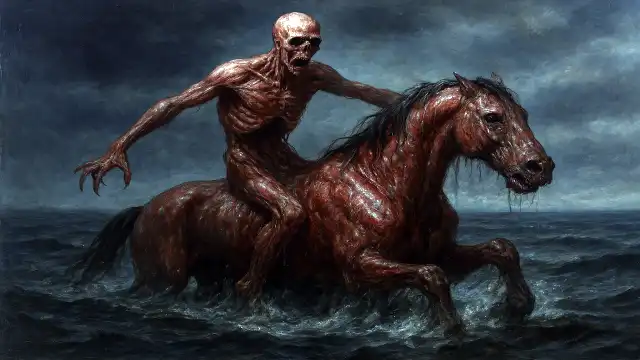
- Skinless Body: The most defining feature. The Nuckelavee has no skin. You can see the yellow veins pulsing with black blood, the white sinews twisting over red, raw muscle.
- Two Heads: It has a massive horse head with a gaping mouth “like a whale’s” and a single, burning red eye. Growing out of the horse’s back is a human torso with a head that lolls sickeningly from side to side, as if its neck is too weak to support it.
- Ape Like Arms: The human torso has long, sinewy arms that drag along the ground, ending in grasping claws.
- Fin Legs: While it walks on land, its equine legs sometimes feature fin like appendages, a reminder of its oceanic home.
Why no skin? It’s a visceral symbol of raw, exposed suffering and rage. In a land where the elements can strip you to the bone, the Nuckelavee is the environment turned inside out.
Origins
Orkney isn’t quite like the rest of Scotland. For centuries, it was ruled by the Vikings, and its folklore is a unique cocktail of Celtic and Norse mythology.
The name “Nuckelavee” is thought to come from the Orcadian dialect word knoggelvi, which translates roughly to “Devil of the Sea.” Scholars believe it may be related to the Norse Nøkk (a water spirit), but twisted into something far more demonic by the harsh isolation of island life.
While many water spirits are ambivalent sometimes helpful, sometimes tricky the Nuckelavee is described as having “unmixed malignity.” It has no redeeming qualities. It doesn’t just want to drown you; it wants to blight your crops, kill your cattle, and poison the very air you breathe.
The Famous Encounter: Tammas and the Beast
Folklore is often vague, but the story of Tammas is specific, terrifying, and legendary. Recorded by Dennison, this account gives us our best look at the creature’s behavior and its one fatal weakness.
The Setup:
Tammas was a local islander walking home late one night along a narrow strip of land. To his right was the churning salt sea; to his left, a fresh water loch (lake). It was a moonless night, lit only by starlight perfect conditions for a monster.
The Chase:
Tammas saw a massive, dark shape moving toward him. Thinking it was a neighbor on horseback, he called out. No answer. As it drew closer, the horrific details came into focus: the raw flesh, the lolling head, the single red eye burning like a coal.
Most men would have frozen. Tammas ran.
The Nuckelavee roared a sound like the sea crashing into a cave and gave chase. Tammas, lungs burning, sprinted toward a nearby stream that connected the fresh water loch to the sea. He knew the old legends: evil spirits cannot cross fresh, running water.
The Escape:
Just as he felt the creature’s hot, pestilent breath on his neck and its long claws grazing his bonnet, Tammas leaped across the stream. The Nuckelavee skidded to a halt on the bank, shrieking in frustration. It lashed out one last time, snatching Tammas’s hat, but couldn’t cross the rivulet. Tammas collapsed on the other side, safe but shaken for life.
Key Takeaway: If you’re ever in Orkney and see a skinless horseman, find a stream. Fast.
The Kelp Burning Connection
Here’s where the folklore gets fascinatingly real.
In the 18th and 19th centuries, Orkney had a booming industry: kelp burning. Islanders would harvest tons of seaweed and burn it to create soda ash, which was valuable for making glass and soap. This process created thick, acrid clouds of pungent smoke that blanketed the islands.
The islanders believed this smoke enraged the Nuckelavee. Why?
- Pollution & Plague: The smoke was awful. It irritated lungs and coincided with outbreaks of a deadly horse disease called Strangles or Mortasheen (Glanders).
- The Blame Game: When horses started dying and crops failed (blighted by the acidic smoke), the locals didn’t blame the industry that was making them money. They blamed the Nuckelavee.
- Mortasheen: This disease was said to be the Nuckelavee’s revenge. The creature would come ashore and breathe its venomous breath on the livestock, causing them to wither and die.
In this light, the Nuckelavee wasn’t just a monster; it was an environmental warning. It personified the guilt and consequences of industrializing the natural landscape. When you burn the sea’s bounty, the sea fights back.
How to Survive a Nuckelavee Attack
Planning a trip to the Northern Isles? Here is your survival guide, courtesy of ancient folklore.
- Find Fresh Water: This is the golden rule. Like the Wicked Witch of the West, the Nuckelavee has a violent aversion to fresh water. Rain, rivers, and streams are your best friends. It’s said the creature never comes ashore when it’s raining (which, luckily for Orcadians, is quite often).
- Don’t Burn Seaweed: Seriously. If you smell burning kelp, run the other way. You’re basically ringing the dinner bell for a demon.
- Pray to the Mither o’ the Sea: In Orkney mythology, the Nuckelavee has a nemesis the Mither o’ the Sea (Mother of the Sea). She is a benevolent spirit who battles the demon every summer and traps him deep underwater. This is why the Nuckelavee is mostly a winter threat.
Why We Need Monsters Like This
The Nuckelavee is brutal, gross, and terrifying. But it’s also necessary.
In the days before modern science, how did you explain a sudden blight that killed all your potatoes? How did you make sense of a horse disease that wiped out your livelihood overnight? You gave it a face.
By creating a monster like the Nuckelavee, the islanders took the random cruelty of nature and gave it a form. And if it has a form, it has rules. And if it has rules like a fear of fresh water it can be survived.
So, the next time you’re by the ocean, close your eyes and listen to the waves. It’s probably just the tide coming in. But if you hear the heavy, wet thud of hooves and smell the stench of decay…
Don’t wait to check for skin. Just find a stream.
Quick Facts
- Name: Nuckelavee (from Orcadian knoggelvi).
- Region: Orkney Islands, Scotland.
- Appearance: Skinless horse/man hybrid, single red eye, long arms.
- Powers: Venomous breath, causes drought and disease (Mortasheen).
- Weakness: Fresh running water; the Mither o’ the Sea.
- Origins: Blend of Norse and Celtic mythology; linked to kelp burning history.
Have you ever heard of a folklore creature as terrifying as the Nuckelavee? Or do you know of other local legends that explain real world disasters? Drop a comment below or share this with your bravest friend!
Source help:
- https://en.wikipedia.org/wiki/Nuckelavee

