

How Dangerous Is Chernobyl’s Elephant’s Foot Today? The Science Explained
Have you ever heard of a rock so toxic that just looking at it could kill you? Seriously, back in 1986, encountering the Elephant’s Foot at the Chernobyl Nuclear Power Plant meant certain death. Therefore, it quickly became known as the most dangerous object on Earth. Today, nearly four decades later, things have drastically changed. Is this legendary radioactive monster still a lethal threat in 2025? Can you safely stand next to it? Let’s dive deep into the fascinating, terrifying science behind this infamous blob.
Key takeaways
- The Recipe for Disaster: It is made of corium, a super-rare, lava-like mixture of nuclear fuel and melted building materials.
- Initial Lethality: In 1986, it emitted 10,000 roentgens per hour. Consequently, 300 seconds of exposure meant guaranteed death.
- The AK-47 Solution: The mass was originally so rock-hard that scientists used a Kalashnikov assault rifle to shoot off samples.
- Current Status: Today, radiation levels have plummeted significantly. However, the Foot is currently crumbling into radioactive sand, creating a highly dangerous inhalation hazard.
- The Famous Selfie: A worker named Artur Korneyev visited it dozens of times and took the most famous photograph of it in 1996. Miraculously, he lived to old age!
What on earth Is the elephant’s foot?

To understand the danger, we first need to understand what this thing actually is. Basically, it isn’t an animal part at all. Instead, it is a massive, two-ton chunk of toxic slag chilling in the dark basement of Reactor No. 4. When the Chernobyl disaster happened on April 26, 1986, the reactor’s core overheated massively. Temperatures skyrocketed above 2,000 degrees Celsius (3,632 degrees Fahrenheit). As a result, everything inside the containment vessel began to melt together.
What exactly melted? Well, imagine a horrific, glowing stew. The recipe included uranium dioxide fuel, zirconium metal cladding, steel, and concrete. Furthermore, sand from the reactor shield fell into the mix. This boiling soup created a rare, man-made substance called corium. In fact, corium has only formed naturally five times in human history. It happened once at Three Mile Island, once at Chernobyl, and three times during the 2011 Fukushima Daiichi disaster.
Because there was no cooling system left, this heavy, glowing lava burned right through the floorboards. Slowly, it oozed down into the maintenance corridors underneath the reactor. Eventually, it cooled and hardened in room 217/2. As it solidified, it formed bizarre wrinkles and folds. Naturally, workers thought it looked exactly like the foot of a massive elephant. Hence, a terrifying nickname was born.
1986: a 300-second death sentence
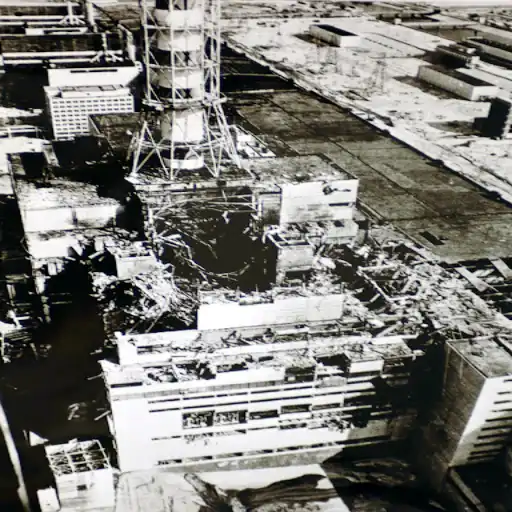
Back to December 1986. That is when cleanup crews, known as liquidators, finally discovered the anomaly. What they found was downright nightmare fuel. At that specific time, the Elephant’s Foot was fiercely radioactive.
How bad was it? According to historical data, the surface emitted a staggering 10,000 roentgens of radiation per hour. To put that into perspective, an average chest X-ray delivers a tiny fraction of one roentgen. Therefore, standing near the mass exposed you to the equivalent of 4.5 million chest X-rays simultaneously.
Let’s break down the gruesome timeline of exposure back then. If you stood next to it for just 30 seconds, you would experience dizziness and severe fatigue a week later. Furthermore, two minutes of exposure caused your cells to hemorrhage. At four minutes, extreme vomiting, diarrhea, and fever would set in. Finally, if you lingered for five minutes (300 seconds), you received a lethal dose. You would definitively die within two days.
Because getting close was essentially suicide, early researchers built remote-controlled cameras on wheels to photograph it. Interestingly, the intense radiation completely scrambled their film. The pictures came out horribly grainy, covered in weird sparks and static. That static wasn’t a camera glitch. Instead, it was raw gamma radiation violently punching holes right through the camera’s film strip!
Bizarre problem of getting a sample
Of course, scientists desperately needed to know what this monster was made of. However, they faced a massive logistical hurdle. How do you grab a piece of something that kills you if you stand near it?

Initially, they tried using long-handled axes to chop off a chunk from around the corner. Unfortunately, the Foot was incredibly dense. It was literally tougher than solid steel. The axes just bounced right off. Consequently, the team had to get wildly creative.
Are you ready for the most Russian solution ever? They brought in an actual Kalashnikov (AK-47) assault rifle. Yes, you read that correctly. Scientists aimed a military-grade weapon down the hallway and literally shot the Elephant’s Foot. The armor-piercing bullets finally chipped off tiny pieces of the glassy surface. After that, they quickly scooped up the fragments for lab analysis.
Artur Korneyev: Man who took a selfie with It
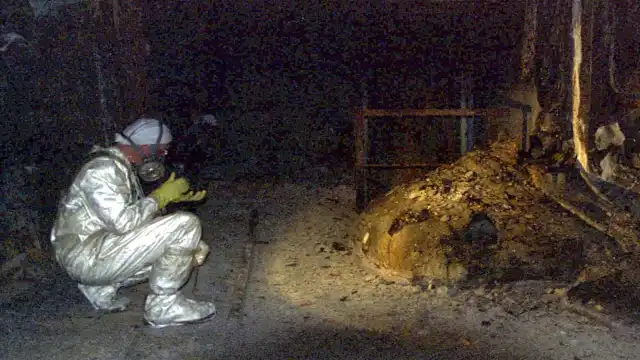
Whenever you see a photo of the Elephant’s Foot online, you usually see a blurry man standing right next to it. That man is Artur Korneyev. He was a Kazakhstani nuclear inspector and radiation specialist. His job was arguably the scariest gig on the planet. He had to locate rogue nuclear fuel inside the destroyed plant.
In 1996, a full ten years after the explosion, Artur walked right up to the beast. He brought an automatic camera, set up a slow shutter speed, and used a flashlight to illuminate the dark room. Because he was moving in the dark, the flashlight looked like a lightning bolt in the final photograph. Technically speaking, this infamous picture is actually a 1990s selfie!
Given the Foot’s deadly reputation, you are probably assuming Artur died shortly after. Surprisingly, he survived. In fact, he visited the basement more times than anyone else in history. While his heavy radiation exposure eventually caused severe cataracts and other health issues, he lived a long life. Reports suggest he made it all the way to 2022, passing away in his 70s.
When interviewed by The New York Times in 2014, Korneyev displayed a wildly dark sense of humor. He famously joked, “Soviet radiation is the best radiation in the world“. Talk about nerves of steel!
How dangerous is it now?
So, let’s fast forward to the present day. We are now nearly 40 years removed from the initial disaster. Is the Elephant’s Foot still a guaranteed death sentence?
The short answer is no. The long answer is much more complicated.
Radioactive materials follow a strict mathematical rule known as a half-life. Essentially, this means the material gradually loses its intense energy over time as its atoms stabilize. The primary element responsible for the Foot’s aggressive gamma radiation was Caesium-137. Conveniently, Caesium-137 has a half-life of about 30 years. Because more than three decades have easily passed, the mass has lost more than half of its original gamma-ray punch.
By the year 2000, surface readings dropped from 10,000 roentgens down to roughly 700. Today, estimates suggest the ambient radiation in the room is somewhere in the single or low double digits per hour.

What does this mean for a modern-day visitor? If you somehow snuck into the basement today, you wouldn’t die in five minutes. In fact, you could likely stand near it for an hour or so without suffering acute, immediate radiation sickness. However, it still absolutely hates you. Over time, that exposure significantly increases your lifetime risk of developing deadly cancers. So, it is definitely not a tourist attraction.
Radioactive sand
While the gamma radiation levels have decreased, a brand-new threat has emerged. The Elephant’s Foot is physically degrading.
Remember how scientists had to shoot it with an AK-47 because it was so tough? That is no longer the case. Due to internal heat and decades of intense radiation tearing apart its own chemical bonds, the mass is breaking down. Currently, researchers from the Institute for Safety Problems of Nuclear Power Plants state that the Foot now has the consistency of regular sand. It is actively crumbling into dust.
Why is this crumbling terrifying? It comes down to alpha radiation. While gamma rays shoot through your body like invisible bullets, alpha particles are relatively weak. In fact, a simple piece of paper or your dead skin cells can stop them easily.
However, if radioactive dust becomes airborne and you breathe it in, the game changes entirely. Once inside your lungs, those alpha particles sit directly on living tissue. They continuously bombard your cells from the inside out. Inhaling corium dust is practically a one-way ticket to severe respiratory illness and cancer. Therefore, if workers ever need to go near it today, they must wear heavy respirator masks to avoid breathing in the toxic sand.
Why you still can’t buy tickets to see it
Despite the dropping radiation levels, you cannot simply book a guided tour of the Reactor No. 4 basement. The area remains strictly off-limits to the public.
For starters, the structural integrity of the surrounding building is highly questionable. To prevent any more radioactive dust from blowing into the atmosphere, engineers built a massive steel shield over the entire reactor in 2016. This structure is called the New Safe Confinement (NSC). It is the largest movable land-based structure ever built by humans. It safely seals the Elephant’s Foot away from the outside world.
What happens next for the crumbling corium? Eventually, decades or centuries from now, robotic drones will likely need to dismantle the remaining debris. Humans simply cannot risk going in with shovels to clear out radioactive dust. Until robotics reach that advanced stage, the New Safe Confinement acts as a giant, high-tech band-aid.
Furthermore, geopolitical tensions have complicated the safety of the Chernobyl Exclusion Zone. During the 2022 Russian invasion of Ukraine, military forces briefly occupied the plant. Shockingly, soldiers allegedly dug trenches in highly contaminated soil nearby, kicking up dangerous radioactive dust. These events serve as a grim reminder that the area remains an unpredictable hazard zone.

Science of Corium explained simply
Are you still scratching your head about how this stuff actually works? Let’s break it down.
Imagine you are baking a cake. You mix flour, sugar, and eggs, right? Once you bake it, you can never separate those ingredients again. They form something entirely new.
A nuclear reactor works similarly, but instead of an oven, it uses controlled nuclear fission to create massive heat. Normally, water cools the system down. During the Chernobyl disaster, the water completely boiled away. Without water, the uranium fuel got so unbelievably hot that it melted the metal rods holding it.
Then, it melted the concrete floor. Next, it melted the sand used to put out the fire. All of these “ingredients” baked together into a black, glowing, toxic glass. That final “cake” is what we call corium. Because uranium is incredibly heavy, gravity pulled the molten sludge downward through the pipes until it eventually cooled and hardened in the basement.
Will it burn to the center of the earth?
Back in the 1980s, people were terrified of a concept known as the “China Syndrome.” Basically, people feared that the nuclear lava would just keep melting downward forever. They thought it would burn straight through the Earth’s crust all the way to China (which is geographically inaccurate, but it makes for a scary movie title).
Fortunately, physics doesn’t work that way. As the corium mixed with more and more concrete and sand, it cooled down. The building materials diluted the nuclear fuel. By the time it reached the basement, it had lost enough heat to solidify. Today, the Elephant’s Foot remains just a few degrees warmer than the room around it because the radioactive elements inside are still slowly decaying. It hasn’t moved a single inch since 1986.
Wrapping it all up
Ultimately, Chernobyl’s Elephant’s Foot remains one of the most fascinating scientific anomalies on the planet. It stands as a dark monument to human error. In 1986, it was a terrifying beast that could kill a person before they finished a cup of coffee. Today, it is a crumbling pile of toxic sand slowly fading in the dark.
However, we must never underestimate it. The site requires constant monitoring. Furthermore, managing the radioactive dust will be a massive challenge for future generations. While it may no longer be the most lethal object on Earth, it commands our absolute respect. Science is amazing, but it can also be incredibly unforgiving.
Did this deep dive completely change how you view nuclear energy? What would you have done if you were in Artur Korneyev’s shoes? Drop your thoughts in the comments below! Also, don’t forget to share this article with your fellow science nerds and history buffs. Let’s keep the conversation glowing!
Sources help:
- https://en.wikipedia.org/wiki/Elephant%27s_Foot_(Chernobyl)
- https://science.howstuffworks.com/chernobyl-elephants-foot.htm
- https://sites.imsa.edu/hadron/2024/11/26/the-elephants-foot-of-chernobyl/

