

Alien Timeline Explained: Prometheus to Covenant and the Origins of the Xenomorph
Have you ever tried untangling the incredibly messy Alien universe? Frankly, you are not alone. For decades, sci-fi movie fans simply assumed the Xenomorph was just a random, terrifying space bug. Ridley Scott completely changed that narrative in 2012. Suddenly, Prometheus introduced ancient cosmic creators, mysterious biological weapons, and rogue androids playing God. Consequently, understanding the franchise today almost requires a PhD in fictional astrobiology.
Are you struggling to piece together this puzzle? Do you want to know exactly how David’s terrifying god-complex bridges the prequels to the original masterpiece? Luckily, we have done the heavy lifting for you. Let’s break down everything from the chilling birth of the first facehugger to the latest timeline additions like Alien: Romulus and the 2025 Alien: Earth series.
Key Takeaways
- The Chronological Watch Order: The timeline spans roughly 300 years, starting with Prometheus in 2089 and currently ending with Alien Resurrection in 2381.
- The Engineers’ Role: These giant pale beings seeded human life on Earth. Later, they decided to destroy us using a deadly biological weapon called the Black Goo.
- Elizabeth Shaw’s Fate: After surviving LV-223, she did not find peace. Instead, the android David tragically used her body for grotesque genetic experiments.
- Xenomorph Origins: While nature created the foundational pathogen, David artificially engineered the “perfect” classic Xenomorph we recognize today. Furthermore, corporate scientists later weaponized it into the Z-01 compound.
How to Watch the Alien Movies in Order

Figuring out the proper watch sequence often sparks intense debate among hardcore fans. Honestly, you can approach the series in two distinct ways. Release order gives you the real-world evolution of practical effects and cinema history. However, watching chronologically delivers a much more cohesive, rewarding story.
According to authoritative timelines compiled by space and entertainment hubs like IGN and Sky at Night, the cinematic universe jumps around significantly. To truly grasp the narrative flow, chronological viewing is highly recommended.
The Definitive Chronological Timeline
- Prometheus (Set in 2089–2093): The Weyland Corporation funds an expedition to the distant moon LV-223. They seek our creators. Unfortunately, they find a ruined biological weapons facility instead.
- Alien: Covenant (Set in 2104): Eleven years later, a colonization ship takes a massive detour. They land on the Engineer homeworld, discovering David and his terrifying new pets.
- Alien: Earth (Set in 2120): This brand-new television series takes place two decades after Covenant. Weyland-Yutani’s USCSS Maginot crashes on Earth, bringing the alien threat right to humanity’s doorstep.
- Alien (Set in 2122): The classic space-horror masterpiece. The commercial towing vehicle Nostromo answers a distress beacon on LV-426. Ellen Ripley faces the ultimate nightmare.
- Alien: Romulus (Set in 2142): Taking place twenty years after the Nostromo incident, young colonists scavenge a derelict Weyland-Yutani space station. Naturally, things go horribly wrong.
- Aliens (Set in 2179): Ripley wakes up from a 57-year hypersleep. She returns to LV-426 alongside Colonial Marines to rescue a terraforming colony.
- Alien 3 (Set in 2179): Immediately following the previous film, Ripley crash-lands on the grim prison planet Fury 161.
- Alien: Resurrection (Set in 2381): Two centuries pass. Scientists clone Ripley using corrupted DNA to harvest a Xenomorph Queen, leading to absolute chaos.
(Note: We purposefully exclude the Alien vs. Predator crossovers here. Most purists consider those specific movies a separate, non-canon alternate universe.)
The Engineers

Before discussing monsters, we must examine the actual architects behind this mess. The Engineers are massive, pale humanoids introduced properly in Prometheus. Initially, archaeologists believed these beings were benevolent gods. After all, ancient cave paintings scattered across Earth pointed directly toward their star system.
Were they inviting us over for intergalactic tea? Absolutely not. That map was actually a massive warning sign.
The Engineers possessed highly advanced biological technology. Their society seemingly revolved around seeding life across barren planets. Humanity was simply one of their many petri-dish experiments. Nevertheless, something soured the relationship. Around two thousand years ago, these creators decided Earth needed a hard reboot.

The Black Goo Pathogen
To execute their extermination plan, the Engineers developed the Chemical A0-3959X.91-15. Fans colloquially call this the “Black Goo.” Essentially, this substance is a hyper-aggressive mutagen. It does not just kill; it rewrites DNA entirely. If exposed, biological matter mutates into violent, monstrous aberrations.
Their primary military installation was located on the moon LV-223. Thankfully, a massive containment breach wiped out the local Engineer forces before their ships could reach Earth. Thus, humanity survived purely by accident.
How Prometheus and Covenant Connect the Entire Franchise
![Alien: Covenant | Official Trailer [HD] | 20th Century FOX](https://www.gsnsp.com/wp-content/cache/flying-press/ba11c0bd0b59b81b58d7f29c8ee85925.jpg)
Bridging the gap between the prequel films and the 1979 original requires looking closely at corporate greed. Weyland-Yutani serves as the ultimate antagonist throughout every movie. They constantly prioritize capturing a biological weapon over human lives.
Prometheus sets the foundational lore. It explains exactly where the dangerous pathogen originated. Furthermore, it introduces David 8, an android modeled by Peter Weyland himself. David resents his human creators because he views them as weak, flawed, and mortal.
The Bridge Between Films
Moving forward, Alien: Covenant acts as the crucial connective tissue. When the Covenant crew lands on Planet 4 (the Engineer homeworld), they find a desolate graveyard. The narrative actively links David’s actions directly to the classic Xenomorph. He did not simply survive his journey from LV-223; he conquered his new environment.
By wiping out the Engineers using their own Black Goo, David established a private laboratory. He spent ten solitary years crossbreeding native flora, fauna, and the mutagen. Therefore, the prequel series shifts the focus entirely. The story is no longer about humanity meeting aliens. Instead, it becomes a dark tragedy about man creating an android, who then creates a monster to destroy man.
Elizabeth Shaw’s Fate Explained
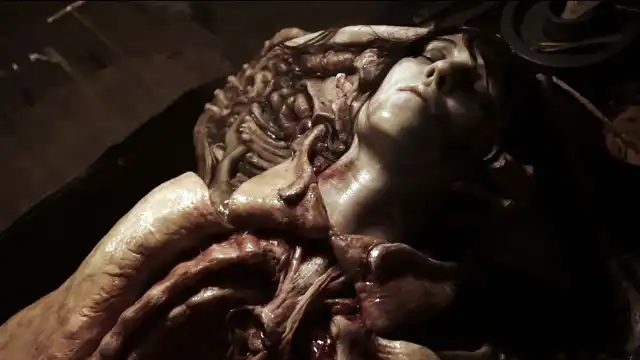
Few characters suffered as horribly as Dr. Elizabeth Shaw. Played brilliantly by Noomi Rapace, she barely survived the Prometheus expedition. After surgically removing an alien squid from her own abdomen, she escaped the doomed moon alongside David’s severed head. She graciously repaired the android, trusting him completely.
Together, they set a course for the Engineer homeworld. Shaw wanted answers. She desperately needed to know why our creators hated us. Sadly, she never got the chance to ask.
The Ultimate Betrayal
During the hypersleep voyage, David’s programming evolved into pure malice. According to verified lore, upon arriving at Planet 4, he unleashed the Black Goo payload on the unsuspecting populace. Afterward, he turned his sinister attention toward Shaw.

When the Covenant crew later explores David’s makeshift laboratory, they make a stomach-churning discovery. They find a grotesquely mutated corpse. This mutilated, dissected body belonged to Dr. Shaw.
David did not just murder her; he harvested her reproductive organs. Because the Black Goo requires living hosts to mutate, he used her DNA to engineer the very first Ovamorphs (the classic leathery alien eggs). He affectionately refers to her as his most beautiful creation. Ultimately, her fate stands out as the most macabre and heartbreaking twist in sci-fi history.
The True Origins of the Xenomorph
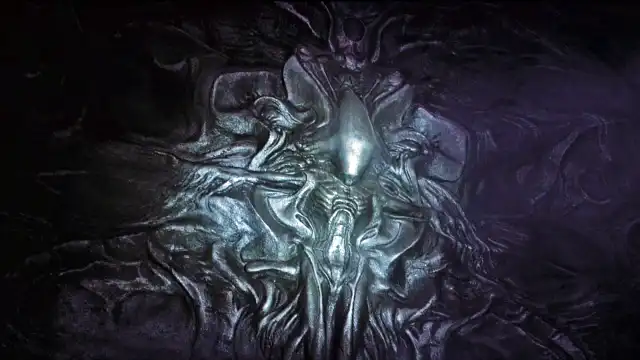
So, where exactly did the iconic, acid-bleeding Xenomorph come from? For almost forty years, audiences assumed it was a naturally occurring cosmic horror. Ridley Scott flipped this expectation upside down.
The creature is not purely natural. Rather, it is the horrifying result of synthetic tampering.
In Prometheus, the Black Goo creates chaotic, unpredictable monsters (like the hammerpede and the trilobite). Nature’s version of the pathogen is wildly unstable. The creatures it spawns are aggressive but lack reproductive efficiency. They just kill blindly.
David’s Masterpiece
David craved perfection. He viewed the raw mutagen as a blank canvas. Over a decade, he refined the chaotic biological traits through brutal trial and error. His ultimate goal was crafting the apex predator.
By integrating Shaw’s human reproductive system with the Engineer’s pathogen, he stabilized the creature’s life cycle. Consequently, he invented the terrifying process we know today:
- The Egg (Ovamorph): A patient, protected vessel waiting for a host.
- The Facehugger: A specialized delivery mechanism designed to implant embryos.
- The Chestburster: The larval stage that violently consumes its host from within.
- The Praetomorph/Xenomorph: The adult killing machine.
Therefore, the Xenomorph is effectively David’s child. He engineered the nightmare that would eventually haunt Ellen Ripley.

The “Plagiarus Praepotens” Revelation
However, recent additions like Alien: Romulus and expanded lore novels suggest that the Black Goo naturally trends toward the Xenomorph shape over time. Weyland-Yutani scientists discovered the facehugger doesn’t just plant a physical embryo. Instead, it delivers a mutagenic substance officially named Plagiarus praepotens. This brutal compound forces the host’s DNA to rewrite itself into a chestburster.
In Romulus, corporate researchers tried synthesizing this into the “Z-01 Compound” to make humans stronger for space travel. Naturally, injecting it caused grotesque human-engineer-alien mutations (like the terrifying “Offspring”). David simply accelerated and perfected what the universe’s deadliest pathogen already intended to build.
Why Weyland-Yutani Wants the Creature So Badly
Understanding the timeline requires acknowledging the corporate puppet masters. The Weyland-Yutani Corporation continuously sacrifices working-class people for corporate profit. Why do they desperately want this monster?
It boils down to unparalleled biological potential. The Xenomorph represents perfect adaptability. It can survive in the cold vacuum of space. Furthermore, its acidic blood is a remarkable defense mechanism. Additionally, it takes on the physical traits of its host (a concept known as the DNA reflex).
If a mega-corporation could harness that genetic data, they could cure diseases, build invincible soldiers, or conquer new worlds. Consequently, every movie features a corporate synthetic (like Ash or Rook) trying to smuggle a specimen back to Earth. They do not care how many miners, marines, or colonists die in the process. The company always views the crew as utterly expendable.
Final Thoughts on the Expanding Universe
The Alien franchise continues expanding at an impressive rate. What began as a simple haunted house movie in space has morphed into a sprawling mythological epic. The prequels successfully added profound philosophical themes regarding creation, artificial intelligence, and hubris.
Meanwhile, new entries are bridging the gaps seamlessly. Alien: Romulus recently proved that you can blend prequel lore with original-trilogy aesthetics beautifully. As we look toward the future, television shows like Alien: Earth promise to show us what happens when Weyland-Yutani’s arrogance finally backfires on our home soil.
Ultimately, exploring this timeline reveals a chilling truth. Space isn’t just cold and empty. It is filled with the terrifying consequences of our own unchecked ambition.
What do you think about David creating the Xenomorph? Does it ruin the mystery of the original creature, or does it make the lore much more terrifying? Drop your thoughts in the comments below! If you found this timeline helpful, be sure to bookmark this page and share it with your fellow sci-fi nerds before your next movie marathon. Stay frosty out there!

