

Odyssey Adventures Explained: Cyclops Polyphemus to Calypso.
The Odyssey (2026) is Christopher Nolan’s ambitious adaptation of Homer’s legendary epic, starring Matt Damon as Odysseus. Before diving into the film, this guide breaks down the mythological creatures, gods, and unforgettable encounters that shape the hero’s perilous journey, giving you the essential context to fully appreciate Nolan’s vision.
Leaving Troy and the Cicones
Most people think the trouble started with the Cyclops. Wrong.
After winning the Trojan War (thanks to the Trojan Horse, an Odysseus special), our hero leaves with 12 ships. They are feeling invincible. Their first stop is Ismarus, the land of the Cicones (allies of Troy).
At first, it goes great. They sack the city, grab some loot, and celebrate. Standard ancient pirate stuff. But here’s the thing: Odysseus tells his men, “Hey, we should leave now.” His men? They refuse. They want to keep partying on the beach.
Big mistake.
The surviving Cicones run into the hills, grab their neighbors (who are much better fighters), and come back with an army “thick as leaves in autumn.” The counterattack is brutal. Odysseus loses six men from every single ship before they manage to flee.
(“Want to know how Nolan changed Homer’s original story? Read our in-depth comparison guide.”)

The Lotus-Eaters
After a massive storm (sent by Zeus, who was just getting warmed up), the ships drift for nine days until they hit the land of the Lotus-Eaters.
This isn’t a violent threat; it’s a chemical one.
The locals aren’t hostile. They just love eating this mysterious flowering plant, the Lotus. They offer some to Odysseus’s scouts. As soon as the men taste the honey-sweet fruit, they lose all desire to go home. They don’t want war and family. They just want to chill and eat flowers forever.
The Cyclops Polyphemus

This is the big one. The moment that curses the entire voyage.
They land on the island of the Cyclopes, a race of giant, one-eyed shepherds who don’t care about laws or hospitality. Odysseus, being overly curious, wants to meet one. He leads 12 men into a massive cave, waiting for the owner to return.
Enter Polyphemus, the son of Poseidon.
He’s not friendly. He blocks the exit with a boulder so heavy that “22 wagons couldn’t budge it.” Then, he grabs two of the crew, smashes them against the floor like puppies, and eats them raw.

The Escape Plan
Odysseus can’t just kill him. If he kills the giant while he sleeps, who moves the boulder? They’d be trapped. So, Odysseus plays the long game.
- The Wine: He gets Polyphemus drunk on super-strong wine.
- The Name: When the giant asks his name, Odysseus says, “My name is Nobody.”
- The Strike: Once the giant passes out, they heat a sharpened olive stake and drive it into his single eye.
- The Punchline: Polyphemus screams for help. His neighbors yell back, “Who is hurting you?” He replies, “Nobody is hurting me!” The other Cyclopes think he’s crazy and go back to bed.
The Fatal Flaw:
They escape by hiding under the bellies of the giant’s sheep. But as they sail away, Odysseus’s ego takes over. He needs the giant to know who beat him. He yells back, “If anyone asks, tell them it was Odysseus of Ithaca!”
Polyphemus prays to his dad, Poseidon, to ensure Odysseus never gets home, or if he does, that he arrives late, alone, and on a stranger’s ship. Poseidon hears him.
“Hear me, Poseidon… grant that Odysseus… may never reach his home alive.” – The Odyssey, Book 9
Aeolus: The Bag of Winds
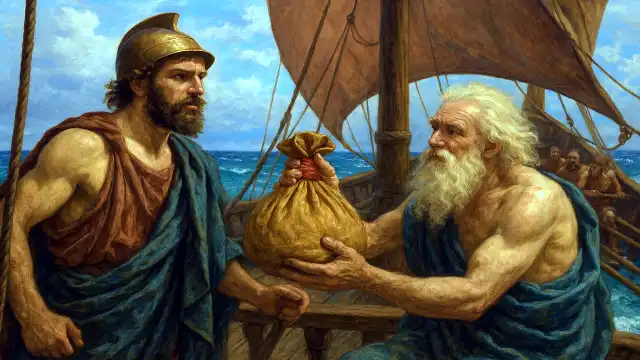
Next, they land on the floating island of Aeolus, the keeper of the winds. Aeolus actually likes Odysseus. He hosts him for a month and gives him a parting gift: a bag containing all the stormy winds of the world. Only the gentle West Wind is left free to blow them home.
It works perfectly. They sail for nine days. They actually see the fires burning on the shores of Ithaca. They are home.
But Odysseus falls asleep. (Notice a pattern? Leaders need sleep, but bad things happen when they get it.)
The crew starts whispering. “What’s in the bag? Gold? Silver? Why does the captain get all the loot?” Jealousy takes over. They open the bag. BOOM. Every storm unleashes at once, blowing them all the way back to Aeolus.
When they beg for help again, Aeolus kicks them out. He figures anyone that unlucky must be hated by the gods. He’s not wrong.
The Laestrygonians: The massacre
If you think the Cyclops was bad, wait until you meet the Laestrygonians.
Odysseus’s fleet (12 ships, remember?) pulls into a calm harbor surrounded by steep cliffs. It looks safe. Eleven ships dock inside the harbor. Odysseus, being paranoid (or smart), moors his single ship outside the harbor.
Big save.
The locals turn out to be a race of giant cannibals, not unlike the Cyclops but more organized. They don’t just eat a couple of guys. They stand on the cliffs and pelt the ships in the harbor with massive boulders. They smash the ships to pieces and spear the drowning men like fish.
The Toll:
- Ships Lost: 11
- Ships Left: 1 (Odysseus’s ship)
- Casualties: Hundreds.
Circe: The Sorceress of Aeaea
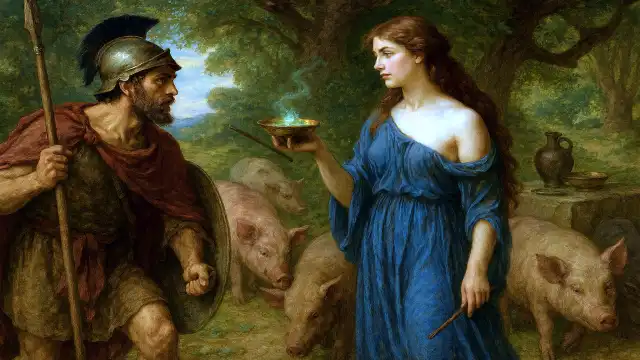
With only one ship left, they reach Aeaea, home of Circe. She is a powerful witch (or minor goddess) who lures men in with food and wine laced with drugs. Then, she taps them with her wand and poof they turn into swine. They keep their human minds, but they are trapped in pig bodies. Horrifying.
Odysseus rushes to save them. On the way, the god Hermes intercepts him. Hermes gives him a holy herb called Moly to block Circe’s magic and tells him exactly how to handle her:
- Eat the herb.
- When she tries to strike you, draw your sword and rush her.
- She will surrender and offer… “hospitality.”
It works. Circe is impressed (and attracted) by the one man who can resist her magic. She turns the crew back into men.
The Detour:
They stay for an entire year. They feast, drink, and recover from their trauma. But eventually, the crew has to remind Odysseus, “Hey, aren’t we supposed to be going home?”
Circe agrees to let them go, but she drops a bomb: To get home, they have to go to Hell. Literally.
The Land of the Dead: Conversations with ghosts
Odysseus sails to the ocean’s edge, to the gloomy land of the Cimmerians, to perform a ritual to summon the spirits. This is the Underworld (Hades).
He sacrifices a ram and a ewe, pouring their blood into a trench. The ghosts swarm up, desperate to drink the blood so they can speak. This scene is pure nightmare fuel.
Key Encounters:
- Elpenor: A crew member who got drunk and fell off Circe’s roof. He demands a proper burial. (Whoops.)
- Tiresias: The blind prophet. He gives the roadmap: Don’t eat Helios’s cattle. If you do, you lose everything. He also predicts Odysseus’s death, peaceful, far from the sea, in old age.
- Anticlea: Odysseus’s mother. This is the emotional gut-punch. She was alive when he left Troy. She tells him she died of a broken heart waiting for him.
The Sirens: The Song you can’t resist
Back on the ship, armed with advice from Circe, they approach the island of the Sirens. These creatures sing a song so beautiful that any sailor who hears it will crash their ship into the rocks just to get closer.
The Strategy:
- The Crew: Odysseus plugs their ears with beeswax. They hear nothing.
- The Hero: Odysseus wants to hear the song (he’s obsessed with knowledge). He has the crew tie him to the mast. He orders them: “No matter how much I scream or beg, do not untie me.”
He hears the music. It promises him wisdom and knowledge of all things. He screams to be released. The crew, seeing him struggle, just ties him tighter. They pass safely.
Scylla and Charybdis: The Impossible choice
This is the ultimate management dilemma. They have to pass through a narrow strait (traditionally the Strait of Messina).
- On one side: Charybdis, a whirlpool monster that swallows the entire ocean three times a day. If you get caught, the whole ship goes down. Everyone dies.
- On the other side: Scylla, a six-headed monster living in a cliff cave. She barks like a puppy but eats sailors like snacks. If you pass her, she will grab six men. No more, no less.
The Decision:
Circe told Odysseus: Better to lose six men than the whole ship.
Odysseus chooses Scylla. He doesn’t tell the crew (because they would stop rowing and hide). As they stare in terror at the whirlpool Charybdis, Scylla swoops down from the cliffs behind them.
“They screamed and reached out their hands to me in their awful death struggle.”
Six men are eaten alive, dangling in the air, calling Odysseus’s name. It is, according to him, the most pitiful thing he ever saw.
Thrinacia: The Cattle of helios
They are exhausted. They land on Thrinacia, the island of the Sun God, Helios.
Odysseus warns them: “Do not touch the cows. Tiresias said so. Circe said so. Just don’t do it.”
But a storm traps them there for a month. Their food runs out. They are starving. While Odysseus goes away to pray (and falls asleep again seriously, Odysseus?), his second-in-command, Eurylochus, makes a speech. He argues that starving to death is the worst way to die. Better to eat the beef and deal with the gods’ anger later.
They kill the finest cattle.
The Consequence:
The meat moos on the spit. The hides crawl around. It’s cursed.
When they finally launch the ship, Zeus strikes it with a massive lightning bolt to appease Helios. The ship is obliterated. The entire crew drowns.
Only Odysseus survives. He clings to a piece of wreckage and drifts back toward Charybdis, barely escaping, and washes up on…
Calypso: The Gilded cage
He washes ashore on Ogygia, the island of the nymph Calypso.
She falls madly in love with him. She offers him immortality and eternal youth if he stays. He is her prisoner/lover for seven years.
This is where The Odyssey actually begins (in media res). We see him sitting on the beach, crying, staring at the ocean, desperate to see the smoke rising from his own hearth in Ithaca.
Eventually, Athena begs Zeus to intervene. Hermes is sent to tell Calypso to let him go. She is furious (claiming a double standard for male vs. female gods having mortal lovers), but she obeys. She helps him build a raft.
He sails away, Poseidon wrecks the raft (one last “screw you”), and he washes up on Scheria (land of the Phaeacians), who finally give him a ride home.
“Want to know how Nolan changed Homer’s original story? Read our in-depth comparison guide.”
The End
Pick up a translation of The Odyssey (I recommend Emily Wilson’s version for a modern flow) and dive in.
Sources
- Mythological Summaries: Cross-referenced with The Odyssey (Homer), Encyclopedia Britannica, and Perseus Digital Library.

