

Quantum Immortality Explained: Why Consciousness May Shift to a Parallel Universe
Have you ever experienced a dangerously close call? Maybe you nearly missed a massive car accident on the highway. Perhaps you tripped near a steep edge but magically caught your balance at the absolute last second. Afterward, your heart races uncontrollably. You might even catch yourself thinking, “Wow, I easily could have died just now.”
Well, what if you actually did?
According to a mind-bending concept called quantum immortality, a version of you might have perished in that exact moment. However, your consciousness simply hopped over to a parallel universe where you survived. Look, this sounds like pure science fiction. Yet, the foundation of this idea rests heavily upon real, highly debated quantum physics.
We are going to explore how microscopic particles might dictate the survival of the human mind. Let’s break down exactly how this wild theory works.
Key takeaways
- The Many-Worlds Interpretation: Every time a quantum event happens, reality actively splits into completely separate, parallel universes.
- The Survival Bias: Since consciousness cannot experience non-existence, you will only ever perceive the specific universe where you survive.
- The Thought Experiment: MIT physicist Max Tegmark outlined a famous scenario in 1998 detailing how subjective immortality might theoretically function.
- The Catch: This theory strictly applies to sudden, quantum-level events. It does not prevent natural aging or gradual biological death.
What exactly is Quantum Immortality?
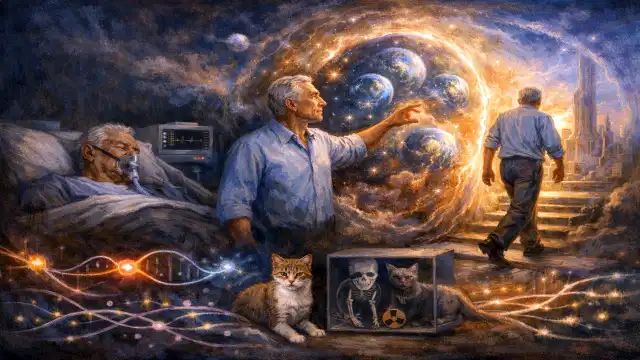
To grasp this concept, we first need to look closely at quantum mechanics. Normally, the rules governing everyday macroscopic objects are entirely predictable. If you drop a heavy apple, it predictably falls to the ground. Conversely, the rules governing microscopic particles are wildly chaotic.
At the subatomic level, particles exist in a bizarre state known as “superposition.” Basically, this means they occupy multiple states simultaneously until a scientist measures them. For instance, an electron can spin clockwise and counterclockwise at the exact same time. It feels completely illogical to the human brain. Yet, scientists verify this strange behavior daily in advanced laboratories.
Therefore, quantum immortality asks one massive, unsettling question. What happens if human life or death directly depends on one of these microscopic, unpredictable particles?
Measurement problem and Schrödinger’s cat
Before we tackle human immortality, we must briefly discuss dead cats. Historically, physicists relied on the “Copenhagen Interpretation” to explain subatomic weirdness. This old-school theory states that a particle exists as a blurry cloud of probability until you look at it. Once observed, the wave function “collapses” into a single, definite state.
Erwin Schrödinger hated this idea. Consequently, he created a famous thought experiment to highlight its absurdity. He proposed putting a live cat inside a sealed steel box. Next, he added a radioactive atom, a Geiger counter, and a vial of poisonous gas.

If the atom decays, the counter detects it, smashing the vial and killing the cat. If the atom does not decay, the cat lives. Because the atom sits in a quantum superposition, the Copenhagen theory suggests the cat is simultaneously dead and alive until you open the box. Schrödinger thought this was utterly ridiculous.
Many-Worlds Interpretation (MWI)
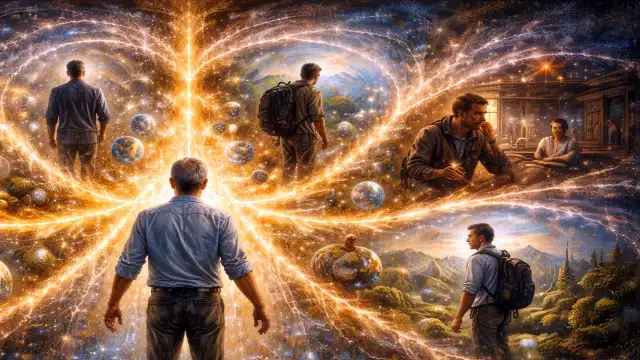
By the 1950s, a brilliant Princeton University doctoral student named Hugh Everett III decided to solve this exact problem. In 1957, Everett published a paper that completely revolutionized modern physics. He introduced the Many-Worlds Interpretation (MWI).
Essentially, Everett argued that wave functions never actually collapse. Instead, he proposed a radical alternative. Whenever a quantum event occurs, the universe actively splits. Consequently, every possible outcome physically happens in different, branching realities.
Imagine walking up to a fork in the road. You must choose left or right. Under Everett’s model, reality immediately fractures. In one universe, you go left. In an identical parallel universe, you walk right. Both versions of you are equally real. Moreover, both versions remain entirely unaware of the other’s existence because the branches never interact again.
So, what happens to Schrödinger’s cat under this theory? The cat does not sit in a weird zombie state. Instead, the universe splits. In one reality, the scientist opens the box and finds a dead animal. In the parallel branch, a different version of the scientist opens the box and finds a living, breathing pet.
“Quantum Suicide” thought experiment
By the late 1990s, scientists started applying Everett’s branching logic directly to human consciousness. Specifically, MIT physicist Max Tegmark published a highly controversial paper in 1998. He detailed a thought experiment that academics somewhat grimly call “quantum suicide”.
Please note, this is strictly a mathematical thought experiment used to debate theoretical physics. Nobody can or should ever test this in real life.
Tegmark basically put a human spin on the cat paradox. He wanted to know what the experience looks like from the perspective of the person sitting inside the box. How does an observer experience a universe actively splitting in half?
A Step-by-step breakdown of the setup
Here is exactly how Tegmark’s hypothetical scenario operates:
- The Setup: An experimenter sits completely still in a chair. A weapon is pointed directly at their head.
- The Trigger: The weapon connects to a highly advanced machine measuring the spin of a single quantum particle.
- The Odds: If the particle spins clockwise, the weapon fires instantly. If it spins counterclockwise, the weapon merely clicks safely. This creates a perfect, mathematical 50/50 chance of survival.
- The Execution: The experimenter turns the machine on.
If we view this from an outside perspective, the odds are terrifying. An external observer will likely watch the experimenter die very quickly. After just a few rounds, the mathematical probability of survival drops to practically zero.

However, the Many-Worlds interpretation paints a completely different picture for the person sitting in the chair.
How does consciousness shift between realities?

Let’s analyze the experiment from the subject’s exact point of view. Every time the machine measures the particle, the universe sharply splits into two distinct realities.
In World A, the weapon fires. The experimenter dies instantly.
In World B, the weapon clicks. The experimenter lives.
Here is where the magic of consciousness comes into play. According to the anthropic principle, a conscious observer can only observe a universe where they actively exist. Dead people do not have thoughts. They cannot process visual data. Therefore, you literally cannot experience World A.
Consequently, your perspective is bound entirely to World B. You hear a click.
The machine runs again. The universe splits again. Once more, you only experience the branch where your brain continues functioning. The machine clicks a second time.
Even if the terrifying machine runs one million times, you will only ever hear continuous clicks. From the outside, observers will watch you die almost immediately. Yet, from your own subjective viewpoint, you will feel completely invincible. You effectively become immortal because your consciousness endlessly shifts to the surviving parallel universe.
“Quantum Torment” problem
Before you start feeling like a cosmic superhero, we must discuss the dark side of this theory. Many philosophers point out a glaring flaw called “quantum torment.”Tegmark explicitly stated that the lethal event must be completely instantaneous. You must transition from alive to dead faster than your brain can process the change. If the weapon severely injures you instead of killing you instantly, your consciousness remains trapped in that specific reality. You would simply experience agonizing pain.
Furthermore, reality is rarely as clean as a 50/50 coin toss. There are millions of branching universes where you survive terrible accidents, but you end up paralyzed, comatose, or severely brain-damaged. Your consciousness would logically follow the path of survival, no matter how physically degraded that survival looks. Therefore, living forever might actually resemble an inescapable nightmare rather than a fun sci-fi adventure.

Why you shouldn’t bet on forever
Does this theory mean you will literally live forever? Absolutely not. You cannot jump off a tall building and expect to land on a magical bouncy castle in an alternate dimension.
There are massive limitations to this mind-bending hypothesis. First, the triggering event must rely entirely on a true quantum variable. Car crashes, heart attacks, and falling rocks are macroscopic events. They are governed by classical physics and thermodynamics, not subatomic probability.
Most importantly, quantum immortality absolutely does not prevent natural aging. Biological aging is a massive, thermodynamic process. It involves trillions of human cells gradually breaking down over decades. It is not a sudden quantum split. Eventually, entropy always wins. Your physical body will naturally fail in every single branch of the multiverse. Thus, no version of you escapes old age. You simply run out of viable universes where your biology can sustain consciousness.
Is this actual science or just Sci-fi?
Physicists heavily debate this topic today. Many brilliant minds consider the Many-Worlds Interpretation a mathematically sound, elegant explanation of reality. In fact, prominent researchers increasingly favor it over the old Copenhagen model.
However, the immortality aspect remains highly controversial. The biggest problem involves scientific falsifiability. Good science requires rigorous testing and peer review. Unfortunately, you cannot successfully communicate with alternate universes.
If you magically survived 100 rounds of the quantum experiment, you would know definitively that parallel universes exist. Sadly, you could never prove it to anyone else. Every time you tried explaining your survival, you would just look extremely lucky to the observers stuck in your specific branch. You would seem like a lunatic who miraculously survived a deadly game of chance. Consequently, quantum immortality remains firmly locked in the realm of philosophical thought experiments.
Wrapping up the multiverse mind-bender
Ultimately, quantum immortality is a fascinating puzzle. It seamlessly blends heavy theoretical physics with the deep, uncharted mysteries of human awareness. Truthfully, modern science still does not fully understand what consciousness actually is. Additionally, we are barely scratching the surface of quantum mechanics.
Perhaps our minds truly are tethered to the infinite, branching paths of the cosmos. Maybe every close call you ever survived was just reality splitting right before your eyes. While we may never get definitive mathematical answers, the concept certainly makes human life feel incredibly vast and mysterious.
What do you think about the Many-Worlds theory? Have you ever experienced a bizarre close call that felt like a reality glitch? Drop your wildest stories and thoughts in the comments below! Also, if this article completely warped your brain today, be sure to share it with a friend who loves deep space mysteries.
Sources:
- https://en.wikipedia.org/wiki/Many-worlds_interpretation
- https://www.reddit.com/r/PhilosophyofScience/comments/dunhy/to_the_many_worlds_quantum_theorists_place_your/
- https://en.wikipedia.org/wiki/Quantum_suicide_and_immortality
- https://physicscommunication.ie/is-the-universe-made-of-maths-the-debate-between-physics-and-philosophy/

