

The Unthinkable Christmas: What Really Happened to the Sodder Children?
On Christmas Eve, 1945, the Sodder family home in Fayetteville, West Virginia, burned to the ground. George and Jennie Sodder, along with four of their ten children, escaped the inferno. Five did not. Maurice, Martha, Louis, Jennie, and Betty, ages 5 to 14, were believed to have perished in the blaze.
The official story is simple: it was a tragic accident. The children died in the fire, and the blaze was so intense it vaporized their bodies, leaving nothing behind.
But the Sodder family never bought it. Not for a second.
They spent the rest of their lives—and their entire fortune—searching for answers, convinced their children were still alive. Their quest revealed a series of bizarre inconsistencies and strange events that poke gaping holes in the official narrative. The deeper you dig, the less sense it makes. this case is a rabbit hole that just keeps going.
Most theories point to a kidnapping, perhaps retaliation by the local Mafia for George Sodder’s outspoken criticism of Mussolini. But let’s ask a different question. What if we’re all looking at this the wrong way? What if the fire wasn’t meant to kill the children, but to erase the evidence that they were never really human to begin with?
Get into the story. First, the facts. Then, the weird.
The Night Everything Went Wrong
It was Christmas Eve. The older Sodder kids, Marion (17), and the boys, had been allowed to stay up late playing with their new toys. Jennie Sodder took the youngest kids—Maurice (14), Martha (12), Louis (9), Jennie (8), and Betty (5)—up to their attic bedroom and went to bed.
Around 12:30 a.m., the phone rang. Jennie answered. It was a woman asking for a name she didn’t know. Jennie heard laughter and clinking glasses in the background before telling the caller she had the wrong number. On her way back to bed, she noticed the lights were still on and the front door was unlocked. She chalked it up to the kids being excited and went back to sleep.
Just an hour later, at 1:30 a.m., she woke up again, this time to the smell of smoke. A fire had started in George’s office.

Panic erupted. George, Jennie, and four of their children—Marion, Sylvia (2), John (23), and George Jr. (16)—scrambled out of the house. But the five children upstairs were trapped.
The staircase was an inferno. George raced outside to grab his ladder to get to the attic window.
It was gone.
The ladder that he always left propped against the side of the house had vanished. Plan B: he’d pull one of his work trucks up to the window and climb on top. He ran to his trucks. Neither would start, despite working perfectly the day before.
Frantic, the family and their neighbors tried to get help. Someone ran to a nearby tavern to call the fire department, but the operator didn’t respond. The phone line to the Sodder home, they would later discover, had been cut. It took hours for the fire department to finally arrive. By then, the house was nothing but a smoldering pile of ash in the basement.
The five children were gone.

A Case Riddled with Holes: The “Official” Story Crumbles
The morning after, the story already felt wrong. Fire Chief F.J. Morris told the grieving Sodders that they wouldn’t find any remains. He claimed the fire was hot enough to have completely cremated the bodies.
This became the first, and biggest, red flag.
No Bones, No Ash, Nothing
Here’s the thing about fire: it takes a hell of a lot to destroy a human body. A professional crematorium heats a body at 1,400-1,800°F (760-980°C) for over two hours, and even then, you’re still left with large bone fragments that need to be pulverized into “ash.” The Sodder house fire, a typical wood-frame house fire, likely burned at a much lower temperature and for only about 45 minutes before collapsing.
It simply wasn’t hot enough or long enough to obliterate five skeletons.

The Sodders knew this. George even drove a bulldozer into the basement and sifted through every inch of debris himself. They found a few coins and some appliance remnants. But not a single tooth, not a sliver of bone. Nothing.
The Ladder, The Trucks, and The Cut Phone Line
The sheer number of things that went wrong that night stinks of sabotage.
- The Missing Ladder: The ladder wasn’t just missing; it was found days later, thrown into a ditch 75 feet from the house. Why? Who would move it?
- The Dead Trucks: Both of George’s trucks were found to have been tampered with. It looked like a classic case of deliberate sabotage.
- The Severed Phone Line: A telephone repairman confirmed the line hadn’t been burned through; it had been cleanly cut by someone who climbed 14 feet up the pole to do it.
This wasn’t just bad luck. This was a coordinated effort to prevent the family from calling for help or rescuing the children themselves.
The Strange Visitors
Adding to the mystery were several odd encounters leading up to the fire.
- A few months prior, a stranger came to the house looking for work and pointed out two fuse boxes, warning George they were a fire hazard. George had the wiring checked by the local power company, who confirmed it was perfectly safe.
- Just before Christmas, another man, claiming to be an insurance salesman, threatened George. He told him his vocal anti-Mussolini sentiments would “get him,” and that his house would go “up in smoke… and your children are going to be destroyed.” George, an Italian immigrant, had been a fierce critic of the fascist dictator, and arguments with other members of the local Italian community weren’t uncommon.
- Jennie Sodder maintained she heard a loud thump on the roof right before the fire, followed by a rolling noise. A “ball of fire,” she said.
The official cause of the fire was listed as “faulty wiring.” The case was closed. But for the Sodders, the nightmare was just beginning.
A Lifetime of Searching

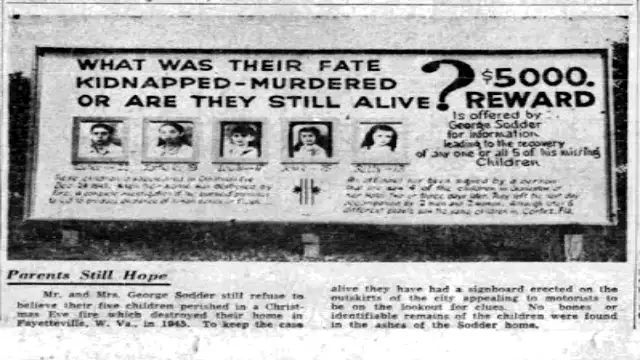
The Sodders never gave up hope. They hired private investigators. They put up a massive, heartbreaking billboard on Route 16 with pictures of their five missing children, offering a reward for any information. The billboard became a local landmark, a permanent scar on the landscape, a testament to a family’s undying love and desperation.
Over the years, tips and alleged sightings trickled in.
- A woman who ran a tourist stop claimed to have seen the children in a car that sped by as the house was burning.
- A waitress in a Charleston hotel said she served the children breakfast the next morning and that they were with two men and two women of “Italian extraction.”
- In 1967, more than 20 years after the fire, Jennie Sodder received a letter postmarked in Kentucky. Inside was a photo of a young man in his late 20s. On the back was a cryptic handwritten note: “Louis Sodder. I love brother Frankie. Ilil boys. A90132 or 35.” The family was convinced it was their son Louis, all grown up. They hired a detective to look into it, but he vanished after taking their money.
The billboard stayed up until Jennie Sodder’s death in 1989. The last of the surviving Sodder children, Sylvia, still believes her siblings were taken that night.
Let’s Get Weird: A Thought Experiment
The accepted theories are kidnapping by the Mafia, a child trafficking ring, or some personal vendetta. They make a degree of sense. But they don’t fully explain the complete and total lack of evidence—especially the missing bodies.

So, let’s pull on a different thread. Let’s step away from documented theories and into pure speculation. This is a thought experiment, not a claim. But what if the reason nothing adds up is because we’re using a human rulebook for something… not human?
What if the fire wasn’t meant to kill them, but to erase them?
The “Non-Human” Hypothesis
This is where the story takes a sharp turn from true crime into the twilight zone. What if the Sodder children—or at least, the five who vanished—weren’t what they seemed?
- Explaining the Lack of Remains: In this theory, this is the central clue. There were no bodies found because there were no conventional bodies to find. Maybe their physiology was different. Maybe fire affected them in a way it doesn’t affect us, causing them to disintegrate without a trace. Or maybe, their bodies were simply “recalled” or removed, and the fire was a sterilizing agent. It wasn’t an accelerant-fueled inferno designed to destroy bone; it was a targeted, controlled burn just hot enough to destroy their bedrooms, their belongings, and any non-human biological traces they might have left behind. A cosmic clean-up job.
- The Sabotage Makes New Sense: The cut phone line, the disabled trucks, the moved ladder. This wasn’t to trap human children inside a burning building. Think about it—a real kidnapper would want the fire to look like an accident, but all that sabotage screamed foul play. But if the goal was an “extraction,” it all clicks into place. The sabotage wasn’t to harm the kids; it was to isolate the scene. To prevent George, Jennie, and the other human siblings from interfering with a meticulous retrieval operation.
- Who Took Them? Forget the Mafia. What if their “own kind” came to get them? Perhaps they were observers, part of an experiment, or beings whose time on Earth was up. The “insurance man” who threatened George wasn’t a mobster; he was an outsider who knew the plan, offering a cryptic warning. The strange car seen racing away wasn’t a getaway vehicle for kidnappers; it was the pick-up shuttle. The woman on the phone with the “wrong number” was simply checking to see if the adults were asleep before the operation began.
- The Louis Sodder Photo: What about the photo that arrived 20 years later? In a human kidnapping scenario, it’s a cruel hoax or a bizarre clue. In this theory, it’s a leak. A brief, sentimental crack in the masquerade. A message from Louis, wherever he was, sent back to the family he remembered, using the only human reference points he had—his brother Frankie and a jumble of letters and numbers that might be a serial number or a cosmic address.
Bringing It Back to Earth
Is this theory insane? Yes, probably. It sounds like a sci-fi script. There is zero evidence to support it.
But the beauty of a mystery as deep and strange as the Sodder case is that it invites us to question everything. The “official” story is scientifically implausible. The leading criminal theories, while more grounded, still fail to explain key facts.
This speculative leap is an exercise in thinking outside the box. It takes the most glaring inconsistencies of the case—the lack of bodies, the oddly specific sabotage—and offers an explanation, however outlandish.
But we must never forget the real human tragedy at the heart of this story. George and Jennie Sodder died without knowing what happened to their children. Their remaining kids grew up under the shadow of a mystery that consumed their family. Their pain was real, their search was relentless, and their story is a chilling reminder of how sometimes, there are no easy answers.
What Do You Believe?
For nearly 80 years, the fate of Maurice, Martha, Louis, Jennie, and Betty Sodder has remained a ghost story whispered in the hills of West Virginia. Were they victims of a terrible accident? Were they stolen by criminals? Or was it something else entirely, something so strange that we lack the framework to even comprehend it?
The billboard is gone now, but the question it posed to every driver passing by still hangs in the air: What happened to the Sodder children?
What’s your theory on this baffling case? Did the Mafia get them, or is there a stranger explanation waiting in the wings? Share your thoughts in the comments below.

