

What Was the Wow! Signal? The Alien Message We Never Heard Again
On August 15, 1977, a giant radio telescope in Ohio was quietly listening to the cosmos, as it did every night. It was part of a SETI project—the Search for Extraterrestrial Intelligence. Mostly, it heard the background static of the universe, the hiss of distant, dead stars.
But on that night, for 72 seconds, something shouted back.
A few days later, a volunteer astronomer named Jerry Ehman was doing the decidedly unglamorous job of reviewing the computer printouts from that observation. He was scanning columns of numbers and letters, looking for… well, anything.
And then he saw it.
On the printout, a string of characters stood out like a flare in the dark: 6EQUJ5.
Ehman’s heart must have been pounding. He grabbed a red pen, circled the sequence, and in the margin, he wrote the only thing that made sense.
“Wow!”
For nearly 50 years, that single word has defined the greatest cosmic mystery of our time. It was a signal that, for one fleeting moment, ticked every single box for a potential alien message. It was loud. It was precise. It came from deep space. And then, it was gone.
It has never, ever been heard again.
So, what did the “Big Ear” telescope hear? Was this a cosmic fluke, a freak of nature, or the one and only time humanity picked up a missed call from an alien civilization?
The “Big Ear” and the Man Who Was Listening
First, let’s get one thing straight. The “Big Ear” telescope at Ohio State University wasn’t a sleek, modern dish you see in movies. It was a beast. It was a non-steerable, grid-like contraption the size of three football fields.
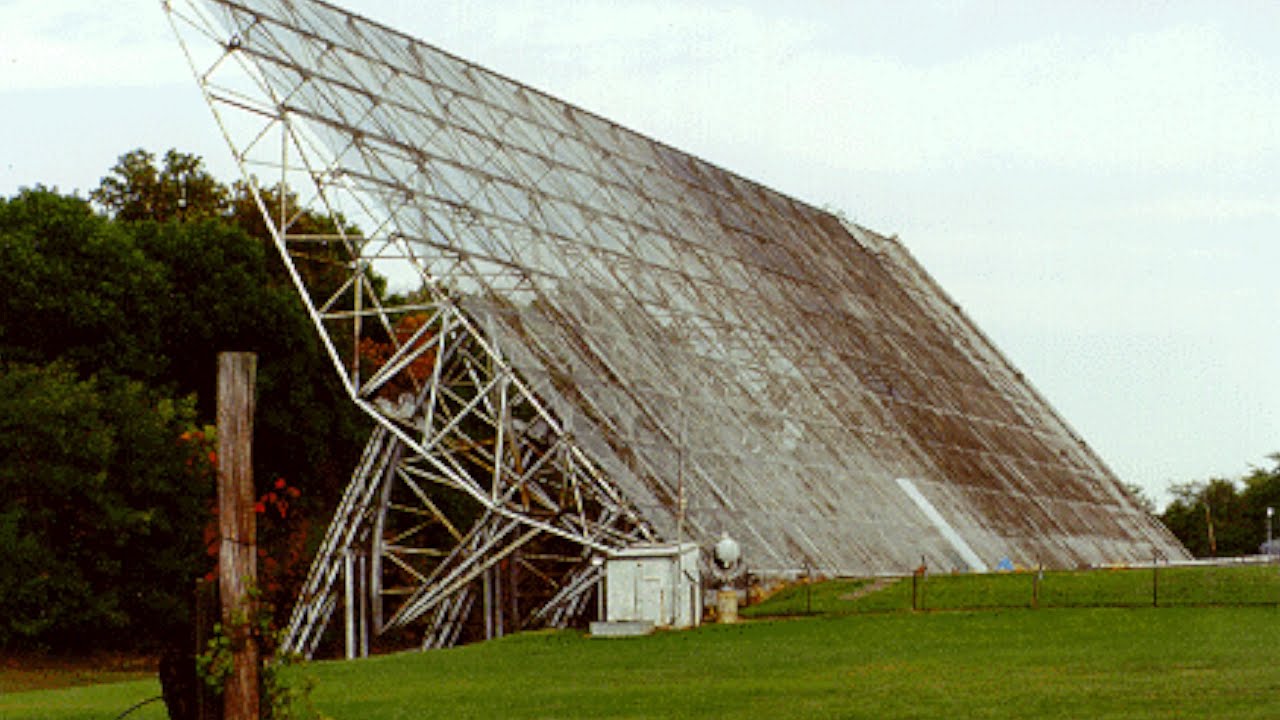
It worked like this: instead of moving to point at things, it stayed still and let the Earth’s rotation do the work. As the planet spun, the telescope’s “gaze” swept across a narrow strip of the sky. This is called a “drift scan.”
It had two “feed horns,” or receivers, sitting side-by-side. Think of it like a shotgun with two barrels. Anything that crossed its path would be seen by the first horn, and then, about three minutes later, by the second horn. This was a crucial design feature to filter out false positives. A real, deep-space signal had to appear in both.

On that night in 1977, Jerry Ehman was just a volunteer. He wasn’t expecting to find anything. He was just checking the data.
Decoding “6EQUJ5”: This Wasn’t a “Message”
This is the biggest misconception about the Wow! signal. The code 6EQUJ5 isn’t an alien message. It’s not a secret language.
It was a strength meter.
Here’s how it worked: The computer measured the signal’s strength every 12 seconds. It assigned a number or letter to how much louder the signal was than the normal, background static.
- 0-9: Meant 0 to 9 times stronger than background noise.
- A-Z: Meant 10 to 35 times stronger than background noise.
So, let’s look at the code “6EQUJ5” again:
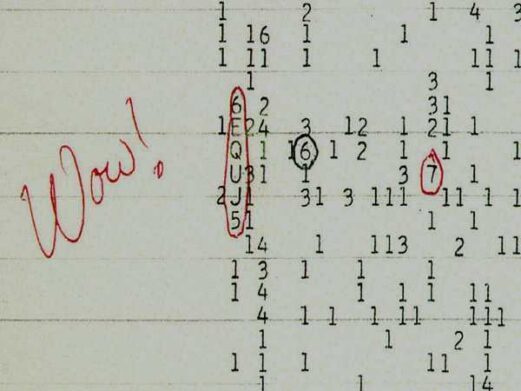
- 6: The signal was 6x stronger than background noise.
- E: It jumped to 14x stronger.
- Q: It jumped again, to 26x stronger.
- U: It peaked at 30 times stronger than the background noise. This was insanely loud.
- J: It began to fade, dropping to 19x stronger.
- 5: It faded back down to 5x stronger… before disappearing back into the static.
This beautiful bell curve—rising in intensity and then falling—is exactly what you’d expect to see. The 72-second duration wasn’t how long the “message” was. It was the exact amount of time it took for the telescope’s “gaze” to sweep past a fixed point. The signal rose as the telescope aimed at it, peaked when it was dead-center, and faded as it moved away.
The data was a perfect match. But it was the signal itself that was so shocking.
Why This Signal Made a Scientist Write “Wow!”
This wasn’t just any signal. It fit every single criterion for a hypothetical “Hello!” from an alien intelligence. It was a SETI scientist’s dream.
1. It Was at the “Watering Hole”
This is the big one. The signal was at a frequency of ~1420.4556 MHz.
To a normal person, that’s meaningless. To an astronomer, that frequency is sacred. It is, for all intents and purposes, the “property of hydrogen.”
Neutral hydrogen, the most common element in the universe, naturally emits energy at 1420.4057 MHz when its electron “flips.” This is known as the hydrogen line.
For decades, SETI scientists have theorized that this would be the perfect channel for interstellar communication. It’s a “quiet” channel, protected by international treaty from Earth-based transmissions. Because it’s so fundamental to the universe, any civilization advanced enough to build a radio transmitter would know about it.
They call it the “watering hole”—the cosmic channel where all intelligent life might, logically, meet to “talk.”

The Wow! signal was sitting right on its doorstep.
2. It Was a Narrowband Whistle
Natural objects in space (like pulsars or quasars) are “noisy.” They broadcast radio signals across a huge, messy range of frequencies. This is called “broadband.” It’s like a cosmic hurricane of static.
Our technology (like a radio station) is “narrowband.” It broadcasts a clean, powerful signal at one specific spot on the dial.
The Wow! signal was a narrowband signal. It was less than 10 kHz wide. It was a single, pure “whistle” in the middle of a cosmic hurricane. In 1977, the only thing we knew of that could produce such a clean signal was… technology.
3. It Came From Deep Space (Probably)
The signal came from the direction of the constellation Sagittarius, near a globular star cluster called M55. More importantly, it showed a “sideral” or “sidereal” drift.
In simple terms: It wasn’t moving with the Earth. It was holding still while the Earth spun past it.
This is a critical piece of evidence. It rules out a signal from Earth, or even a satellite in orbit. A signal from Earth would have been “fixed” and would have filled the receiver for hours. A satellite would have moved much faster. This thing was stationary, far out in deep space.
The Big Problem, and the Hunt for “Natural” Answers
There’s one, giant, inescapable problem with the Wow! signal.
It was only seen by one of the two feed horns.
Remember the double-barrel shotgun? A real source from deep space should have passed over the first horn, and then, about three minutes later, passed over the second.
The Wow! signal appeared in one horn… and then vanished. It wasn’t in the second horn. This means that whatever it was, it either:
- Turned on, broadcast for 72 seconds, and then turned off forever in the three-minute window before the second horn could see it. (This is the spooky “aliens said hello and left” theory).
- It was an Earth-based signal that was reflected off a piece of space debris in just the right way to mimic a deep-space source. (This is incredibly unlikely, but not impossible).
- It was a natural phenomenon we just don’t understand.
For decades, people have tried to find a natural explanation.
The Comet Theory (and Why It’s Probably Wrong)
The most famous “debunk” came in 2017. A researcher, Antonio Paris, proposed that the signal came from a previously undiscovered comet (or two) that just happened to be in that part of the sky.
The theory: Comets release a massive cloud of hydrogen gas as they get near the sun. This hydrogen cloud could, in theory, broadcast at the hydrogen line frequency.

It sounded plausible. It made headlines. But the scientific community, including Jerry Ehman himself, overwhelmingly rejected it.
Here’s why it doesn’t hold water:
- The “Two-Horn” Problem: A comet’s hydrogen cloud is massive—millions of miles across. It’s not a tiny “point source.” It would have been seen by both of the Big Ear’s feed horns, not just one.
- The Signal Strength: Comets are “cold.” The hydrogen they release isn’t excited enough to produce a signal 30 times stronger than the background noise. The math just doesn’t work.
- The Location: Other astronomers checked the orbital data. The comets in question weren’t exactly in the right spot at the right time.
The comet theory was a good try, but it created more problems than it solved.
The Newest Theory: A Cosmic “Maser”?
As recently as August 2024, a new hypothesis emerged from the “Arecibo Wow!” project. This team suggests the signal could have been a “hydrogen maser flare.”
In simple-talk, this is a very rare event where a cloud of cold hydrogen gas is blasted by a huge burst of energy from something like a magnetar (a hyper-magnetic dead star). This energy flash could make the hydrogen cloud light up like a laser at its natural frequency, creating a temporary, super-bright, narrow signal.
This is a compelling natural explanation… but it’s also a theory. It’s a phenomenon that has never actually been observed.
The Verdict: A Ghost in the Machine
So… was it aliens?
The honest, scientific, and slightly-less-fun answer is: We don’t know. And we can’t say “yes.”
Science demands repeatability. You have to be able to see it twice. To get that second data point. In nearly 50 years, and with hundreds of follow-up searches of that exact patch of sky with far more powerful telescopes, we’ve found nothing. Silence.
The Wow! signal is not proof of anything. It is, by definition, an anomaly. It’s a single, perfect data point that fits all our theories but refuses to give us the one thing we need: more.
It’s the ultimate “one-hit wonder.”
It’s a ghost story for astronomers. A single, 72-second “Wow!” in the dark from an unknown source, which has haunted the search for alien life ever since. It’s a tantalizing, goosebump-inducing reminder that the universe is vast, and we have only just started to listen.
So, what’s your take? Was the Wow! signal a cosmic fluke, a rare natural event, or a missed call we’ll never get back? Share your theories in the comments below!

