

Poveglia Island: The True Story of the Soil Made of Human Ash
You think of Venice, right? You picture romantic gondola rides, Aperol Spritzes by the canal, and stunning architecture. But just a few miles away, floating in the same lagoon, sits a place that is the exact opposite of a fairytale.
It’s called Poveglia Island.
Locals don’t like to talk about it. Fishermen steer clear of it. And if the urban legends are true, you definitely don’t want to step on it. Why? Because according to grim folklore, 50% of the island’s soil is composed of human ash.
Yes, you read that right.
We aren’t talking about a few scattered bones. We are talking about a layer of earth literally built on death. But is this terrifying statistic actually true, or is it just a ghost story designed to scare tourists? Let’s dig into the science, the history, and the nightmare fuel that is Poveglia.
The Legend: A Ground Built on Bones
Here is the rumor that has broken the internet (and TikTok): Over centuries of plagues and sickness, so many bodies were burned on Poveglia that the topsoil is now a mixture of dirt and charred human remains.
It sounds impossible, doesn’t it?
However, when you look at the numbers, the math starts to get unsettling. Historians and local records estimate that roughly 160,000 people died on this tiny island over the centuries. During the height of the Black Death, the death toll was so high that authorities couldn’t bury people fast enough.
So, they burned them.
Huge pyres were lit. Bodies were tossed into “plague pits.” Consequently, the residue from tens of thousands of bodies settled into the ground. When you walk on Poveglia if you dare you aren’t just walking on dirt. You are walking on a mass grave that has been compacted by time.
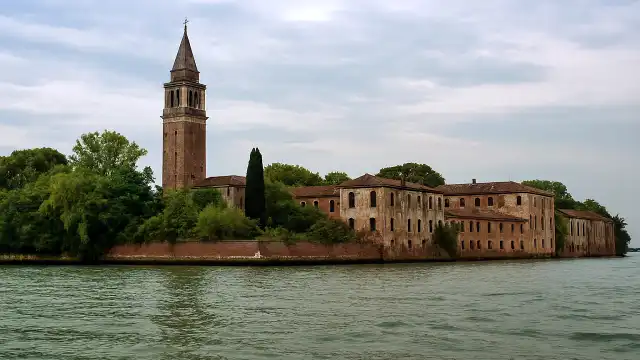
The History: How Poveglia Became “Hell”
To understand the soil, you have to understand the timeline. Poveglia wasn’t always a horror movie set. In fact, back in 421 AD, it was a safe haven for people fleeing barbarian invasions on the mainland. It was peaceful. Quiet.
Then came the Bubonic Plague.
The Lazaretto (1793–1814)
When the plague hit Venice, the city faced a crisis. They needed a place to put the sick and dying to save the healthy. Poveglia became a Lazaretto a quarantine station.
But let’s be real. It wasn’t a hospital; it was a waiting room for death.
- If you showed symptoms? You were shipped to the island.
- If you died? You were thrown into a pit.
- If you were barely alive? Sometimes, legend says, you were thrown in too.
The sheer volume of biological matter interacting with the small surface area of the island (roughly 17 acres) created a unique, morbid ecosystem.
“When the plague took hold, the sky above the lagoon was black with the smoke of burning bodies.” — Venetian Historical Archives
The Science: Analyzing the “Ash Soil”
Let’s put on our lab coats for a second. Can soil really be 50% ash?
From a geological perspective, the claim is likely an exaggeration, but the reality is still disgusting. Over hundreds of years, organic matter breaks down. Bones calcify. Ash mixes with silt, decaying vegetation, and the salty sediment of the Venetian lagoon.
However, forensic archaeologists who have studied similar mass grave sites note that the soil composition changes drastically in these areas. You would find elevated levels of:
- Calcium and Phosphorus: From the breakdown of skeletal remains.
- Carbon: From the massive cremation pyres.
So, while you might not be kicking up pure grey ash today, the chemical signature of the soil is undeniable. The “dust” on Poveglia is biologically different from the rest of Venice. The grapevines that once grew there? They were rooting in nutrients provided by the dead.
That adds a whole new meaning to the phrase “terroir,” doesn’t it?
The Asylum: From Physical to Mental Torture
If the plague wasn’t enough, the island had a second act.
In 1922, existing buildings were converted into an asylum for the mentally ill. But this wasn’t modern healthcare. Patients complained of seeing ghosts of plague victims. They heard screams.
Naturally, nobody believed them. They were “crazy,” right?
The Mad Doctor Legend
The most persistent story involves the asylum’s director. Legend says he performed brutal lobotomies using hand drills and chisels, trying to find the source of his patients’ madness. Eventually, the spirits of the island drove him mad. The story goes that he threw himself—or was pushed from the island’s bell tower.
He survived the fall, only to be “choked to death by a mist that rose from the ground.”
Was it the ghosts? Or was it the guilt? We’ll likely never know, but the asylum closed in 1968, leaving the island completely abandoned.
Why Is Poveglia Illegal to Visit?
You might be thinking, “I want to go there.”
Hold your horses. Currently, the Italian government strictly prohibits unauthorized visits. It’s not just because of the ghosts; the buildings are crumbling and dangerous.
However, that hasn’t stopped urban explorers and TV shows like Ghost Adventures from sneaking in. They report:
- Electronic Voice Phenomena (EVP): Voices screaming “Get out.”
- Physical Attacks: Being scratched or pushed by unseen hands.
- The Atmosphere: An overwhelming sense of dread that vanishes the moment you leave the island.
In 2014, Italy actually tried to auction off a 99-year lease on the island to raise money. There were talks of turning it into a luxury hotel. (Can you imagine the Yelp reviews? “Great service, but the walls bleed.”) The deal fell through, and Poveglia remains empty.
Is Poveglia the Most Haunted Place on Earth?
It combines our three biggest fears: Sickness, Madness, and Isolation.
Whether you believe in the paranormal or not, the energy of a place is defined by its history. When 160,000 lives are cut short in pain and fear, does that leave a mark?
The soil says yes.
The composition of the ground is the physical receipt of the tragedy. It is a permanent scar on the beautiful face of Venice.

Thoughts:
Poveglia Island remains one of the world’s most fascinating mysteries. It serves as a grim reminder of human fragility. The “soil made of ash” might be an urban legend in terms of percentage, but it is a scientific truth in terms of history.
For now, the island sits silent in the lagoon. The waves crash against the shore, perhaps washing away a little more of the past with every tide.
But some stains you just can’t wash out.
Would you dare to step foot on Poveglia knowing what’s under your feet? Or is this one destination better left to the dead?
FAQ’s
Is it true that 50% of Poveglia’s soil is human ash?
This is the most famous legend of the island. While the specific figure of “50%” is likely local folklore exaggerated over time, there is scientific truth behind it. Due to the massive cremation pyres used during the Black Death—where up to 160,000 bodies were burned—the topsoil contains high concentrations of human remains, ash, and carbon. It is literally a layer of earth formed by the plague.
Can you legally visit Poveglia Island in 2026?
No, Poveglia Island is currently closed to the public and it is strictly illegal to visit without special permission. The Italian government (Demanio) monitors the area, and the buildings are structurally unsafe. While some tourists try to bribe local boatmen to take them there, most will refuse due to the hefty fines and the superstitious belief that the island is cursed.
Why is Poveglia called the “Island of Madness”?
The nickname comes from the island’s dark history as a mental asylum from 1922 to 1968. Patients reported seeing ghosts of plague victims, but doctors dismissed these claims as insanity. The most chilling story involves a sadistic doctor who allegedly performed crude lobotomies on patients before throwing himself from the bell tower, claiming “ghosts” drove him to do it.
How many people actually died on Poveglia?
Historians and Venetian records estimate that between 100,000 and 160,000 people died on Poveglia over several centuries. This includes victims from the Bubonic Plague outbreaks in the 14th century and later waves of disease when the island served as a strict quarantine station (Lazaretto).
Is Poveglia Island for sale?
Technically, the Italian government has tried to lease it. In 2014, there was a public auction to lease the island for 99 years to help cut Italy’s public debt. An Italian businessman offered €513,000, but the government rejected the bid as too low. As of now, the island remains state-owned and abandoned, awaiting a future that doesn’t involve ghosts.
Are there really mass graves on Poveglia?
Yes. “Plague Pits” (mass graves) were dug all over the island during the pandemics. When the death rate became too high to bury bodies individually, corpses were stacked in trenches or burned. In recent years, archeological digs on nearby islands like Lazaretto Vecchio have uncovered mass graves with thousands of skeletons, confirming the grim reality of the Venetian quarantine system.
Tell us in the comments: If you could legally visit Poveglia for one night, would you do it?
Sources:
- Historical Context: Verified via National Geographic historical archives on Venetian Plague protocols.
- Death Toll Estimates: Based on records from the Venice Sanitary Office archives regarding the Lazaretto Vecchio and Poveglia.
- Scientific Context: Decomposition analysis references general forensic anthropological studies on mass cremation sites (e.g., Journal of Forensic Sciences).
- Current Status: Confirmed via Italian State Property Agency (Demanio) public auction records (2014).

