

What Happened to the Radium Girls? The Dark True Story of “Radium Jaw”
Ever heard of a job that literally made you glow in the dark? Sounds like a cool sci-fi superpower. Back in the 1910s and 1920s, hundreds of young American women landed exactly that gig. They painted watch dials with a magical, glowing substance. They were paid well. Furthermore, everyone told them the work was entirely safe.
Spoiler alert: It wasn’t.
Ultimately, these women paid the ultimate price for corporate greed. Their bodies broke down. Their bones literally disintegrated. Consequently, their fight for justice changed American labor laws forever. This is the tragic, enraging, and deeply important story of the Radium Girls.
Key takeaways;
- The Job: Young women in the 1910s and 1920s were hired to paint military and civilian watch dials using radium-infused paint.
- The Technique: Supervisors told the girls to “lip, dip, paint” (point the brushes with their mouths), leading them to swallow massive amounts of radioactive material.
- The Disease: Ingesting radium caused a horrifying condition known as “radium jaw,” where the jawbone decayed, honeycombed, and fell apart.
- The Cover-Up: Companies like the U.S. Radium Corporation actively lied about the dangers, silencing doctors and delaying lawsuits.
- The Legacy: The legal victories of women like Grace Fryer and Catherine Donohue paved the way for modern workplace safety laws and the creation of OSHA.
Glowing dream job of the 1920s
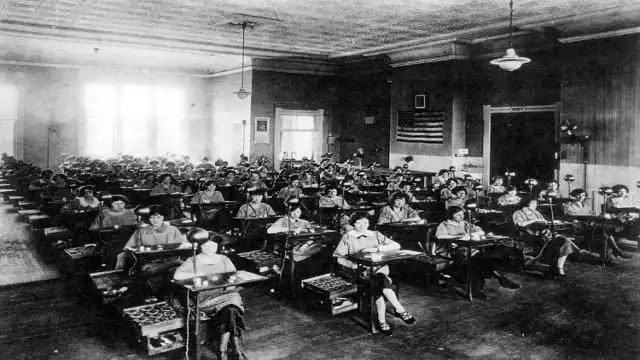
World War I is raging, and soldiers desperately need watches they can read in the pitch-black trenches. Suddenly, a miraculous solution appears. Using a freshly discovered element called radium, factories whipped up a luminescent paint branded as “Undark”.
Naturally, companies needed workers with small, steady hands to paint the tiny numbers on watch faces. Enter the dial painters. These were mostly working-class women in their late teens and early twenties. For them, landing a job at a factory like the United States Radium Corporation (USRC) in Orange, New Jersey, felt like hitting the jackpot.
The pay was incredible for the era. Some girls made roughly a penny and a half per dial, allowing them to take home $3.75 a day (about $94 today). Moreover, the environment was fun. The factory floors were filled with chatting friends, sisters, and neighbors.
Because radium dust floated everywhere, it settled on the workers’ clothes, hair, and skin. Consequently, they earned the nickname “ghost girls.” After their shifts, they would walk home glowing brightly under the streetlights. Some even painted their teeth to show off glowing smiles at weekend dance parties. Why wouldn’t they? After all, scientists and executives absolutely swore the paint was harmless.
“Lip, Dip, Paint”

How exactly did the poison get inside them? It came down to a penny-pinching corporate instruction.
Painting millimeter-thin numbers required a razor-sharp brush. However, after a few strokes, the camel-hair bristles would lose their shape. When the girls asked for water rags to clean their brushes, management said no. Rags wasted too much time and expensive material.
Instead, bosses instructed the women to use their lips and tongues to twist the bristles back into a fine point. “Lip, dip, paint.” That was the official mantra.
Every single time a worker put that brush in her mouth, she swallowed a tiny dose of radium. Some girls painted 250 dials per shift. Over the years, they unknowingly ingested hundreds, sometimes thousands, of microcuries of a highly radioactive metal.

Are you cringing yet? It gets worse.
Grisly reality of “Radium Jaw”

To understand what happened next, you need a quick chemistry lesson. Radium and calcium share very similar chemical properties. Because of this, the our body cannot tell them apart.
When you drink a glass of milk, your body sends the calcium straight to your bones to make them stronger. Unfortunately, when the Radium Girls swallowed glowing paint, their bodies mistook the radium for calcium. The radioactive element marched directly into their skeletons and settled there permanently.
Once lodged inside the bone tissue, the radium began decaying. It fired off alpha particles constantly, basically machine-gunning the women’s cells from the inside out.
By the early 1920s, the horrific side effects started showing up. It usually began with a severe toothache. A girl would go to the dentist to get the bad tooth pulled. Instead of healing, the empty socket would fester, ooze pus, and form painful ulcers. Then, the next tooth would rot. And the next.
Doctors eventually named this occupational disease radium jaw (technically known as radium necrosis).
Heartbreaking case of Mollie Maggia
Mollie Maggia was one of the first dial painters to fall seriously ill. Initially, her symptoms seemed like ordinary dental trouble. Soon, the severe pain radiated down her limbs, leaving her unable to walk.
Dentists were completely baffled. No matter what they tried, Mollie’s infections simply worsened. Her jawbone was literally disintegrating inside her head. By the end of her life, the decay was so catastrophic that her dentist reached into her mouth and gently lifted her entire lower jaw straight out. It snapped right off, completely dead.
Tragically, Mollie died in 1922, just days before her 25th birthday. Her death certificate wrongly listed syphilis as the cause, a final insult that haunted her grieving family. Dozens of other women soon followed, suffering from extreme anemia, shattered bones, and massive tumors.
Corporate Cover-ups and Fake science
You might be wondering: Didn’t anyone know radiation was dangerous?
Actually, yes. The executives at USRC absolutily knew. The scientists handling the pure radium in the back labs wore lead aprons and used metal tongs. USRC had even published literature for the medical community detailing the “injurious effects” of the element.
Yet, the company flat-out lied to the women on the factory floor.
To make matters worse, the general public was obsessed with radium. Quack doctors hailed it as a miracle cure-all. You could buy radium-laced toothpaste, face creams, and even health tonics like Radithor. People genuinely believed radiation added “vitality” to the body.
When the dial painters started dropping dead, the U.S. Radium Corporation launched a massive cover-up. They hired experts to publish fake studies claiming the girls were completely healthy. They smeared the victims’ reputations. Whenever a sick worker asked for financial help with her towering medical bills, the company slammed the door in her face.
Grace fryer and the New jersey five

Eventually, the girls realized nobody was going to save them. They had to save themselves.
In New Jersey, a former dial painter named Grace Fryer decided to sue USRC. By this point, her spine was literally crushing itself due to bone decay, forcing her to wear a heavy steel back brace.
Finding a lawyer was nearly impossible. The corporation was rich, powerful, and closely tied to the military. Furthermore, New Jersey had a tricky two-year statute of limitations on occupational injuries. Since the radium poisoning took years to manifest, most lawyers claimed the girls’ legal window had already closed.
Finally, in 1927, an attorney named Raymond Berry took the case on a contingency basis. Grace was joined by four other dying women: Edna Hussman, Katherine Schaub, and sisters Quinta McDonald and Albina Larice. The press dubbed them the “Radium Girls.”
Grueling court battle

The legal defense tried to stall the trial at every turn. They knew the clock was ticking on the plaintiffs’ lives. By the time the first court hearing rolled around in January 1928, the women were so weak that none of them could even raise their right arms to take the oath.
Public outrage exploded. The media heavily covered the trial, publishing photos of the bedridden “walking dead”. National sympathy put massive pressure on the legal system.
Ultimately, the judge ruled that because the radium was still actively sitting inside their bones and destroying tissue, the injury was “continuous”. Therefore, the statute of limitations didn’t apply.
Sensing a PR nightmare, the company settled out of court. The women each received $10,000 (about $188,000 today), plus a $600 annual pension and full coverage of their medical bills. Sadly, money couldn’t buy a cure. All five of these incredibly brave women passed away by the 1930s.
Illinois tragedy: Catherine donohue’s final days
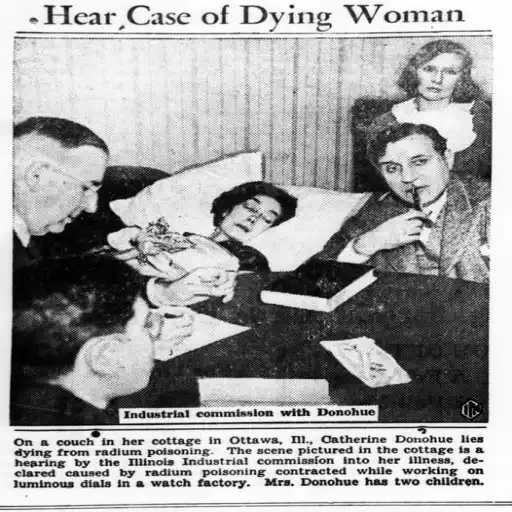
Meanwhile, a separate tragedy was unfolding out West.
In Ottawa, Illinois, the Radium Dial Company had hired its own crew of young women during the 1920s. The management there knew exactly what was happening in New Jersey. Nevertheless, they continued encouraging their workers to lip-point the brushes, swearing the paint was harmless.

Catherine Donohue was one of those painters. She loved her job, but by the 1930s, her body was completely breaking down. A grapefruit-sized tumor grew on her hip. Her teeth fell out. Eventually, she weighed less than 70 pounds.
Despite her agonizing pain, Catherine chose to fight. Alongside her friends, she sued Radium Dial in 1937. Her lawyer, Leonard Grossman, worked for free.
Catherine’s dedication to exposing the truth was nothing short of heroic. When she became too sick to travel to the courtroom, the legal commission literally brought the hearing to her living room. She gave her official testimony while lying on her couch, tucked in a cotton nightgown, with her heartbroken husband by her side.
She reportedly told the room, “It is too late for me, but maybe it will help some of the others.”
Catherine won her case before the Illinois Industrial Commission in 1938. She died just weeks later at the age of 35. Her husband eventually received a meager $5,700 payout after the Supreme Court rejected the company’s final appeal. But her legacy? That was priceless.
How the Radium Girls changed your life today
It is incredibly easy to read history and feel disconnected from it. However, the suffering of the Radium Girls directly impacts the modern world. Their sacrifices built the foundation for the rights that keep you safe at your job right now.
Here is exactly what their grueling legal battles accomplished:
- Establishing Occupational Disease Laws: Before these lawsuits, getting sick from your job wasn’t treated the same as getting injured by falling machinery. The Radium Girls forced the legal system to recognize that silent, long-term toxic exposure is a direct corporate responsibility.
- The Creation of OSHA: Their story laid the historical groundwork for the Occupational Safety and Health Administration (OSHA), which was officially established in 1970. If your boss provides you with safety goggles, ventilation, or hazardous materials training, you can thank the dial painters.
- Nuclear Safety Standards: During World War II, the U.S. government launched the Manhattan Project to build the atomic bomb. Scientists specifically studied the medical records of the Radium Girls. Consequently, they established strict radiation handling protocols that protected thousands of workers.
- The Death of Quack Medicine: The intense media scrutiny helped push the Federal Trade Commission to ban radioactive consumer products. The days of swallowing glowing health tonics finally came to an end.
A Haunting legacy that still glows
The Radium Girls weren’t just victims; they were fierce pioneers. They were young women who faced down powerful corporations, corrupt doctors, and an unfair legal system while their own bodies were literally disintegrating.
They refused to go quietly. Instead, they used their final breaths to ensure that no future worker would ever have to suffer the horrors of radium jaw.
Interestingly, science tells us that the half-life of radium-226 is about 1,600 years. That means if you visit the graves of Grace Fryer, Mollie Maggia, or Catherine Donohue today with a Geiger counter, the soil above them will still click. Their bones are still glowing. Truly, they left an indelible, radiant mark on history that will never be erased.
Did this dark slice of history make you view workplace safety differently? Drop a comment below and let us know your thoughts on the incredible bravery of the Radium Girls. If you found this article eye-opening, don’t forget to share it with a friend who loves fascinating true-crime history!
Sources:
- https://en.wikipedia.org/wiki/Radium_Girls
- https://www.orau.org/blog/history/radium-girls-the-health-scandal-of-radium-dial-painters-in-the-1920s-and-1930s.html
- https://ahf.nuclearmuseum.org/ahf/history/radium-girls/

