

Labor Day in the Marshall Islands (First Friday of September): history, traditions & How it’s celebrated
Have you ever wondered what a public holiday looks like in the middle of the Pacific Ocean? Picture this. Instead of crisp autumn air and backyard barbecues, you are surrounded by turquoise lagoons, swaying palm trees, and the sound of outrigger canoes slicing through the water.
Welcome to Labor Day in the Republic of the Marshall Islands (RMI).
Unlike the United States, which celebrates its workforce on the first Monday of September, the Marshall Islands does things a little differently. Specifically, they honor their workers on the first Friday of September. Consequently, this creates a guaranteed long weekend filled with sports, massive feasts, and deep community bonding.
Key takeaways
- When is it? Annually on the first Friday of September.
- What is the purpose? It honors the contributions of the Marshallese workforce, recognizing both modern government employees and traditional fishers or farmers.
- How is it celebrated? Through massive basketball and volleyball tournaments, local parades, community feasts, and political speeches.
- Why is it unique? It blends deep-rooted Pacific Island survival skills with modern wage-earning culture, reflecting a society rapidly adapting to the 21st century.
What exactly is the Marshall Islands?
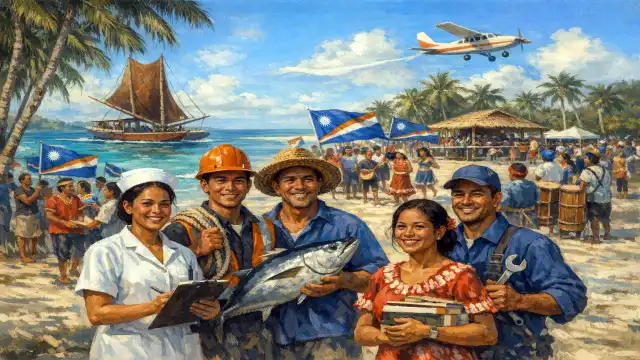
Before we talk about the holiday, we need to understand the location. Located near the equator in the Pacific Ocean, the Marshall Islands is a sprawling nation of 29 coral atolls and five single islands.
Historically, this remote paradise has a complex past. After being occupied by Spain, Germany, and Japan over various decades, the islands fell under United States administration following World War II. Ultimately, the country gained full independence in 1986 under the Compact of Free Association (COFA).
Therefore, the local culture is a fascinating mix. You will find ancient Polynesian navigation traditions blending seamlessly with heavy American influences, right down to the adoption of certain US-style holidays.
Evolution of “Work” in the marshall islands
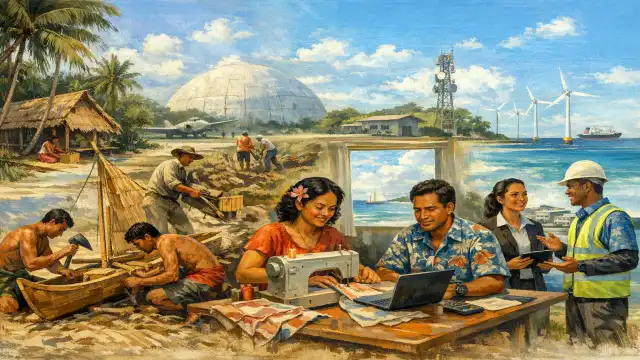
To truly appreciate Labor Day here, you must understand how the concept of “labor” has drastically changed for the Marshallese people.
1. Era of subsistence survival
Centuries ago, work was not about earning a paycheck. Instead, it was purely about community survival. Everyone had a specific job. Men generally focused on building proas (outrigger canoes), deep-sea fishing, and navigating by the stars. Meanwhile, women managed the land, weaving complex mats from pandanus leaves and preparing food. There were no weekends. Survival required daily, unified effort.
2. Copra boom
During the late 19th and early 20th centuries, foreign colonizers introduced a new type of labor: the copra trade. Copra is the dried meat of a coconut, used globally to extract coconut oil. Suddenly, Marshallese families were working to produce goods for a global market. Consequently, a wage-based economy slowly began to replace traditional trading.
3. Modern workforce
Today, the labor landscape looks vastly different. According to the CIA World Factbook, the RMI government is actually the largest employer in the country. Thousands of locals work in public administration, education, and healthcare. Furthermore, the commercial fishing industry remains a massive economic driver.
Therefore, Labor Day in the Marshall Islands is not just a nod to office workers. Primarily, it honors the rapid, challenging transition from ancient island survival to participating in the modern global economy.
Why celebrate on the first friday of september?
You might be asking a logical question right now. If the Marshall Islands has such strong ties to the United States, why don’t they celebrate on the first Monday of September like Americans do?
Interestingly, the decision is highly practical.
Fridays hold a special place in Marshallese culture. By scheduling the holiday on the first Friday of the month, the government guarantees a solid three-day weekend. This is vital for a country spread across hundreds of miles of ocean. Families often need extra travel time to take a boat from a busy hub like Majuro (the capital) to visit relatives on more remote outer islands. Thus, a Friday holiday simply makes logistical sense.
How the marshallese celebrate labor day
If you visit Majuro during the first week of September, you will immediately notice the shift in energy. The streets are busy, schools are closed, and the government buildings are locked up tight.
Here is exactly how the locals celebrate their hard work.
Obsession with sports tournaments
First and foremost, Marshallese people love sports. They take them very seriously. Labor Day weekend is synonymous with massive athletic competitions.
- Basketball: Basketball is arguably the most popular sport in the country. During this weekend, local municipalities and church groups form teams. Consequently, indoor courts and outdoor concrete hoops are packed with screaming fans cheering on fast-paced, highly physical games.
- Volleyball: Similarly, volleyball nets pop up on beaches and fields everywhere. Both men and women participate in highly competitive, day-long tournaments.
- Canoe Racing: To honor their roots, you will often find traditional outrigger canoe races in the calm lagoon waters. These sleek wooden boats move incredibly fast, showcasing ancient engineering skills that are still passed down today.
Political speeches and civic pride
Because the government is the biggest employer, politics heavily influence the holiday. Local mayors, traditional chiefs (Iroij), and members of the national parliament (Nitijela) usually give speeches.
These public addresses often focus on pressing modern issues. For example, leaders might discuss the necessity of raising the minimum wage, creating better jobs for the youth, or protecting the local workforce from the devastating impacts of climate change.
Ultimate island feast
Naturally, no Pacific Island holiday is complete without a massive amount of food. The Marshallese deeply value communal eating. While Labor Day might not always feature a formal kemem (a highly structured traditional feast usually reserved for first birthdays), the style of eating is very similar.
Families gather large woven baskets of food. If you are lucky enough to be invited to a Labor Day barbecue, here is what you will likely find on your paper plate:
- Fresh Reef Fish: Caught that morning, usually grilled whole over an open fire or baked in coconut milk.
- Bwiro: This is a traditional fermented breadfruit dish. It has a sour, unique taste and acts as a major staple for islanders.
- Roasted Pig: For big community gatherings, roasting a whole pig is a sign of celebration and respect.
- Coconut Crab: These massive, land-dwelling crabs are a local delicacy. Their meat is incredibly sweet because they literally eat coconuts.
- Pancakes and Rice: Thanks to Western influence, dense pancakes and massive scoops of white rice are mandatory side dishes at any gathering.
Unique challenges for the RMI workforce
While Labor Day is joyous, it also highlights the intense struggles the local workforce faces today. Living in the middle of the ocean is not easy.
First, climate change is a severe threat. The Marshall Islands sit only a few feet above sea level. Rising ocean tides frequently flood roads and ruin agricultural land. Consequently, people who rely on farming pandanus or coconuts are finding their traditional labor threatened by saltwater intrusion.
Moreover, there is a massive “brain drain” occurring. Under the Compact of Free Association, Marshallese citizens can legally live and work in the United States without a visa. The US Department of the Interior notes that thousands of young adults have migrated to places like Arkansas, Hawaii, and Washington state seeking higher-paying factory or healthcare jobs.
Therefore, Labor Day is often a bittersweet moment. It celebrates the workers currently building the nation, but it also serves as a reminder of the talented laborers who had to leave the islands to support their families from afar.
Youth and the future of work
Currently, the younger generation in the Marshall Islands is redefining what “labor” means.
Historically, young adults either worked for the government or joined a fishing crew. However, internet access is slowly improving across the capital. As a result, tech-savvy youth are exploring digital labor. From graphic design to social media management for local NGOs, the definition of a “worker” in the RMI is expanding.
Additionally, there is a massive resurgence in cultural preservation. Young artisans are turning traditional skills into viable businesses. They are selling hand-woven bags, intricately carved wooden jewelry, and custom-designed island clothing to tourists and online buyers. Thus, they are proving that traditional labor still holds massive value in a modern economy.
How you can honor the day (From anywhere)
Obviously, most people reading this will not be in Majuro on the first Friday of September. However, you can still honor the spirit of the holiday.
- Educate Yourself on COFA: Take ten minutes to read about the Compact of Free Association. Understanding how the US and the Marshall Islands interact economically explains a lot about Pacific geopolitics.
- Support Marshallese Creators: Look online for Marshallese artists or weavers. Buying their crafts directly supports the traditional workforce.
- Acknowledge Climate Impact: Understand that for island nations, environmental protection is job protection. Supporting climate action helps preserve the livelihoods of traditional fishermen and farmers.
More than just a day off
Ultimately, Labor Day in the Marshall Islands is a beautiful collision of past and present. It is a day to rest tired hands, whether those hands type on a keyboard in a government office or pull heavy fishing nets from the Pacific Ocean.
By pushing the holiday to the first Friday of September, the locals prioritize what truly matters: time. Time to travel. Time to play basketball until the sun sets. Time to sit with family, eat good food, and appreciate the hard work it takes to thrive on a tiny strip of coral in a massive ocean.
Did you know that Marshallese citizens can work in the US without a visa? What do you think about the unique blend of ancient island traditions and modern jobs? Drop a comment below with your thoughts, and share this article with a friend who loves learning about hidden global cultures!

