

The 27 Club: Famous Members, History, and the Curse Explained
- The Myth: The 27 Club is a massive cultural phenomenon surrounding highly influential musicians, artists, and actors who all tragically died at age 27.
- The Founders: Between 1969 and 1971, legendary rock icons Brian Jones, Jimi Hendrix, Janis Joplin, and Jim Morrison all passed away within exactly two years of each other.
- The Science: Despite the incredibly creepy coincidence, scientific studies absolutely prove there is no statistical spike in musician deaths at age 27.
- The Reality: However, famous musicians in their 20s and 30s suffer a mortality rate two to three times higher than the general public due to high-risk lifestyles.
Have you ever noticed how some of music’s absolute brightest stars burn out at the exact same age? Consequently, you inevitably stumble down a midnight internet rabbit hole reading about the infamous 27 Club. This heavily discussed, deeply tragic list includes some of the most groundbreaking musicians in modern human history. Specifically, they all share one haunting detail: their lives ended at age 27.
But is there an actual supernatural curse haunting the music industry? Or are we simply looking at a series of heartbreaking coincidences fueled by dangerous rock-and-roll lifestyles? Let’s dive deep into the origins, the famous members, and the cold, hard science behind this legendary pop culture mystery.
How did the 27 club start?

Interestingly, nobody was talking about a literal “club” back in the psychedelic 1970s. Sure, heartbroken fans definitely noticed a weird, terrifying pattern. Between July 1969 and July 1971, four massive rock icons died completely out of the blue. However, it actually took another two decades for the concept to permanently cement itself into our collective brains.
According to music biographer Charles R. Cross, the idea of the 27 Club didn’t truly hit the mainstream zeitgeist until Kurt Cobain’s tragic death in 1994. Following his passing, Cobain’s grieving mother famously told an Associated Press reporter, “Now he’s gone and joined that stupid club.” Suddenly, the media frantically connected the dots. They grouped Cobain with the fallen stars of the counterculture era. As a result, an inescapable urban legend was officially born.
The bizarre “White Lighter” myth
Whenever you discuss this curse, you will likely hear about the “White Lighter Myth.” This bizarre offshoot legend claims that Jimi Hendrix, Janis Joplin, Jim Morrison, and Kurt Cobain all had white disposable lighters in their pockets when they died. Therefore, superstitious fans avoid white lighters like the absolute plague.
However, this is totally false. Actually, disposable Bic lighters weren’t even invented until 1973 — years after Hendrix, Joplin, and Morrison had already passed away. Therefore, you can confidently cross this creepy detail off your conspiracy board.

Famous members of the 27 club
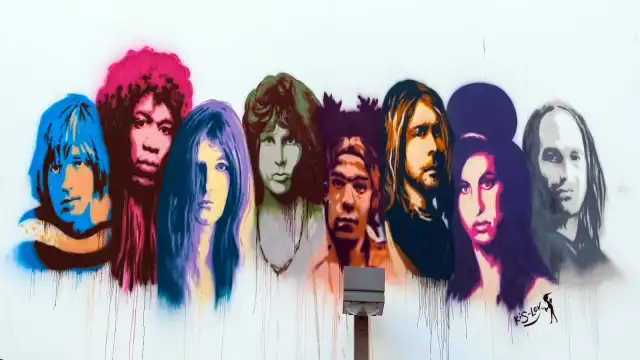
So, who actually belongs to this tragic roster? Let’s break down the most notable figures whose immense talent was cut incredibly short by the pressures of fame, addiction, and mental illness.
1. Robert Johnson: The Original Legend
Long before the hippie era, there was Robert Johnson. He was a pioneering genius of the Delta blues in the 1930s. Legend falsely claims he literally sold his soul to the devil at a dark Mississippi crossroads to master the acoustic guitar. Consequently, his dark mythology only exploded when he died on August 16, 1938. While the exact cause remains unknown, historical rumors heavily suggest he drank poisoned whiskey provided by a wildly jealous husband in a local juke joint.
2. Brian Jones: The Fallen Stone
Brian Jones famously founded the Rolling Stones and played almost every musical instrument you can imagine. Sadly, his heavy substance abuse and erratic behavior led the band to officially fire him in June 1969. Just one month later, on July 3, 1969, he was found motionless at the bottom of his swimming pool in England. The coroner legally ruled it “death by misadventure,” though conspiracy theories about his murder still circulate today.
3. Jimi Hendrix: The Guitar God
Jimi Hendrix completely revolutionized how the electric guitar sounded. His electrifying performance at Woodstock remains an iconic piece of Americana. Yet, the intense pressure of sudden, massive fame took a brutal toll on his mental health. On September 18, 1970, Hendrix died in London. Tragically, he asphyxiated on his own vomit while sleeping after accidentally overdosing on strong barbiturates.
4. Janis Joplin: The Queen of Psychedelic Soul
Just 16 days after Hendrix passed away, the music world lost Janis Joplin. Her raspy, incredibly powerful voice defined an entire generation of rebels. Unfortunately, she battled severe, ongoing heroin and alcohol addictions behind closed doors. On October 4, 1970, Joplin tragically died of a heroin overdose alone in a Los Angeles hotel room.
5. Jim Morrison: The Lizard King
The Doors’ charismatic frontman was globally famous for his poetic lyrics and wild, unpredictable stage antics. Eventually, Jim Morrison moved to Paris to escape the suffocating American spotlight and focus quietly on his poetry. On July 3, 1971 — exactly two years to the day after Brian Jones died — he was found unresponsive in a bathtub. Because French authorities suspected a standard heart failure and found zero evidence of foul play, they never performed a formal autopsy.

6. Kurt Cobain: The Voice of Grunge
Nirvana’s lead singer reluctantly became the voice of Generation X in the early 1990s. He struggled intensely with sudden global fame, a chronic stomach illness, and severe clinical depression. Tragically, Cobain took his own life on April 5, 1994, in Seattle. His death completely shattered the music industry and directly launched the 27 Club back into global headlines.
7. Amy Winehouse: The Modern Tragedy
Decades later, the supposed curse seemingly struck again. Amy Winehouse possessed a completely once-in-a-generation jazz and soul vocal talent. However, her extremely public battles with drug and alcohol addiction constantly overshadowed her massive Grammy-winning success. On July 23, 2011, she died of accidental alcohol poisoning in her London home. Ultimately, her highly publicized death forced the modern world to heavily re-examine how the ruthless tabloid media treats struggling artists.
| Name | Profession | Year of Death |
|---|---|---|
| Alan Wilson | Canned Heat co-founder | 1970 |
| Ron “Pigpen” McKernan | Grateful Dead | 1973 |
| Dave Alexander | The Stooges bassist | 1975 |
| Pete Ham | Badfinger | 1975 |
| Chris Bell | Big Star | 1978 |
| Jean-Michel Basquiat | Artist | 1988 |
| Mia Zapata | The Gits vocalist | 1993 |
| Kristen Pfaff | Hole bassist | 1994 |
| Anton Yelchin | Actor | 2016 |
| Fredo Santana | Rapper | 2018 |
Is the curse actually real?

So, does a supernatural curse specifically target 27-year-olds? Absolutely not. Let’s look closely at the actual, verified data.
In December 2011, The British Medical Journal (BMJ) published a massive, highly detailed scientific study regarding this exact urban myth. Led by statistician Adrian Barnett, researchers thoroughly analyzed the mortality rates of 1,046 famous musicians who achieved a number-one UK album between 1956 and 2007.
What did the math actually reveal? Statistically, there is zero peak in death rates at age 27. In fact, the researchers observed nearly identical death rates at ages 25 and 32. Out of the 522 musicians at risk in that age bracket, only three died at 27. This translates to a rate of exactly 0.57 deaths per 100 musician years.
Furthermore, a separate 2014 comprehensive study by public health researcher Dianna Kenny examined over 12,000 popular musicians. She discovered that musicians are actually most likely to die at age 56. Therefore, the 27 Club is basically a textbook example of “confirmation bias.” We specifically remember the stars who died at 27 because they perfectly fit the creepy narrative, while we entirely ignore those who tragically died at 24, 29, or 33.
Why do so many musicians die young?
While the specific age of 27 isn’t mathematically cursed, the music industry itself is undeniably dangerous. The exact same BMJ study revealed a deeply disturbing truth. Famous musicians in their 20s and 30s are two to three times more likely to die prematurely than the general population.
Why is the mortality rate so incredibly high? The answers aren’t supernatural in the slightest. Rather, they are fundamentally, painfully human.
- Intense Pressure: Sudden, global fame completely isolates young artists from their normal support systems. They go from playing tiny local clubs to carrying million-dollar tours overnight.
- Easy Access: The classic “rock star lifestyle” heavily glorifies extreme drug and alcohol abuse. Consequently, rich addicts are constantly surrounded by “yes-men” enablers instead of people who will actually help them get clean.
- Mental Health Struggles: Many brilliant artists purposefully pour their deep emotional trauma directly into their art. Sadly, without proper therapy, that raw, unhealed trauma often leads to dangerous self-medication.
Basically, massive fame acts as a giant magnifying glass. It takes existing human vulnerabilities and blows them completely out of proportion on a global stage.
Remembering the music, not the myth
Ultimately, the 27 Club is a fascinating, genuinely eerie slice of pop culture history. It perfectly captures our morbid human curiosity about youth, extreme fame, and tragedy. However, reducing these brilliant, complicated artists to a spooky urban legend completely misses the point of their lives.
They weren’t helpless victims of a magical, unbeatable curse. Instead, they were incredibly talented human beings battling very real, very painful inner demons under a blinding public spotlight. Therefore, the absolute best way we can honor their memories isn’t by obsessing over the exact age they died. Rather, we should continuously celebrate the timeless, groundbreaking music they generously left behind for us.
What do you think? Does the extreme pressure of the modern music industry still put today’s artists at massive risk, or have things significantly improved since the 1970s? Drop your honest thoughts in the comments below! If you found this historical deep-dive interesting, please share it with a friend who loves rock and roll history!

