

Planet of the Apes (2001) Ending Explained: Making Sense of the Timeline
Remember watching Tim Burton’s sci-fi reboot and staring blankly at the screen as the credits rolled? You are definitely not alone.
When Mark Wahlberg’s character, Leo Davidson, finally escapes the ape-ruled planet, flies back to Earth, and crash-lands in Washington D.C., he expects a hero’s welcome. Instead, he looks up at the Lincoln Memorial and sees the face of General Thade. Then, a swarm of ape police officers surround him. Cut to black.
Audiences were furious. Critics were baffled. It felt like a cheap shock tactic meant to set up a sequel that never happened. But here is the crazy part: the ending actually makes perfect, mathematical sense. You just need to understand how the movie’s time travel mechanics operate off-screen.
The exact timeline of the 2001 Planet of the Apes and figure out how a bloodthirsty chimp managed to rewrite Earth’s history.
Quick read
- The storm runs backwards: The electromagnetic space storm operates on a reverse chronological timeline. The later you enter the storm, the earlier you exit it.
- Leo created the problem: The ape planet (Ashlar) only exists because Leo’s mothership, the U.S.S. Oberon, followed him into the storm and crashed thousands of years in the past.
- Thade hijacked a ship: According to official DVD materials, General Thade salvaged Leo’s sunken space pod and flew into the storm after Leo left.
- Earth was rewritten: Because Thade entered the storm after Leo, he arrived on Earth before Leo, giving him time to lead an ape uprising and conquer humanity.
The U.S.S. oberon and the Space storm
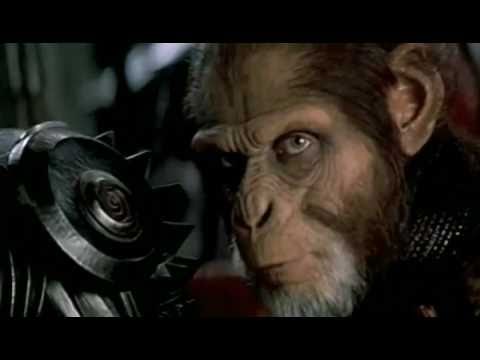
To understand the ending, we have to start at the beginning. The year is 2029. Leo Davidson is an astronaut stationed on the U.S.S. Oberon, a massive research vessel. The crew uses genetically modified apes as pilots for dangerous space probes.
A mysterious electromagnetic storm appears near the station. Pericles, a trained chimpanzee, is sent in a small pod to investigate. He vanishes. Refusing to abandon his favorite chimp, Leo disobeys direct orders, hops into a second pod, and flies into the anomaly to save him.
When Leo loses contact, the Oberon’s commander makes a fateful decision. He steers the entire multi-billion-dollar space station into the storm to search for Leo.
Three separate travelers entered the storm. This exact departure sequence is the master key to unlocking the entire movie.
- Pericles (First)
- Leo (Second)
- The Oberon (Third)
The “First in, Last out” rule
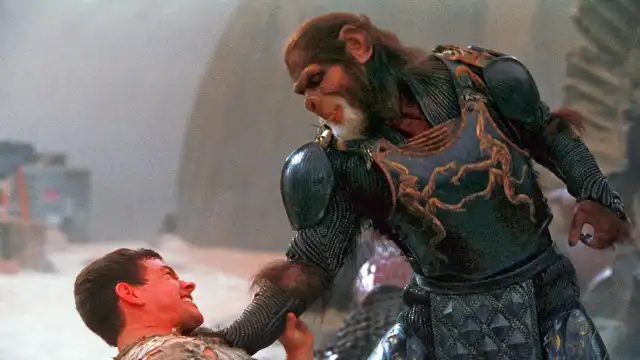
Here is the crucial detail the movie completely failed to explain clearly. The electromagnetic storm is a time portal, but it operates like a mirror. Time inside the anomaly runs in the opposite direction.
Think of it like stacking plates in a cupboard. The first plate you put in is at the bottom. The last plate you put in is right at the top. When you go to pull a plate out, the last one you put in is the first one you grab.
Because of this reverse chronological rule, whoever enters the storm last gets spat out first on the other side.

Event 1: The Crash of the Oberon
Since the massive Oberon space station entered the storm last, it exits the storm first. It gets thrown thousands of years into the planet Ashlar’s past.
The crash kills many human crew members. The surviving apes, led by a highly intelligent chimp named Semos, realize they outnumber their captors. They mutiny. Semos leads a bloody revolution, enslaving the humans and building a brand-new society.
Over the centuries, the Oberon rusts and decays. The apes forget their origins and begin to worship Semos as a god. The ruins of the ship become a holy temple known as “Calima.” This name is simply derived from a partially obscured sign on the ship’s hull: CAution LIve aniMAls.
Event 2: Leo Davidson Arrives
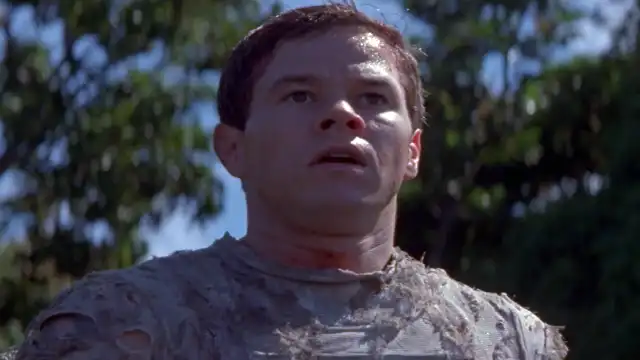
Leo entered the storm second. Therefore, he exits the storm second.
He crashes his pod into a swamp on Ashlar in the year 5021 A.D. By this point, the ape civilization has been thriving for millennia. Humans are nothing more than mute scavengers and slaves. Leo has absolutely no idea that he is fighting descendants of the very apes he used to train.
Even worse, he is stuck in a classic causal loop paradox. If Leo hadn’t chased Pericles into the storm, the Oberon would never have followed him. Semos would never have crashed, and the ape planet would never exist. Leo accidentally orchestrated his own nightmare.
Event 3: Pericles Drops In
Pericles was the very first traveler to enter the storm back in 2029. Following our plate-stacking rule, that means he is the absolute last person to exit.
This perfectly explains the climax of the film. Right as General Thade and his ape army are about to slaughter Leo and the human rebels, a small space pod descends from the sky. The apes stop fighting, believing their god Semos has returned. Instead, the pod opens to reveal Pericles.
The chimp didn’t pause time or take a detour. He simply experienced the delayed exit of the time storm.
Mark Wahlberg Returns to Earth
With the battle over and a temporary peace established, Leo decides it is time to go home. He leaves Ashlar, climbs into Pericles’ perfectly intact space pod, and launches himself back into the electromagnetic storm.
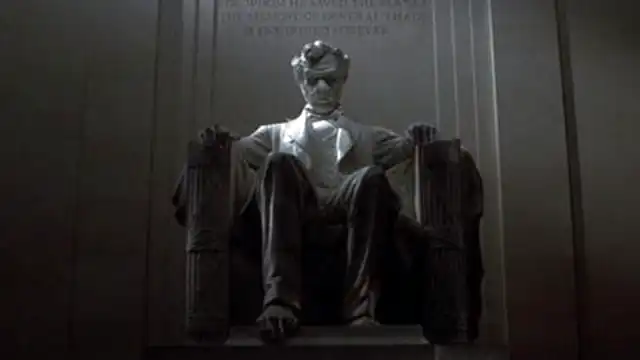
He navigates the swirling vortex and crashes in Washington D.C. He steps out of his pod, walks up the steps of the Lincoln Memorial, and stares in absolute horror. Abraham Lincoln is gone. A massive stone statue of General Thade sits in the chair.
Apes in police uniforms, ape firefighters, and ape news reporters swarm the area. Earth has been conquered.
Most viewers threw their hands up in frustration right here. How did a bloodthirsty ape beat an astronaut back to Earth? Did Thade invent a teleporter? Did the writers just give up?
The Off-Screen Journey of Thade
The movie ends abruptly, but the studio actually provided an official answer. You just had to buy the DVD to find it.
An insert included in the film’s home release confirmed exactly what happened after Leo left Ashlar. General Thade was left trapped inside the ruins of the Oberon. However, he eventually escaped. Driven by his burning hatred for humanity, Thade sought a way to follow Leo.
Remember Leo’s original pod? The one he crashed into the swamp at the beginning of the movie?
Thade managed to salvage that sunken pod. He overcame his natural ape fear of water, retrieved the ship, and somehow managed to get it operational. Thade launched himself into the electromagnetic storm after Leo had already left.
Now, let’s apply our time travel rule one last time.
- Leo entered the storm to go home.
- Thade entered the storm after Leo.
Because Thade entered the storm later, he exited the storm earlier on Earth.
Thade likely landed on Earth sometime in the 1800s, around the era of the American Civil War. Using his advanced knowledge of human weaknesses and the technology from the pod, he led a hostile ape takeover. He rewrote human history from the ground up.
When Leo eventually exits the storm in 2029, he is stepping into an alternate timeline. Humanity is already gone. Thade has been dead for over a century, revered as the Ape Lincoln of this new world.
A Misunderstood Tribute to the Original Novel
Why did Tim Burton choose this confusing route instead of the iconic 1968 Statue of Liberty ending? He was actually trying to honor the original source material.

Most casual fans don’t realize that Planet of the Apes started as a 1963 French sci-fi novel written by Pierre Boulle. In the book, the protagonist explores an alien world ruled by apes, manages to escape, and flies his ship back to Earth. He lands in Paris, excited to be back in human civilization.
When an airport rescue worker opens the door to his ship, the protagonist looks up. The rescue worker is a gorilla.
Burton wanted to recreate that exact feeling of gut-wrenching irony. The 1968 movie went with a post-apocalyptic Earth reveal. Burton went with the alternate-reality Earth reveal. Both are valid interpretations of the core concept.
Why Tim Burton’s Ending Backfired with Audiences
If the timeline math is so flawless, why is the 2001 film ending universally mocked? The answer boils down to basic storytelling.
A movie should never require its audience to do complex off-screen math to understand the climax. Burton hid the mechanics of the time storm a little too well. There is no scene where a character draws on a chalkboard to explain the “first in, last out” rule. There is no post-credits scene showing Thade pulling a spaceship out of a swamp.
Viewers felt cheated. They assumed the filmmakers just slapped a shocking visual on screen for the sake of a plot twist. Let’s be real — nobody wants to pause a blockbuster movie to calculate temporal physics in their head.
The execution was flawed, but the underlying logic was rock solid.
Does the Timeline Hold Up?
When you map out the chronology of the electromagnetic storm, every single puzzle piece snaps perfectly into place. From the creation of Calima to the arrival of Pericles, the timeline behaves exactly according to its own bizarre rules.
Leo Davidson didn’t just stumble onto an ape planet. He accidentally created it. And by leaving his crashed pod behind in a swamp, he inadvertently handed a genocidal ape the keys to Earth. It is a bleak, tragic, and utterly fascinating sci-fi tragedy.
The 2001 Planet of the Apes might not have the emotional weight of the 1968 original, or the cutting-edge motion capture of the Andy Serkis reboot trilogy. Make no mistake, though — its ending is far smarter than it gets credit for.
What do you think about Tim Burton’s wild twist? Did you piece together the reverse-time rules on your first watch, or did it leave you scratching your head? Drop your thoughts in the comments below, and if you love deep-dive movie explanations, be sure to bookmark our page for more sci-fi timeline breakdowns!

