

Is The Phantom of the Opera Based on a True Story? The Real Palais Garnier History
Few images in theater history are as deeply iconic as a masked man guiding a young singer through a misty, candle-lit underground lake. Andrew Lloyd Webber’s musical adaptation of The Phantom of the Opera has captivated millions of people worldwide with its sweeping romance and gothic terror.
But behind the velvet curtains and the pipe organ lies a question that has puzzled audiences for over a century. Is The Phantom of the Opera based on a true story?
The short answer is both yes and no. While the specific character of Erik — the disfigured musical genius lurking in the shadows — is a product of fiction, the world he inhabited was entirely real. When French author Gaston Leroux penned the original gothic novel in 1910, he did not pull his ideas out of thin air. He pulled them directly from the headlines, architecture, and bizarre rumors surrounding the heart of Paris.
At a glance
Gaston Leroux’s The Phantom of the Opera blends gothic fiction with historical realities from the Palais Garnier. As an investigative journalist, Leroux incorporated real Parisian headlines and architectural rumors into his narrative. He maintained throughout his life that the titular character was based on an actual figure.
The story features authentic elements like the subterranean reservoir built for structural stability and the 1896 chandelier counterweight accident. Other inspirations include a disfigured pianist seeking refuge in the basement and acoustic anomalies in the opera house’s Box 5 that created the illusion of a haunting.
Gaston Leroux: The Journalist Who Claimed It Was All Real
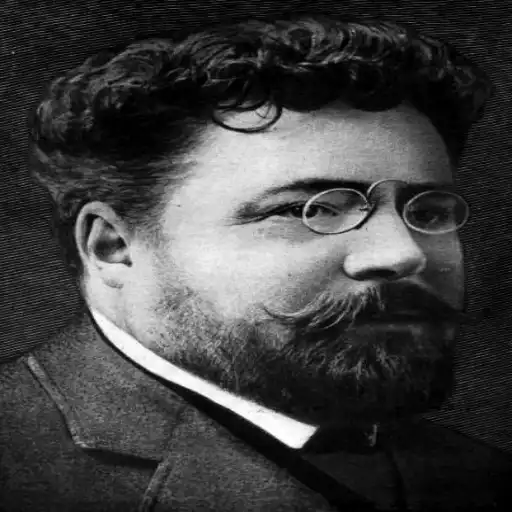
To understand why the line between fact and fiction is so blurry, you have to look at the man who started it all. Long before he became a novelist, Gaston Leroux was a high-profile investigative reporter. He worked for major Parisian newspapers like L’Écho de Paris and Le Matin, covering sensational crime stories, courtroom dramas, and public disasters.
Leroux was not a casual storyteller. He approached his fiction with the mind of a detective.
When he published Le Fantôme de l’Opéra as a newspaper serial in 1909, he went to extreme lengths to present the narrative as a piece of real investigative journalism. The prologue of his book contains a bold statement that he repeated throughout his entire life:
“The Opera Ghost really existed. He was not, as was long supposed, a creature of the imagination.”
Leroux spent years wandering the back corridors, dressing rooms, and deep basements of the Paris Opera House. He interviewed old stagehands, managers, and ballet girls. Even on his deathbed in 1927, Leroux reportedly looked at his family and whispered one final insistence that the Phantom was entirely real. While historians agree the specific romance plot is fictional, Leroux’s genius lay in his ability to weave genuine historical occurrences into a seamless tapestry of gothic horror.
[Gaston Leroux's Writing Blueprint]
   │
   ├── Accurate Architectural Blueprint (Palais Garnier)
   ├── Real News Headlines (Chandelier Incident)
   └── Local Backstage Rumors (The Subterranean Dweller)
The Real Palais Garnier History
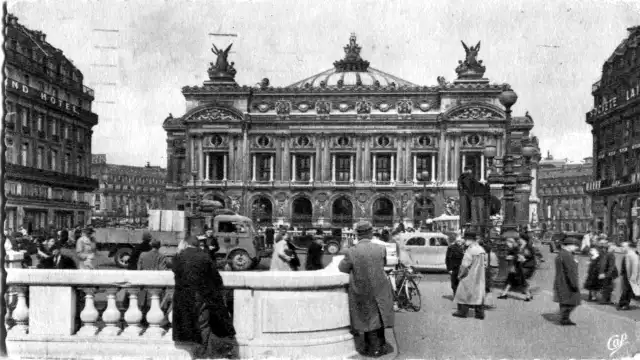
The stage for this grand mystery is the Palais Garnier, an architectural masterpiece that defines the skyline of Paris. The history of how this building came to exist reads like a political thriller.
On January 14, 1858, Italian anarchists threw bombs at the carriage of Emperor Napoleon III while he was on his way to the old Paris opera house on the Rue Le Peletier. The Emperor survived the assassination attempt, but the bloody event convinced him that the city needed a new, much safer, and grander venue for the arts.
A massive architectural design competition was launched in 1861. Out of 171 contestants, the judges unanimously chose a relatively unknown 35-year-old architect named Charles Garnier.
Garnier designed the building in what he called the “Napoleon III style” — a breathtakingly opulent mix of classical Greek symmetry, Roman grandeur, and highly detailed Baroque ornamentation. Construction began in 1862, but it was immediately plagued by a relentless series of historical disasters:
- The Franco-Prussian War (1870): Progress ground to a halt as resources shifted to the war effort.
- The Paris Commune (1871): Radical revolutionaries seized control of the city. During this chaotic upheaval, the half-finished, skeletal shell of the opera house was used as an armory, a military base, and a prison. The deepest vaults of the basement were transformed into literal holding cells where political prisoners were kept in chains.
- The Salle Le Peletier Fire (1873): The old opera house burned to the ground in a catastrophic 27-hour fire, forcing the government to fast-track the completion of Garnier’s building.
When the Palais Garnier finally held its grand opening on January 5, 1875, it was one of the largest buildings in the world. It was a labyrinth of luxury, boasting miles of corridors, hidden staircases, and alcoves. The sheer scale of the structure meant that entire teams of staff could live, sleep, and eat inside the building without ever being noticed by the wealthy patrons in the auditorium.
The Palais Garnier Underground Lake: Myth vs. Engineering Reality
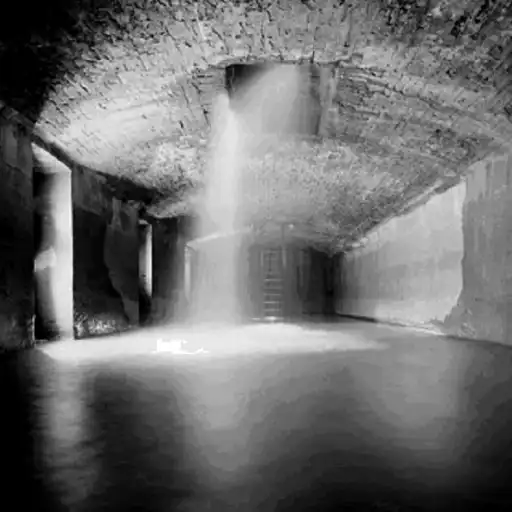
In the musical, the Phantom rows a boat through a misty, subterranean lake to reach his hidden lair. This seems like pure theatrical fantasy, a dreamscape designed to look beautifully eerie on a broadway stage.
Yet, if you venture beneath the cellars of the real Palais Garnier, you will find a massive body of water. The Palais Garnier underground lake is 100% real.
When workers began digging the foundations for the opera house in 1862, they ran into a massive, unexpected obstacle. The ground was incredibly swampy. They had accidentally tapped into a high water table fed by a hidden arm of the Seine River. Water flooded the construction site at an alarming rate.
        [THE WATER PRESSURE CHALLENGE]
                       │
     Hydrostatic Pressure from Groundwater
                       ▼
   ┌──────────────────────────────────────┐
   │ Garnier's Vaulted Concrete Cistern  │ ◄── Water acts as a stabilizer
   └──────────────────────────────────────┘
                       ▲
         Massive Weight of the Building
For eight straight months, steam pumps ran day and night trying to drain the marshy soil. The effort failed completely. Charles Garnier realized he could not defeat the water, so he decided to control it.
He constructed a massive, vaulted concrete reservoir — a cistern — directly beneath the stage. This structure was designed to gather the rising groundwater and channel it safely into a controlled pool. The weight of the water inside the reservoir actually helps counteract the upward hydrostatic pressure of the earth, preventing the massive foundation from cracking under the immense weight of the building above.
The Reservoir Today
This hidden lake looks less like a romantic grotto and more like a vast, flooded cathedral basement. It is completely off-limits to the public, but it serves a vital purpose for modern Paris.
The Paris fire brigade uses the underground lake as a specialized training facility. Firefighters plunge into the ink-black, freezing water to practice navigation, diving, and rescue missions in zero-visibility conditions. A fun bit of local lore reveals that the water is also home to a single, fat white catfish, kept as an unofficial pet by the theater’s technical staff. When Leroux heard rumors of this dark, inaccessible pool hiding beneath the stage, his journalistic imagination ran wild. He turned a piece of brilliant engineering into the ultimate monster’s lair.
The Chandelier Disaster of 1896
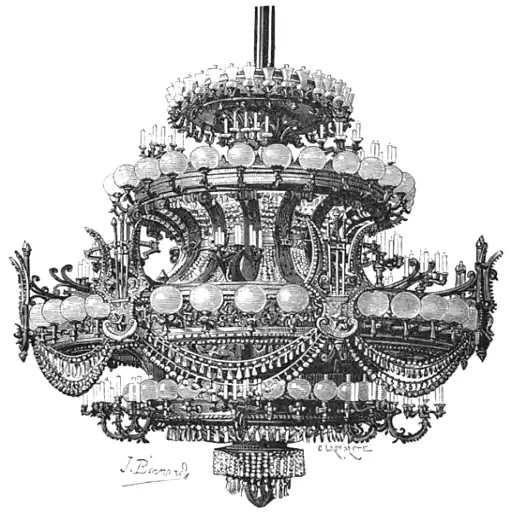
The most spectacular moment in The Phantom of the Opera occurs when the Phantom cuts the cables of the grand chandelier, sending it crashing into the terrified audience below. It is a moment of pure shock value.
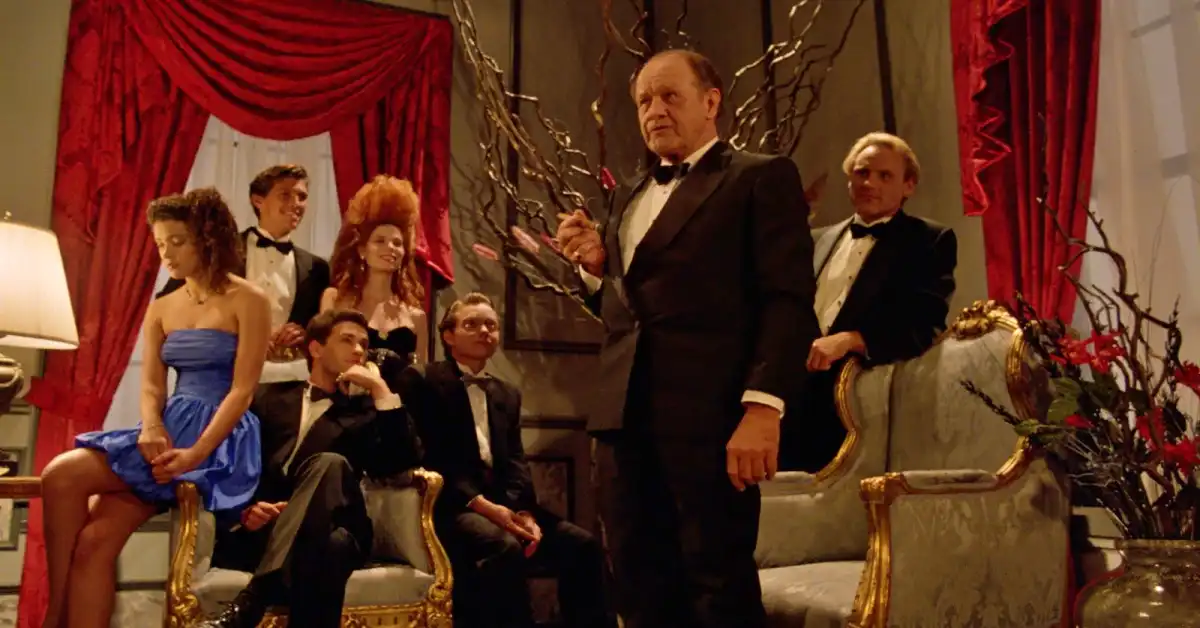
It also actually happened.
On the evening of May 20, 1896, the Palais Garnier was packed with patrons watching a performance of the opera Hellé. At exactly 8:57 p.m., a sudden, terrifying crash echoed through the auditorium, filling the room with plaster dust and screams.
Contrary to popular belief, the actual six-ton bronze chandelier did not fall from the ceiling. Instead, the accident involved a massive counterweight — a heavy block of iron weighing several hundred pounds used to balance the light fixture.
   [THE 1896 ACCIDENT MECHANICS]
                 │
  Overheating Electrical Cable
                 │
                 ▼
  Melts Steel Counterweight Rope
                 │
                 ▼
  700 lb Iron Disc Crashes Through Ceiling
                 │
                 ▼
  Strikes Spectator (Mme. Chomette) in Fourth Tier
Investigators later discovered that an electrical wire running along the ceiling had short-circuited. The intense heat generated by the electrical failure completely melted through the steel cable holding the heavy counterweight. The iron disc tore through the ornate ceiling artwork, plunged through the upper tiers, and crashed directly onto the audience seated in the fourth tier.
The tragedy injured several patrons and claimed the life of a single spectator: a woman named Madame Chomette, who was struck by a falling girder dislodged during the impact. Gaston Leroux was working as a reporter in Paris at the time of the disaster. He read the horrific accident reports, noted the public panic, and recognized how easily a malicious villain could weaponize the theater’s own heavy machinery.
Gaston Leroux’s Real-Life Inspirations Behind Erik
If the lake and the chandelier were real, what about the Phantom himself? Historical research indicates that Leroux based the character of Erik on a fascinating combination of real people, tragic love stories, and local legends.
1. The Disfigured Pianist of 1873
The primary physical inspiration for the Phantom traces back to the devastating fire at the Salle Le Peletier in 1873. A young ballerina tragically perished in the flames, and her fiancé — a talented company pianist — survived the disaster but was left horribly disfigured by the intense heat.
Devastated by grief and hiding his scarred face from a judgmental society, the pianist sought isolation. Legend says he retreated into the subterranean basements of the newly constructing Palais Garnier. He lived out the remainder of his days in the dark vaults beneath the stage, dedicating his lonely existence to composing a grand hymn to love and death. His body was never formally identified, leading many to believe his remains were mixed up with the casualties of the Paris Commune.
2. The Tragic Ballet Love Triangle
The romantic conflict in the novel between Christine Daaé, Raoul, and the Phantom closely mirrors a famous backstage drama from the early days of the Paris Opera Company. A talented young ballet dancer named Boismaison fell deeply in love with a beautiful ballerina named Nanine Dorival.
Their romance faced an immediate obstacle. A wealthy, high-ranking French military officer named Sergeant Mauzurier also desired the ballerina’s affection. Mauzurier used his immense power and political influence to systematically sabotage Boismaison’s career, turning the dancer’s life into a waking nightmare.
When Boismaison died, he left behind a bizarre, romantic final request: he wanted his bones to be preserved inside the opera house so he could remain close to his beloved art form forever. Rumors persisted for decades that his real skeleton was eventually cataloged and used as a stage prop in various theatrical productions.

3. The Discovery of the Vaulted Corpse
In the early 1900s, while workers were clearing out a deep basement alcove to install a set of audio recording capsules for a time-capsule project, they made a grisly discovery. They unearthed a skeleton bricked up inside a hidden wall.
The body showed distinct structural asymmetries, and a gold ring was still clinging to one of the finger bones. While modern historians point out that the corpse was likely a victim of execution from the bloody days of the 1871 Paris Commune, Leroux used the discovery as definitive proof for his book. He claimed the skeleton was none other than the tragic, forgotten body of Erik himself.
The Secret of Box 5
In the fictional world of the play, the Phantom demands that Box 5 be left empty for his personal use at every performance. If management dares to sell tickets for his box, disaster immediately follows.
If you take a guided tour of the real Palais Garnier today, you can walk up to Box 5 on the first tier. Mounted on the wooden door is a permanent brass plaque that reads: “Loge du Fantôme de l’Opéra” (Box of the Phantom of the Opera).
   [THE ACOUSTIC ILLUSION OF BOX 5]
                  │
   Stage Noise / Whispers from Corridors
                  │
                  ▼
      Hollow Support Pillar
                  │
                  ▼
   Amplifies Sound Directly Inside Box 5
Why did Leroux pick this specific box? It wasn’t random. Box 5 possesses a unique architectural quirk. The heavy support pillar directly adjacent to the seating area is completely hollow.
During the 19th century, people noticed that this structural void created a strange acoustic phenomenon. If a person stood near the back columns or whispered inside the service corridor, the sound would echo down the hollow pillar and amplify perfectly inside Box 5, making it sound like an invisible entity was whispering right into your ear from thin air. It was a natural optical and acoustic trick that Leroux brilliantly transformed into a supernatural haunting.
The Eternal Power of the Myth
When we look closely at this historical timeline, we see that The Phantom of the Opera is not a simple fairy tale. It is a brilliant collection of real-world elements bound together by a master journalist.
| Element | The Gothic Fiction | The Historical Fact |
| The Phantom’s Lair | An underground palace built on a dark, misty lake | A massive concrete cistern built to trap groundwater |
| The Chandelier Drop | Cut down by a vengeful ghost to kill an opera crowd | A short-circuited wire that melted a counterweight cable |
| The Skeleton Prop | The literal remains of the disfigured monster, Erik | A forgotten casualty from the 1871 Paris Commune |
| The Disembodied Voice | A supernatural entity haunting Box 5 | An acoustic echo caused by a hollow support column |
The story continues to captivate us because the human heart loves a mystery wrapped in beautiful architecture. Charles Garnier didn’t just build a home for opera; he built a palace of shadows, secret doors, and subterranean depths. Gaston Leroux simply looked into those shadows and gave the world a face to go with the darkness.
The next time you hear a creak in an old theater or watch a chandelier slowly ascend to the ceiling, take a closer look at the shadows. The Phantom may not be real, but the history that created him will live forever.
Join the Mystery!
Have you ever visited the grand Palais Garnier in Paris? Did you get a chance to peek at the real Box 5, or do you find the engineering behind the underground lake more fascinating than the ghost stories?
Let’s keep the conversation going in the comments below! If you loved unmasking the truth behind this timeless legend, share this historical deep-dive with your favorite theater fan.

