

History is written by the winners. This is why you’ve probably heard of Martin Luther. It’s why you’ve heard of St. Francis of Assisi.
And it’s almost certainly why you’ve never heard of Arnold of Brescia.
Which is a damn shame. Because Arnold… Arnold was on another level.
This wasn’t a guy who just nailed some theses to a door. This wasn’t a gentle friar who charmed the Pope into letting him preach to birds. This was a 12th-century monk, a “big-brained” intellectual, and a fiery orator who looked at the medieval Church—then at the absolute peak of its wealth and power—and said, “This is all wrong.”
didn’t just criticize the Pope. He kicked him out of Rome.
He didn’t just dream of a new government. co-founded a republic in the heart of the city. was a heretic, a reformer, and a political revolutionary all rolled into one, 350 years before Luther was even born.
And for this, the Church erased him. They didn’t just kill him; they made his body disappear from the face of the earth.
This is the story of the rebel you were never supposed to know about.
Who the Hell Was Arnold of Brescia?
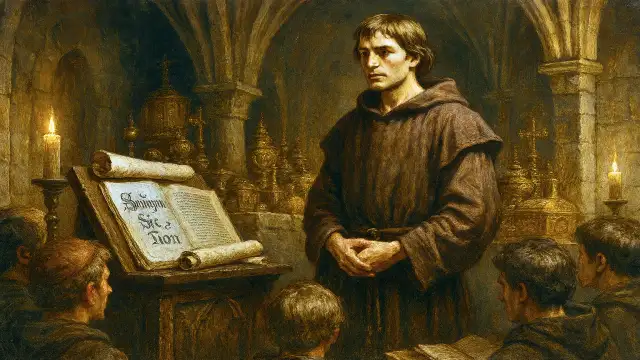
To understand Arnold, you have to understand his teacher.
Arnold was a student of Peter Abelard. If you don’t know that name, just think of him as the 12th-century equivalent of a rockstar philosopher. He was the smartest man in Europe, famous for his brilliant, argumentative mind and his tragic, scandalous love affair with Héloïse.
Abelard’s whole thing was teaching his students to question. His most famous work, Sic et Non (“Yes and No”), was a textbook that listed 158 apparent contradictions in the Bible and the writings of church fathers. His goal wasn’t to destroy faith, but to force students to use logic and reason to find the truth.
Arnold of Brescia took this “question everything” method and aimed it at the biggest target in the world: The Church’s wealth.
The “Radical” Idea That Shook the World: Apostolic Poverty
Arnold’s core message was, on its face, simple. He called it apostolic poverty.
It went like this:
- Jesus and his apostles were poor.
- They had no property, no palaces, no land, no armies.
- Therefore, the true Church should be poor.
Why was this so dangerous? Because in the 12th century, the Pope wasn’t just a spiritual leader. He was a king.
The Church was the single largest landowner in Europe. Bishops were feudal lords. Abbots were princes. They collected taxes, ruled over vast territories, and commanded armies. This “temporal power” (a.k.a. worldly, political power) was the entire basis of the Church’s authority.
Arnold’s preaching wasn’t a friendly suggestion to be more humble. It was a direct, full-frontal assault on the Church’s entire economic and political system.
He was, in essence, telling the Pope, the cardinals, and the bishops:
“You cannot be saved if you own property. Give it all up. Give up your palaces. Give up your land. A true priest is a poor priest.”
This, to the men in charge, was more than heresy. It was a declaration of war.
From Preacher to “Most Wanted”
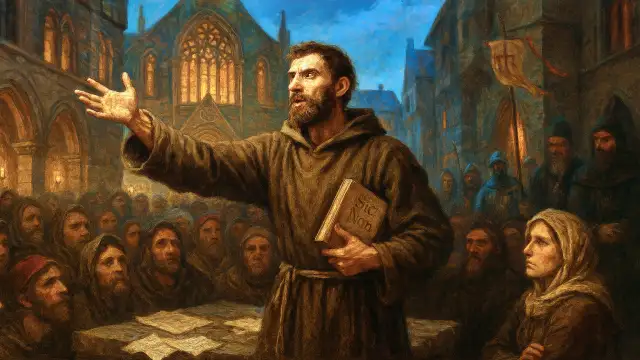
Naturally, Arnold got in a lot of trouble.
He started in his hometown of Brescia, Italy, preaching against his own bishop’s worldly possessions. an instant hit with the common people. He was, as you can imagine, not a hit with the bishop.
His first major showdown came at the Second Lateran Council in 1139. The Church, led by the brilliant papal defender Bernard of Clairvaux (who hated Abelard and his students), had Arnold formally condemned.
- He was found guilty of “heresy.”
- He was banished from Italy.
- He was forbidden from preaching. Permanently.
So, did he stop? Of course not.
He fled to France to seek protection with his old teacher, Abelard. Bad move. Bernard of Clairvaux had Abelard also condemned at a council. The two were now a “master and student” duo of Europe’s Most Wanted.
Arnold was hounded across Europe, from Paris to Zurich, always one step ahead of the bishops, and always preaching his message of poverty to crowds of adoring commoners. He was a fugitive, an intellectual celebrity, and a massive, growing problem for the papacy.
The Main Event: The Commune of Rome
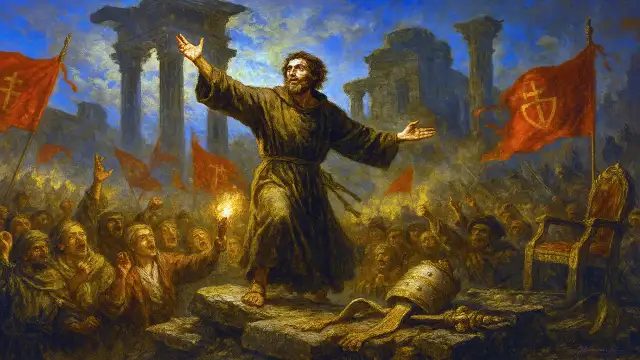
This is where things gets real.
While Arnold was in exile, something was brewing in Rome. The people of Rome were, frankly, sick of being ruled by the Pope. They were a shadow of their former glory, but they remembered the idea of the Roman Republic.
In 1144, the citizens staged a full-blown revolt. They stormed the Capitoline Hill and declared a new, independent government: The Commune of Rome.
During the fighting, Pope Lucius II was—and this is 100% true—leading troops to storm the Capitol when he was hit by a stone and died. The rebels had literally killed the Pope.
His successor, Pope Eugene III, saw the writing on the wall and fled the city.
This is when Arnold of Brescia, the most famous anti-papal preacher in the world, makes his grand entrance. Around 1145, he arrives in Rome. The brand-new republic welcomed him with open arms.
He was the perfect intellectual and spiritual leader for their political revolution.
- The Commune wanted political independence from the Pope.
- Arnold gave them the theological justification for it.
For nearly a decade, Rome was a republic. The Pope was in exile, and Arnold of Brescia was the city’s spiritual guide, preaching from the ruins of the Forum about apostolic poverty and the glory of a new, free Rome.
He had won. He had defeated the papacy and built a new world.
It did not last.
The Empire Strikes Back (Literally)
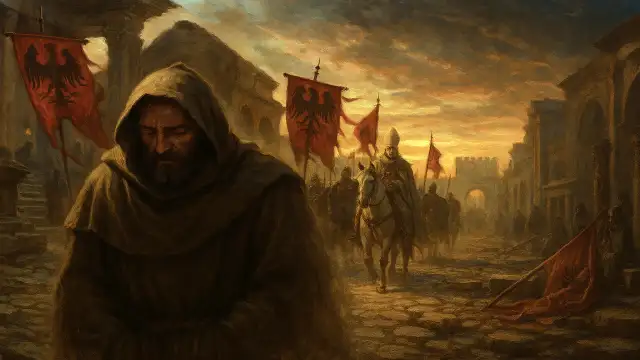
The Church needed a “nuclear option.” It found one in a new, tough-as-nails Pope and a new, terrifyingly ambitious Emperor.
Player 1: Pope Adrian IV
In 1154, an Englishman named Nicholas Breakspear became Pope Adrian IV. He was the only English Pope in history, and he was not messing around. He was tired of this Roman Republic.
His ultimate weapon? The Interdict.
An interdict is a spiritual lockdown. Adrian IV declared that, as long as Arnold was in Rome, the entire city was cut off from the Church.
- No mass.
- No baptisms.
- No confessions.
- No last rites.
- No Christian burials.
This was a terrifying weapon. The people of Rome were pious. The idea of dying without the sacraments—of their babies not being baptized, of their parents being buried in unholy ground—was a horror. Public support for Arnold began to crumble.
Player 2: Emperor Frederick Barbarossa
At the exact same time, the new Holy Roman Emperor, Frederick “Redbeard” Barbarossa, was marching his massive German army into Italy. He had one goal: to be crowned Emperor by the Pope in Rome, as was tradition.
Pope Adrian IV and Barbarossa made a deal. It was simple:
- The Pope: “You get me my city back and crush this rebellion, and I’ll give you the crown.”
- The Emperor: “Deal.”
Faced with a spiritual lockdown from within and one of the most powerful armies in the world from without, the Commune of Rome collapsed. Arnold fled the city, his dream in ashes.
The Martyrdom That Was Meant to Be Forgotten
Barbarossa’s men captured Arnold almost immediately. They handed him over to the papal authorities.
His end was swift. And total.
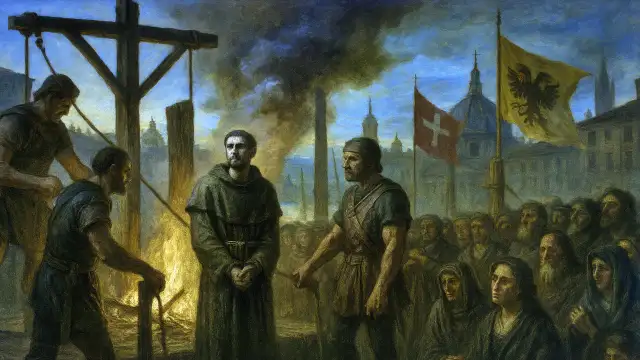
In 1155, Arnold of Brescia was taken to the Piazza del Popolo in Rome.
- He was hanged.
- His dead body was burned at the stake.
- His ashes were gathered and thrown into the Tiber River.
Why? Why this extreme, three-stage execution?
This wasn’t just cruelty. It was a calculated, cold-blooded act of erasure.
The Church knew that if they buried him, his grave would become a shrine. If they burned him, his followers (the “Arnoldists”) would gather his bones as holy relics. A single finger bone from a martyr could start a new religion.
By throwing his ashes into the river, they ensured there was no body. No relics & shrine. No saint.
They wanted to make sure that Arnold of Brescia, and his dangerous idea, were physically and historically gone.
Why Is He So “Forgotten”? (Arnold’s True Legacy)
They almost succeeded.
- His own writings were all destroyed. We have nothing written by Arnold himself. We only know his ideas because his enemies—like the great historian Otto of Freising—wrote them down in order to condemn them.
- He was a political failure. He lost. The Pope and the Emperor won. History is written by the winners.
- He was a “tweener.” He came after the first wave of reformers but before the big ones like Wycliffe and Luther. He was a man out of time.
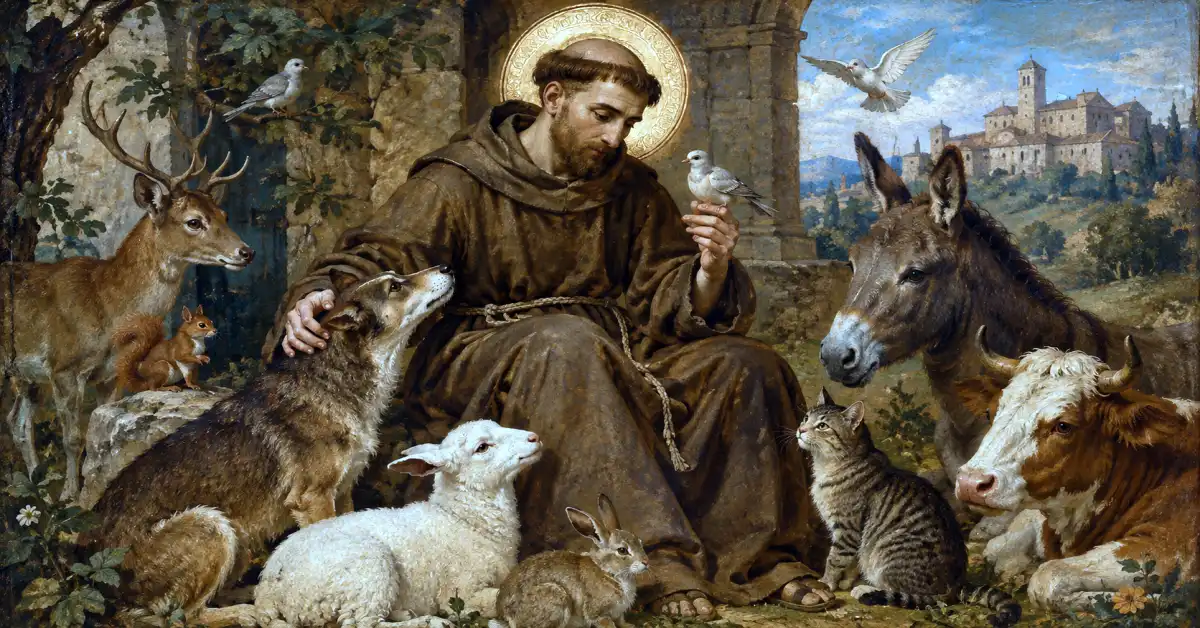
- St. Francis of Assisi (who came 80 years later) co-opted his main idea. Francis also preached poverty, but he did it with the Pope’s permission. He was the “safe” version of Arnold, which is why he became a saint and Arnold became a heretic.
But the idea lived on. The “Arnoldists” survived as an underground movement. Later reformers would see him as a forerunner. And in the 19th century, when Italy was finally fighting to become a free, unified republic, Italian nationalists like Giuseppe Garibaldi rediscovered his story.
To them, Arnold wasn’t a heretic. He was a patriot. He was the first man to dream of a free Rome, independent from the power of the Pope. In 1892, the city of Brescia put up a statue to its long-lost, forgotten son.
Arnold of Brescia was a fascinating failure. He was the man who asked a simple question—”Shouldn’t the Church be poor?”—and in doing so, threatened to burn the entire medieval world to the ground. He was a man 300 years too soon.
Call to Action
What do you think? After hearing his story, was Arnold of Brescia a true reformer who just came too early? A political revolutionary who used religion as a tool? Or a dangerous heretic who deserved to be stopped?
Let me know your take in the comments below.

