

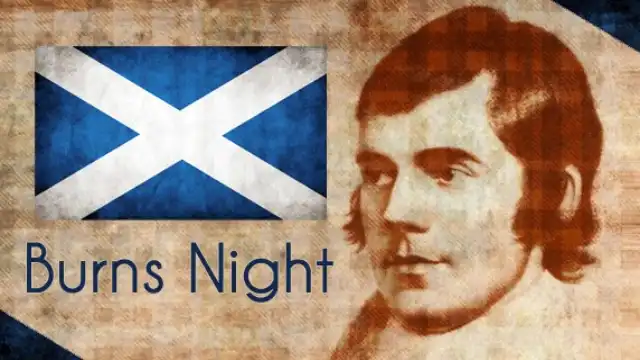
Robert Burns was Scotland’s national poet. He was born in 1759, wrote in Scots and English, and left behind songs and poems that still travel far beyond Scotland. Burns Night is held on 25 January, his birthday, and haggis became part of the tradition because Burns wrote Address to a Haggis — not because he invented the dish.
Need To Know
- Burns was born in Alloway, Ayrshire, on 25 January 1759, and died in Dumfries in 1796 at age 37.
- He wrote poetry and songs in Scots and English, and he is widely treated as Scotland’s national poet.
- Burns Night happens on 25 January and grew out of early remembrance dinners after his death.
- Haggis predates Burns by centuries; his poem gave the dish its ceremonial place, not its recipe.
Robert Burns

Robert Burns was a Scottish poet, songwriter, and cultural giant. Britannica describes him as Scotland’s national poet, born in Alloway in 1759, writing lyrics and songs in Scots and English. The Poetry Foundation adds that he came from a tenant-farming family and later worked as an excise collector in Dumfries, where he died in 1796. That background matters. Burns was not writing from a castle or a salon. He wrote from the ground up, close to farm life, local speech, love, work, and daily struggle.
That is a big reason his work still feels alive. Burns did not polish away ordinary life. He kept it. He turned plough fields, friendships, heartbreak, and country humor into poetry people could actually feel. National Trust for Scotland says his work is tightly linked to Scottish culture, and Britannica notes that he wrote more than 300 songs that celebrate love, friendship, work, and drink. That mix of everyday detail and emotional punch is hard to fake. It is also why people still quote him without feeling like they are reading something dusty.
Why Burns still matters
Burns is not remembered only because he was good with words. He mattered because he used words to reach people who were often left out. The National Trust for Scotland says he believed strongly in equality and independence of people and ideas, and that his writing often challenged religious hypocrisy and social double standards. Britannica also places him as a pre-Romantic poet who influenced later Romantic writers such as William Wordsworth and Samuel Taylor Coleridge. In other words, Burns was local, but his reach was wide. Very wide.
He also helped keep Scots language visible in serious literature. That does not mean every line is easy for a modern reader. Some of it is not. But that is part of the charm. Burns trusted his own voice. He did not flatten it for approval. He wrote in a way that sounded alive then, and still sounds alive now. That plainspoken style is one reason his poems can sit comfortably beside songs, speeches, family suppers, and even football chants.

How Burns Night started
Burns Night is held every year on 25 January, his birthday. Scotland.org says the date celebrates Burns’s life and legacy, while the National Trust for Scotland explains that the tradition began after his death. The first Burns Supper took place on 21 July 1801, five years after Burns died, when nine close friends gathered in Alloway to remember him. They recited his work, shared food, and raised a toast. That gathering became the first Burns Supper. By 1803, the date had shifted to his actual birthday, 25 January.
So Burns Night is not random. It grew from memory, affection, and local tradition. Over time, the supper gathered the elements people now expect: haggis, neeps, tatties, a dram, readings, toasts, and song. Scotland.org says the evening usually includes recitals of Burns’s famous work, and the National Trust for Scotland notes that the haggis is piped in, the poetry is read aloud, and the night often ends with Auld Lang Syne. That is why Burns Night feels less like a dinner and more like a shared ritual.
Here is the part many people miss: Burns Night became bigger than the man himself. It turned into a yearly checkpoint for Scottish identity, and eventually a global one. You will now find Burns Suppers in homes, pubs, clubs, schools, and cultural groups far from Scotland. The core idea has stayed steady. Eat well. Read something meaningful. Remember the poet. Pass the story on. That is a simple formula, but it works.
Why haggis is tied to Burns
Burns did not invent haggis. That is the cleanest way to say it. The National Trust for Scotland says haggis is Scotland’s national dish and that the first recorded recipe dates back to the 15th century. So the dish was already around long before Burns wrote about it. What Burns did was give it a literary spotlight. His poem Address to a Haggis, written in December 1786, was the first of his poems to appear in a newspaper. On Burns Night, it is traditionally recited as the haggis is brought in and served.
That detail matters because it changes the story. Burns is not the inventor of the food. He is the poet who helped make the food ceremonial. Big difference, right? Haggis had been a practical Scottish dish for centuries. Burns turned it into a symbol of pride, humor, and cultural memory. His words gave the meal a voice. That is why the poem still matters more than a recipe ever could.
The National Trust for Scotland says the traditional Burns Night menu often includes haggis, neeps, and tatties, with the haggis taking center stage. Scotland.org describes it as the centerpiece of the supper. And the ritual around it is part of the fun: the piper, the procession, the toast, the poetry. It may sound theatrical, but that is exactly the point. Burns Night is supposed to be memorable. The haggis is not just dinner. It is the scene-stealer.
The poems and songs people still know

Burns left behind more than one famous line. Britannica says he is known for Tam o’ Shanter, published in 1791, and for his contribution to over 300 songs. Among them is Auld Lang Syne, one of the most recognizable songs in the English-speaking world. Britannica notes that Burns first wrote it down in 1788, that it was published after his death, and that it later became tied to New Year’s Eve and Hogmanay.
That is a neat example of Burns’s reach. A poem tied to memory and friendship becomes the song many people sing at midnight without even thinking about where it came from. The words feel bigger than Scotland, yet they are deeply Scottish at the same time. Burns had a talent for that kind of double life. He wrote local speech that somehow became international. Not many writers pull that off.
He also had a feel for emotional honesty. Ae Fond Kiss is a good example. The National Library of Scotland notes that Burns wrote it in December 1791 for Agnes McLehose, and the poem is now one of his most recorded songs. That combination of private feeling and public survival runs through a lot of his work. It is why his poems are still read aloud, not just read silently. They want a voice.
The man behind the myth
Burns can sound larger than life, but the man himself was complicated. The National Trust for Scotland says he was shaped by books, music, nature, and women, and that he often pushed back against the establishment. It also notes the contradictions in his life, including the fact that he accepted, but did not take up, a job in Jamaica in 1786 overseeing a plantation worked by enslaved people, before later taking work as an exciseman to support his family. That is part of the real story too. Burns was brilliant, but he was not simple.
That honesty is useful because it keeps the picture balanced. Burns should be celebrated, but not flattened into a postcard. He was a poet of common people, yet he lived in a world shaped by class, empire, money, and hard choices. His legacy is stronger when readers understand that. The man was human. Messy, gifted, and memorable. That is probably why he still feels present. Perfect saints fade fast. Real people stick.
Why Burns still clicks with modern readers
Burns still lands because he writes like someone talking to you, not at you. He can be tender one moment, cheeky the next, then suddenly serious. That range keeps his work from feeling trapped in a museum. Britannica points to his songs about love, friendship, work, and drink, while the Poetry Foundation highlights how his poetry recorded farm life, regional experience, traditional culture, class, and religion. That mix is basically the recipe for lasting relevance. People still care about those things. Of course they do.
There is also a practical lesson here for modern readers and writers. Burns shows that you do not need fancy language to sound powerful. You need truth, rhythm, and a real point of view. He made local words carry global weight. That is not just a literary trick. It is a reminder that small details can hold big meaning when they are handled well. A poet in a farming family managed to shape how a nation remembers itself. That is no small thing.
Quick FAQ
Did Robert Burns invent Burns Night?
No. Burns Night grew after his death. The first known Burns Supper was held in 1801 by friends remembering him, and the date later settled on 25 January, his birthday.
Did Robert Burns invent haggis?
No. Haggis long predates Burns; the National Trust for Scotland says the first recorded recipe dates to the 15th century. Burns’s Address to a Haggis gave the dish its ceremonial role at Burns Suppers.
Why is Burns so famous?
Because he wrote memorable poems and songs in Scots and English, including Tam o’ Shanter and Auld Lang Syne, and because his writing still feels close to real life.
Final words
So, who was Robert Burns? He was a poet from rural Scotland who wrote with honesty, rhythm, and heart. He became the national poet of Scotland because he gave ordinary life dignity. Burns Night keeps that spirit alive. Haggis gives it a table to sit at. And Auld Lang Syne gives it a song to leave on. Not bad for a man born in a cottage in 1759.
Share this with someone who loves Scottish culture.

