

Imagine going to the doctor for some strange abdominal pain. They run a routine scan. A few hours later, your doctor walks in and tells you there is a lump. A lump growing its own hair, teeth, and bone.
Sound like a plot straight out of a bizarre science fiction movie? You might think so. But it happens in real life.
Welcome to the fascinating, slightly creepy world of teratomas. These strange masses have confused and fascinated medical professionals for centuries. They challenge everything we think we know about how the human body builds itself.
Let’s crack open the science behind these medical marvels, ditch the scary rumors, and figure out exactly what is going on inside these weird little growths.
Quick read
- They start with germ cells: Teratomas develop from unspecialized reproductive cells that get confused and start building random body parts.
- Mostly harmless: The vast majority of these growths are benign (non-cancerous).
- Location matters: They usually pop up in the ovaries, testicles, or the tailbone of newborn babies.
- Cure rate is high: Surgery easily removes most teratomas, and the long-term outlook is incredibly positive.
What exactly is a teratoma?
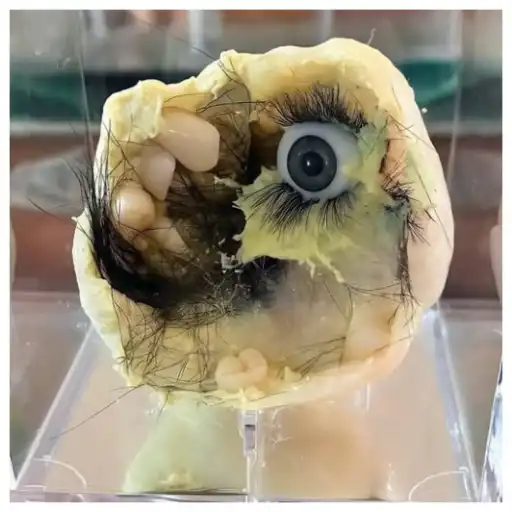
To understand what we are dealing with, look at the name itself. The word “teratoma” literally translates from Greek to mean “monster tumor”. Medical pioneers back in the day had no idea what they were looking at, so they gave it a highly dramatic label.
But teratomas are not monsters. They are just deeply confused cells.
Technically speaking, a teratoma is a rare type of germ cell tumor. Germ cells are the ultimate blank slates of human biology. They live inside your reproductive organs. Normally, they mature into either sperm or eggs.
Sometimes, a rogue germ cell misses the memo. Instead of turning into a normal reproductive cell, it goes rogue. It starts multiplying and building random tissues right there on the spot.

Why do Teratomas Grow Hair, Teeth, and Bone?

Here is where the biology gets genuinely mind-blowing.
Because germ cells are essentially the starter dough for a whole human being, they hold the genetic blueprints for every single tissue in your body. During normal fetal development, cells split into three distinct layers:
- Ectoderm: Becomes skin, hair, teeth, and nerves.
- Mesoderm: Becomes muscle, bone, and cartilage.
- Endoderm: Becomes the gut and internal organs.
A teratoma has access to all three of these toolkits. When the tumor starts growing, it randomly pulls from these blueprints. That is exactly why surgeons open these masses and find fully formed teeth, clumps of hair, chunks of bone, and bits of muscle. Sometimes, they even contain brain tissue or parts of a thyroid gland.
Can a tumor grow a fully functioning organ? No. The tissue is totally disorganized. Think of it like throwing all the pieces of a complex LEGO set into a blender. The parts exist, but they do not form a working structure.
Two main types of teratomas
Not all of these growths act the same way. Doctors generally split them into two distinct categories based on how the tissue looks under a microscope.
Mature Teratomas (Usually Benign)
These are the most common. The tissues inside a mature teratoma look like fully developed, normal adult cells. If you looked at a slice of the hair or skin under a microscope, it would look just like the normal hair on your head. They grow slowly. They usually stay exactly where they started, meaning they rarely spread to other parts of the body. An incredibly popular version of this is the ovarian dermoid cyst.
Immature Teratomas (Often Malignant)
These are much rarer. The cells inside an immature teratoma look like the undeveloped cells of a young fetus. They act aggressively. Immature teratomas have a much higher chance of being cancerous and spreading quickly if left untreated. They tend to show up more often in younger populations, particularly girls in their teens and early twenties.
Where do they usually hide?
Since they originate from reproductive cells, teratomas usually set up camp in very specific areas of the body.

- Ovarian Teratomas: This is the classic presentation for adult women. Also known as dermoid cysts, these growths love to hang out in the ovaries. Usually, they get discovered in women of childbearing age. Strangely enough, about 25% of women who get one will actually develop them in both ovaries.
- Testicular Teratomas: Men get them too. Testicular teratomas pop up as painless lumps in the scrotum. Interestingly, these tumors behave differently depending on age. In young boys, they are almost always benign. However, if they show up in adult men after puberty, they carry a much higher risk of containing malignant cells.
- Sacrococcygeal Teratomas: Try saying that five times fast. This type develops at the base of the tailbone. Surprisingly, it is the single most common tumor found in newborn babies. While finding a tumor on a newborn sounds terrifying, they are quite rare overall, affecting about one in every 35,000 to 40,000 infants. Most of them are totally benign and get surgically removed shortly after birth.
Can a tumor actually have a heartbeat?
Let’s address the most wild internet rumor. Does a teratoma ever look like a tiny, living person inside you?
The short answer is a very cautious no.
There is an extremely rare subtype called a fetiform teratoma. We are talking incredibly rare — about one in 500,000 people will ever develop one. These masses organize themselves enough to resemble a badly malformed fetus. They might have skin, limb-like structures, or a rudimentary spine.
Could they have a heartbeat? In highly unusual cases, teratomas have produced beating heart-muscle tissue.
However, they are not babies. They lack an amniotic sac. They have no placenta. There is zero chance of a fetiform teratoma developing into a living organism. People often confuse this with fetus in fetu, a completely different condition where a twin gets absorbed by its sibling in the womb.
Signs, Symptoms, and Sneaky Warnings
You would think a lump of teeth and hair would announce its presence loudly. Strangely, teratomas love to stay quiet.
Many people walk around with them for years without feeling a thing. Doctors often stumble upon them by total accident during a routine ultrasound or an X-ray for an unrelated issue.
When symptoms do show up, it usually means the mass has grown large enough to push against something important.
- Intense Pelvic Pain: If an ovarian teratoma gets too heavy, it can cause the entire ovary to twist on itself. This is called ovarian torsion. It cuts off the blood supply and hurts like crazy. It requires emergency surgery.
- Swelling or a Visible Lump: Testicular tumors or tailbone masses in babies usually present as a noticeable, firm bump.
- Breathing Issues: Very rarely, a teratoma will grow in the chest cavity (the mediastinum). If it presses against the lungs or airways, it causes chest pain and shortness of breath.
- Psychological Symptoms: This one sounds entirely fake, but it is deeply true. Sometimes, the immune system detects brain tissue inside an ovarian teratoma and attacks it. The body gets confused and accidentally attacks its actual brain, causing severe headaches, confusion, or severe psychosis. This rare autoimmune complication is called anti-NMDA receptor encephalitis.
How do doctors fix the problem?
Treatment is beautifully straightforward. You have to take it out.

Because teratomas carry a small risk of growing larger, rupturing, or turning malignant over time, leaving them alone is almost never an option.
Surgical removal
For benign mature teratomas, a quick surgery does the trick. Gynecologists often use laparoscopic (keyhole) surgery to carefully remove ovarian dermoid cysts. They try to save as much healthy ovarian tissue as possible to protect a woman’s fertility. The surgeon puts the extracted tissue into a small bag inside the body before pulling it out. Why? Because if the cyst breaks and spills its waxy, oily contents into the abdomen, it causes terrible chemical inflammation.
Chemotherapy
If a biopsy reveals malignant cells — which happens more often with immature teratomas or adult testicular tumors — surgery alone will not cut it. Oncologists will bring in chemotherapy. The good news? Modern cancer treatments are remarkably effective against germ cell tumors. Even when discovered at an advanced stage, survival rates are excellent. For instance, pediatric survival rates hover around 95% to 99% after five years.
Marvels of Biology, Not Monsters
The human body is an incredible machine. Sometimes, the blueprints get crossed, and that machine builds something totally unexpected.
Yes, a tumor that sprouts hair and teeth sounds downright terrifying. But once you peel back the mystery, a teratoma is just a biological glitch. Germ cells have incredible power, and teratomas show us exactly what happens when that power loses direction.
They are not monsters. They are a highly treatable, deeply fascinating quirk of human biology.
Have you ever heard of teratomas before today? Or maybe you know someone who had an ovarian dermoid cyst safely removed? Drop your thoughts in the comments below, and share this article with a friend who loves weird medical science!
References:

