

Ascension Day Explained: Date, Biblical Meaning, and Traditions
Easter baskets are packed away. The colorful egg hunts are officially over. The chocolate bunnies are long gone. Most people assume the Christian holiday calendar goes completely quiet until Christmas rolls around again. But if you look closely at the springtime schedule, there is a massively important milestone hiding in plain sight.
Welcome to Ascension Day.
This isn’t just a minor footnote in religious history. It is one of the oldest and most profound feasts in the entire Christian faith. Without it, the story of Easter actually remains unfinished. Yet, unless you grew up in a highly traditional church or live in certain parts of Europe, you might barely notice when it passes by.
So, why does this specific Thursday matter? the exact date for 2026, the mind-bending biblical history, and the incredibly unique ways people celebrate this day around the globe.
Quick read
- The 2026 Date: Western churches will observe Ascension Day on Thursday, May 14, 2026.
- The Math: The holiday always lands exactly 39 days after Easter Sunday, making it the 40th day of the Easter season.
- The Core Meaning: It commemorates the physical departure of Jesus Christ from Earth into heaven, marking the end of his earthly ministry.
- Global Public Holiday: While Americans mostly treat it as a regular workday, many European countries officially shut down banks and schools to celebrate.
When is Ascension Day 2026?
Grab your calendar. For Western Christians (Catholics, Protestants, and Anglicans), Ascension Day 2026 falls squarely on Thursday, May 14.
Why does this date constantly jump around the calendar every single year? You can blame the moon. Ascension Day is permanently tethered to Easter Sunday. Because Easter is a movable feast based on the lunar cycle, every holiday connected to it has to slide around accordingly.
The ancient rule is beautifully simple. Ascension Day always happens on the 40th day of Easter. If you count Easter Sunday as day one, you will inevitably land on a Thursday exactly 39 days later. This is why you will frequently hear people refer to the holiday as “Ascension Thursday” or “Holy Thursday.”
Things look a bit different if you follow the Eastern Orthodox tradition. Because the Orthodox Church calculates its dates using the older Julian calendar instead of the modern Gregorian one, their timeline is naturally delayed. For Eastern Orthodox believers, Ascension Day will take place a week later on Thursday, May 21, 2026.
The Great “Sunday Shift”
If you live in the United States, finding a church service on a random Thursday morning can be surprisingly tough. Most people have to commute to work. Kids are stuck in school. Attending a midweek religious festival simply doesn’t fit into the modern daily grind.
To solve this practical problem, many ecclesiastical provinces have officially moved the celebration to the following weekend. This is widely known as “Ascension Sunday.” In 2026, that moved observance will happen on Sunday, May 17.
What actually happened?
To truly grasp why millions of people still celebrate this event, we have to look at the original source material. The clearest historical accounts live right inside the New Testament, specifically in the Gospel of Luke and the Book of Acts.
According to scripture, the resurrection on Easter Sunday was not the end of the story. Jesus didn’t just walk out of the tomb and immediately vanish into thin air. He stuck around. For 40 days, the resurrected Christ actively appeared to his disciples. He ate meals with them. He proved he possessed a physical body. He spent weeks intensively teaching them about the kingdom of God.
Then came the grand finale.
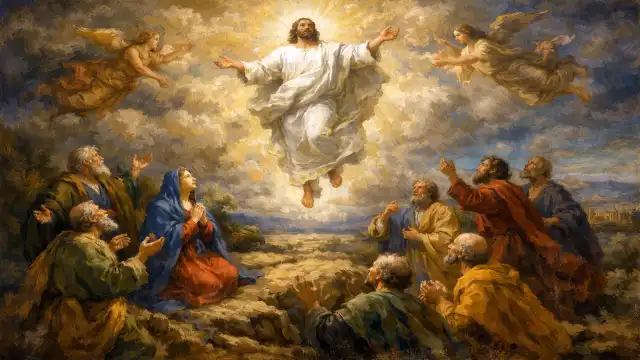
According to Acts 1:9-11, Jesus gathered his closest followers on the Mount of Olives, a prominent ridge sitting just east of Jerusalem. He gave them one final, massive directive. He told them to stay in the city until they received power from the Holy Spirit. He commanded them to take his teachings to the absolute ends of the earth.
As soon as he finished speaking, gravity simply stopped applying.
Jesus was physically lifted up from the ground. A cloud eventually obscured him from their sight. The disciples were left standing on the dirt, staring blankly into the sky. Two figures dressed in white robes suddenly appeared beside them and offered a gentle rebuke. They basically asked, Why are you guys just standing here looking up? He is coming back the exact same way.
The Hidden theological meaning
Reading the story is one thing. Understanding the deep theological architecture behind it is another. Why is this specific moment so crucial to the Christian faith?
At first glance, the Ascension feels a bit like an abandonment. The disciples just got their best friend back from the dead, only to lose him again a month later. But early theologians viewed it entirely differently. They didn’t see a departure. They saw a royal coronation.
1. Taking the Throne
The Ascension represents Jesus completing his earthly rescue mission and taking his rightful seat at the right hand of God. The ancient Nicene Creed, finalized in the fourth century, explicitly requires believers to confess this exact event. It proves that Christ’s saving work was entirely finished and universally accepted.
2. Humanity Enters Heaven
This concept will bend your mind a little bit. When Jesus ascended, he didn’t shed his human body. Christian theology teaches that he took glorified human flesh directly into the divine presence. For the very first time, humanity was permanently bridged with heaven.
3. Making Room for the Holy Spirit
Jesus actually told his disciples this departure was necessary. In the Gospel of John, he plainly states that if he does not leave, the Advocate (the Holy Spirit) cannot come. The Ascension creates the necessary vacuum for Pentecost. Exactly ten days after Jesus ascends, the church celebrates Pentecost — the dramatic arrival of the Holy Spirit that officially launches the global Christian church.
Bizarre and Beautiful global traditions
Religion is rarely just about reading old texts. It is deeply tied to human culture, geography, and changing seasons. Over the centuries, Christians have developed some wildly unique ways to mark this specific Thursday.
The Extinguished Candle
Step into a traditional Catholic or Anglican church on Ascension Day, and you will witness a powerful visual metaphor. Since Easter Sunday, a massive beeswax pillar known as the Paschal candle has burned brightly near the altar. It symbolizes the physical presence of the risen Christ. During the Ascension Day mass, this giant candle is ceremoniously snuffed out. The smoke drifting up into the vaulted ceiling visually mimics Jesus disappearing into the clouds.
Germany’s “Father’s Day” Hikes
Leave it to Germany to turn a solemn religious feast into a legendary outdoor party. In Germany, Ascension Day (Christi Himmelfahrt) is a massive public holiday. Curiously, it also doubles as their official Father’s Day (Vatertag or Männertag).
The history here is fascinating. Back in the 18th century, German communities held elaborate street parades to celebrate the Ascension. Afterward, mayors would routinely hand out small gifts to local fathers. Today, that tradition has evolved into groups of men hiking through the woods or cycling down country lanes. They usually pull small wooden wagons completely loaded with beer, sausages, and pretzels. It is a brilliant mix of springtime joy and community bonding.
Swedish Forest Choirs
Swedes celebrate the holiday with a beautiful, quiet tradition called Gökotta. Long before the sun comes up, families will trek deep into the freezing, dark woods. They arrive just in time to hear the spring birds start singing at dawn. Specifically, they are listening for the distinct call of the cuckoo bird. Connecting with the renewal of nature perfectly mirrors the spiritual themes of hope and ascension.
Beating the Bounds in Britain
In rural England, Ascension Day was traditionally tied to “Rogation days.” These were specific days of fasting and prayer to bless the upcoming summer harvest. Villagers would walk the literal borders of their parish. Young boys would carry long willow branches and physically beat the boundary stones. This quirky practice, known as “beating the bounds,” ensured everyone knew exactly where their community lines were drawn before modern maps existed.

Why does Ascension Day feel overlooked?
If this day is so incredibly important, why do most modern folks ignore it?
The answer boils down to simple economics and modern scheduling. Christmas and Easter land squarely on a weekend or carry massive retail momentum. You can sell a million pine trees and chocolate eggs. Selling a Thursday church service in the middle of May is a much harder marketing pitch.
In the United States, capitalism entirely ignores Ascension Day. Nobody gets a day off. Banks stay completely open.
Europe, however, kept the faith. In countries like Switzerland, France, Belgium, and Colombia, Ascension Day remains a strict public holiday. Government offices lock their doors. Schools close down. In fact, many European workers simply take the following Friday off as well, creating a massive, highly anticipated four-day weekend right as the spring weather hits its absolute peak.
Simple ways to observe the day in 2026
You don’t need to pull a wagon of beer through a German forest to celebrate properly. If you want to lean into the historical rhythms of the Christian calendar this May, here are a few simple, highly meaningful ways to observe the day.
- Read the Original Story: Take five minutes on Thursday morning to read Acts 1:1-11. It resets your focus before the daily chaos begins.
- Take a “Literal” Hike: Ascension is all about going upward. Take your family on a hike up a local hill or mountain. When you reach the top, talk about the concept of Jesus elevating his mission and passing the baton to us.
- Go Cloud Watching: Make theology incredibly simple for a kid. Lay a blanket out in the backyard, look up at the clouds, and discuss the sheer mystery of the biblical story. Kids grasp visual metaphors significantly faster than complex sermons.
- Start a Novena: The nine days between Ascension Thursday and Pentecost weekend are historically set aside for deep prayer. A “novena” is simply a commitment to pray for a specific intention for nine consecutive days. Use this quiet stretch to ask for wisdom, patience, or a renewed sense of purpose.
Looking up
We spend an agonizing amount of time looking downward. We stare at our glowing phones, we stress over our messy floors, and we hyper-focus on the immediate problems sitting right in front of our faces.
Ascension Day 2026 offers a jarring, beautiful invitation to simply look up.
It reminds believers that the story of faith doesn’t end in a graveyard. It doesn’t end in defeat. It ends with a triumphant king taking his throne and trusting his followers to finish the work he started on the ground. The next time you find yourself entirely overwhelmed by the daily grind this spring, remember the view from the Mount of Olives. The real mission is just getting started.
How do you plan to celebrate the spring season this year? Have you ever witnessed any of these wild global traditions in person? Drop a comment below, share this article with a curious friend, and let’s keep the conversation going!

