

Was El Dorado a City or a Person? The True Story of the Muisca Legend
If you grew up watching movies like The Road to El Dorado or playing video games like Uncharted, you probably have a specific image in your head. You picture a glittering metropolis hidden deep in the Amazon rainforest. Temples made of solid gold. Streets paved with precious gems. A lost civilization just waiting for a swashbuckling explorer to chop through the vines and find it.
It makes for a fantastic movie plot. Unfortunately, it is a complete historical misunderstanding.
El Dorado was never a city. It was never a hidden kingdom. Originally, El Dorado was just one guy.
The myth that drove European explorers mad, cost thousands of lives, and literally caused a famous English knight to lose his head all started with an indigenous religious ceremony in the Andes mountains. Over the centuries, a game of historical telephone warped a sacred ritual into a legendary empire of wealth.
At a glance
- Not a Place, but a Person: El Dorado translates to “The Gilded One.” It referred to a king of the Muisca people in Colombia who covered his body in gold dust during a sacred ritual.
- The Sacred Lake: The ceremony took place at Lake Guatavita. The king would float to the center on a raft and throw gold and emeralds into the water as offerings to a goddess.
- The Vain Quest: Spanish conquistadors like Gonzalo Jiménez de Quesada conquered the Muisca in the 1530s but found no golden city.
- Disastrous Excavations: Treasure hunters spent centuries trying to drain Lake Guatavita to steal the sunken gold. Some attempts ended in bankruptcy; others ended in deadly landslides.
- The Myth Mutates: When the golden city didn’t materialize in Colombia, explorers pushed the myth eastward, convincing themselves the empire lay hidden in the Guianas.
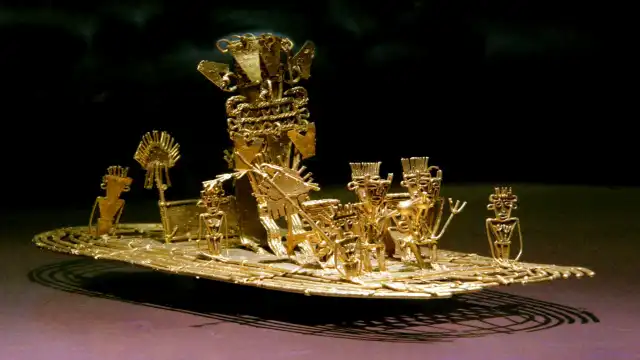
- Hard Proof: In 1969, farmers found the “Muisca Raft,” an incredible pre-Columbian gold artifact that perfectly depicts the El Dorado ceremony.
The Birth of “The Gilded One”
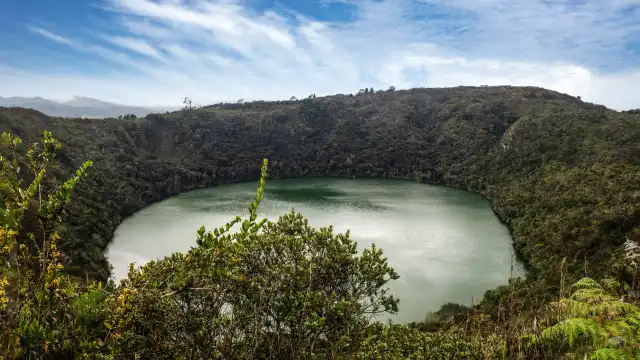
To understand how the rumor started, we have to travel to the high-altitude plateaus of the Colombian Andes. Long before the Spanish arrived, this region was ruled by the Muisca people. They were a highly advanced society, skilled in farming, weaving, and — most importantly — goldsmithing.
To European explorers, gold was money. It was a commodity used to fund armies, buy land, and secure power. To the Muisca, gold (nyia) had absolutely zero financial value. Instead, they viewed the highly reflective metal as holding the sacred, life-giving energy of the sun. They didn’t use it as currency. They used it to connect with the divine.
When a new Muisca ruler — known as the Zipa — was ready to take power, he didn’t just put on a crown. He underwent a massive initiation rite that culminated at Lake Guatavita.
This nearly perfectly circular alpine lake was incredibly sacred. According to Muisca beliefs, it was the home of Chie, the water goddess.
During the coronation ceremony, priests would strip the new Zipa naked. They coated his skin in a sticky layer of resin or sap. Next, they used hollow reeds to blow fine gold dust all over his body until he literally became a living, breathing golden statue.
The newly minted “Golden Man” would then board a ceremonial raft made of rushes. Accompanied by four highly ranked priests, he paddled out to the exact center of the lake. The crowds on the shoreline would play flutes and sing, creating a deafening roar that echoed off the crater walls.
Once in the center, the Zipa tossed massive piles of intricately crafted gold ornaments and emeralds into the dark water as an offering to the goddess. Finally, he dove into the freezing lake himself, washing the gold dust from his skin to seal the covenant between his people and the gods.
When the Spanish heard rumors of this ritual, they didn’t care about the spiritual significance. They only cared about the math. If a king was throwing piles of gold into a lake every time a new ruler was crowned, the bottom of that lake had to be worth billions.
They started calling this legendary king El Hombre Dorado (The Golden Man). Soon, they shortened it to just El Dorado.
Enter the conquistadors (And their gold fever)
By the 1530s, the Spanish had already crushed the Aztec Empire in Mexico and the Incan Empire in Peru. They had hauled literal tons of plundered gold back to Europe. Because of these massive payouts, rumors of another golden kingdom in the interior of South America didn’t sound crazy. They sounded like an investment opportunity.
In 1536, a Spanish lawyer named Gonzalo Jiménez de Quesada decided to trade his legal texts for a sword. He led an expedition of 900 men up the Magdalena River into the heart of present-day Colombia.
The journey was a waking nightmare. They spent eight months hacking through dense tropical rainforests. Disease, starvation, and attacks by indigenous tribes decimated their ranks. By the time Quesada’s expedition finally reached the Andean highlands, only about 160 men were left alive.
They easily conquered the Muisca territory. The Spanish looted temples, seized land, and established the city of Santafé de Bogotá.
Yet, Quesada hit a massive wall of disappointment. He found no sprawling metropolis made of gold. There were no golden streets. There was only the Muisca civilization, and they pointed him toward Lake Guatavita.
Draining the sacred lake: Treasure hunt
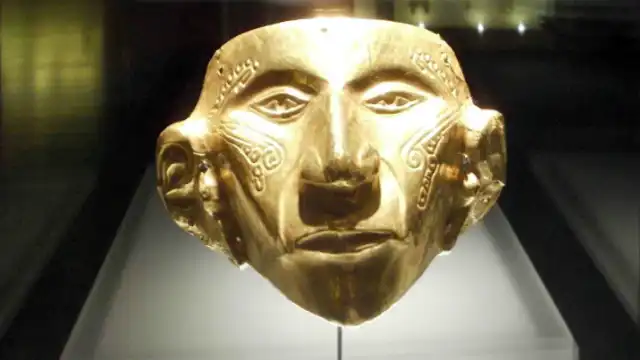
Realizing the treasure was sitting at the bottom of a freezing alpine lake, the Spanish faced a massive engineering problem. You can’t just dive into the muddy, high-altitude depths of Lake Guatavita and grab the loot. Scuba gear wouldn’t be invented for another four hundred years.
So, they decided to simply drain the lake. What followed was a multi-century saga of greed, destruction, and spectacular failure.
Attempt 1: The Bucket brigade (1545)
Hernán Pérez de Quesada (Gonzalo’s brother) and a man named Lázaro Fonte organized the first attempt. They enslaved local indigenous people and forced them to form a continuous bucket line. For months, workers passed buckets of water from the lake over the mountain rim.
They actually managed to lower the water level by about ten feet (three meters). The Spanish recovered roughly 4,000 pesos worth of gold from the exposed muddy edges. It was a nice payday, but nowhere near the legendary hoard they expected. The water was too deep, and they eventually gave up.
Attempt 2: The Deadly trench (1580)
Thirty-five years later, an entrepreneur named Antonio de Sepúlveda tried a more aggressive approach. Why use buckets when you can use gravity?
He hired thousands of indigenous workers to cut a massive V-shaped trench directly into the rim of the mountain enclosing the lake. The plan worked initially. The water rushed out of the gorge, lowering the lake level by a staggering 65 feet (20 meters). Sepúlveda found golden breastplates, emeralds, and ceremonial armor.
Then, disaster struck. The deeply cut trench became structurally unstable. The earth gave way, collapsing in a massive landslide that killed many of the workers and permanently sealed the drainage ditch. Sepúlveda lost his funding, went broke, and died penniless.
Attempt 3: The Baked cement trap (1898)
The most ridiculous attempt happened three centuries later. A group of London contractors formed “The Company for the Exploitation of the Lagoon of Guatavita.”
They approached the problem with industrial revolution technology. Instead of digging a trench, they dug a subterranean tunnel that opened up underneath the center of the lake. It worked perfectly. The lake drained entirely, leaving only four feet of muck at the bottom.
The British crew celebrated, assuming they just had to walk out and pick up the gold. Nature had other plans. The mud at the bottom of the lake was incredibly deep and dangerous to walk in. Before they could secure specialized equipment to traverse it, the scorching Andean sun baked the mud. It turned into a rock-hard layer of cement, sealing the gold away completely.
Finding only about £500 worth of artifacts, the London company filed for bankruptcy. The tunnel eventually collapsed, the rains returned, and the lake filled right back up.
How the myth mutated into a lost empire
Because Lake Guatavita refused to yield its ultimate treasure, European explorers experienced cognitive dissonance. They couldn’t accept that the massive haul of gold they dreamed of was just a localized ritual that got exaggerated.
Instead of admitting defeat, they moved the goalposts.
If the city of gold wasn’t in Colombia, it must be further east! The legend of El Hombre Dorado (the man) mutated into the legend of El Dorado (the city). Explorers convinced themselves that the golden empire was located in the uncharted Amazon basin, or perhaps in the Guianas, surrounding a mythical body of water called Lake Parime.
This delusion led to some of the most tragic expeditions in colonial history.
The most famous victim of this mutated myth was Sir Walter Raleigh. The legendary English courtier was completely obsessed with finding El Dorado. He launched his first expedition to Guiana in 1595, finding nothing but jungle.
Decades later, in 1617, an aging Raleigh convinced King James I to let him try one last time. Raleigh stayed at a base camp in Trinidad while his son, Watt Raleigh, led a detachment up the Orinoco River. The expedition was a catastrophe. They found no gold, clashed violently with Spanish outposts, and Watt was killed in a firefight.
Raleigh returned to England broken, grieving, and entirely empty-handed. Because he had unlawfully attacked the Spanish during a time of peace, King James I had Raleigh beheaded in 1618.
The quest for a phantom city had literally destroyed him.
Discovery of the Muisca Raft
For centuries, skeptics wondered if the golden ritual at Lake Guatavita was entirely fabricated by overly excited Spanish writers. Did the Zipa actually cover himself in gold dust, or was that just indigenous folklore taken too literally?
In 1969, the world got its answer.
Three farmers were exploring a small cave in the municipality of Pasca, south of Bogotá. Tucked away in the dark, they found a ceramic pot. Inside that pot was one of the most significant archaeological discoveries in South American history.
It is called the Muisca Raft. Measuring just under eight inches long, it is a stunning votive (a dedicated religious offering) made from tumbaga — an alloy of gold, silver, and copper.
The piece was created using a complex “lost-wax” casting method. A craftsman spent hundreds of hours sculpting the scene in beeswax, encasing it in clay, melting the wax out, and pouring in the molten metal. The entire raft, with all its intricate dangling ornaments, was created in a single pour with no welded joints.
Look closely at the figures on the raft. A massive central chieftain sits on a throne. He is wearing a heavy headdress and a nose pendant — symbols of Muisca royalty. Surrounding him are ten smaller attendants and oarsmen. Some are wearing masks. Others are holding poporos (gourd flasks used for sacred coca rituals).
It is an exact, perfectly preserved snapshot of the El Dorado ceremony.
Today, the Muisca Raft is the crown jewel of the Gold Museum in Bogotá, Colombia. It serves as undeniable, tangible proof that the legend of the Gilded Man was absolutely real.
The Real treasure was never gold
The story of El Dorado is ultimately a tragedy born from a massive cultural mistranslation.
The European explorers were blinded by a ledger mentality. They saw gold as a ticket to social status, real estate, and power. They murdered countless indigenous people, wiped out entire civilizations, and threw away their own lives searching for a kingdom that only existed in their imaginations.
The Muisca understood something the conquistadors didn’t. The true value of the gold wasn’t in hoarding it. Its value was in letting it go. By returning the sacred metal to the earth, they were maintaining harmony with nature and honoring the waters that kept their society alive.
Lake Guatavita is heavily protected by the Colombian government today. Treasure hunting is strictly forbidden. The waters remain quiet, green, and completely undisturbed.
Whatever gold still rests at the bottom of the crater finally belongs to the goddess Chie again, exactly where the Muisca intended it to be.
What do you think? If you were a 19th-century explorer, would you have joined the London company’s wild scheme to drain the lake, or do you think the Muisca gold should remain untouched at the bottom? Drop your thoughts in the comments below, and share this piece with a friend who loves a good historical mystery!

