

The Richat Structure Atlantis Theory: Is the Eye of the Sahara the Lost City?
We all love a good mystery. When you see satellite photos of a massive, perfectly circular “bullseye” sitting in the middle of the Sahara Desert, your brain immediately screams aliens or ancient civilization. Add in some viral YouTube videos claiming this 25-mile-wide target is actually the lost city of Atlantis, and you suddenly have a modern internet phenomenon.
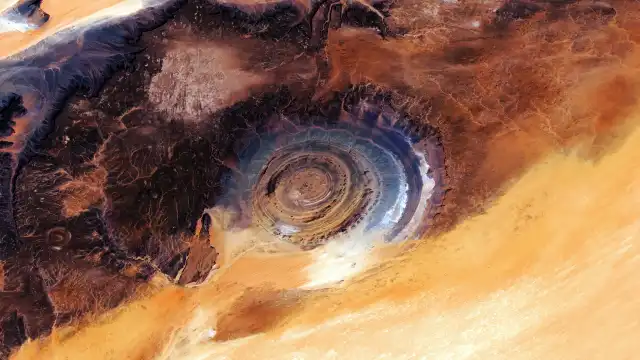
It is called the Richat Structure, or the “Eye of the Sahara.” Located in the remote, punishing dunes of Mauritania, it definitely looks like the sunken island empire Plato wrote about 2,400 years ago.
It makes a fantastic story. Sadly, it is entirely fictional.
The true origin of the Eye of the Sahara involves hundreds of millions of years of deep-earth geology, bubbling magma, and relentless wind. No mythical sea kings required. Here is the scientific reality behind the internet’s favorite Atlantis theory.
Key takeaways
- The Viral Myth: Internet sleuths claim the Richat Structure in Mauritania is the exact site of Atlantis because its concentric rings visually match Plato’s ancient descriptions.
- The Geological Reality: The structure is a 100-million-year-old eroded dome (essentially a volcanic blister that never popped). The rings are just different layers of rock eroding at different speeds.
- The Dealbreaker: The Eye of the Sahara sits 1,300 feet above sea level and hundreds of miles inland. It was not underwater 11,000 years ago during the supposed time of Atlantis.
- The Evidence: Geologists and archaeologists have mapped the area extensively. They found ancient stone axes from early cavemen, but zero evidence of a Bronze Age civilization. There are no ruins, no harbors, and no engineered canals.
What Exactly is the Eye of the Sahara?
Before we bust the myth, we need to understand the actual science.
Locals call it Guelb er Richat. It is an enormous geological oddity located in the Adrar Plateau of northwestern Mauritania. Spanning roughly 25 miles (40 kilometers) in diameter, it is so massive that scientists didn’t fully comprehend its shape until early astronauts started using it as a visual landmark from orbit.
Initially, geologists assumed it was an impact crater. It looks exactly like the scar left behind by a massive meteorite strike. However, when researchers finally hiked into the blistering desert to test the rocks in the 1960s, they found a completely different story.
They found absolutely zero evidence of “shock metamorphism.” When a meteor hits the earth, the insane heat and pressure melt rocks into glass and create specific high-pressure minerals. The Richat Structure had none of those things.
Instead, geologists discovered it was an alkaline igneous intrusion.
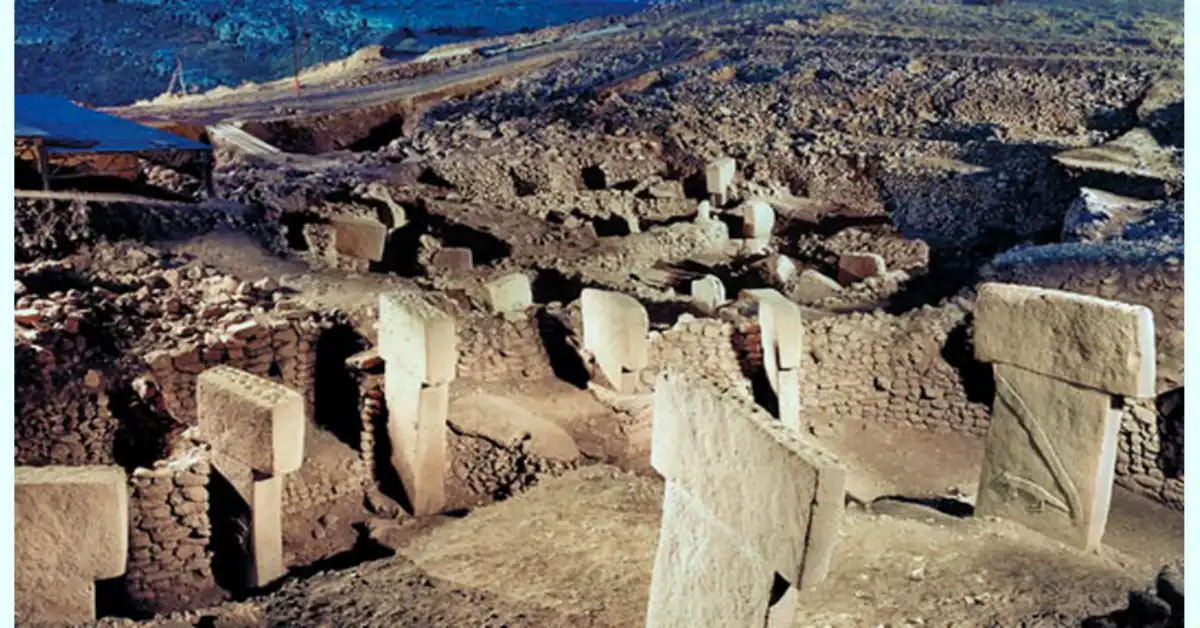
Don’t let the jargon intimidate you. Imagine a giant underground blister. Over 100 million years ago, during the Cretaceous period, a massive pool of molten magma pushed up from deep inside the earth. It forced the flat layers of sedimentary rock on the surface to bend upward into a massive dome.
The magma never broke through the surface to become a volcano. It just cooled and hardened underground. Over tens of millions of years, fierce desert winds and ancient rivers sliced the top off that dome like a knife cutting the top off an onion.
Because the dome was made of alternating layers of hard rock (like quartzite) and soft rock (like limestone), they eroded at different speeds. The hard rocks stood tall, forming the circular ridges. The soft rocks crumbled away, forming the valleys.
The Eye of the Sahara wasn’t built by human hands. It was carved by deep time.
Why Do People Think It’s Atlantis?
If the science is so clear, why do millions of people think this desert bullseye is a legendary sunken city?
The modern theory exploded online a few years ago, heavily popularized by alternative history channels on YouTube and TikTok. These creators pointed to Plato’s original dialogues, Timaeus and Critias, written around 360 BC.
Plato described Atlantis as a utopian island empire made of concentric rings of water and land. Specifically, he claimed the city had two rings of land and three rings of water. He also mentioned mountains to the north that sheltered the city from cold winds, and a massive, fertile plain to the south.
When you look at a satellite map of the Richat Structure, the visual similarities are admittedly striking.
- It has concentric rings.
- There are mountains (the Adrar Plateau) to the north.
- There is a sweeping sandy plain to the south.
Believers also point out that Atlantis supposedly existed 9,000 years before Plato’s time (roughly 11,600 years ago). During that exact era, Africa was experiencing a “Humid Period.” The Sahara wasn’t a desert; it was a lush, green landscape filled with massive lakes and rivers.
Could the rings of the Richat Structure have been filled with water during this wet period, perfectly matching Plato’s description?

Explore how the specific claims stack up against the geological facts below:
The Hard Science: Why the Theory Collapses
Visual similarities make for great YouTube thumbnails. They do not make for great science. When you actually apply basic geology and archaeology to the Richat Structure, the Atlantis theory completely falls apart.
Here are the four massive scientific roadblocks that debunk the myth.
1. The Elevation Problem
Plato explicitly states that Atlantis was an island empire located in the ocean. According to the legend, the gods punished the arrogant Atlanteans by sinking their city beneath the waves in a single day and night of fire and earthquakes.
The Eye of the Sahara is not underwater. It sits roughly 1,300 feet (400 meters) above sea level. It is also located over 300 miles inland from the Atlantic coast.
Internet theorists claim that a massive tectonic shift or a catastrophic tsunami pushed the city upward and stranded it in the desert. Geology proves this is impossible. The African tectonic plate is incredibly stable in this region. The coastline of Mauritania has not drastically changed in the last 11,000 years. The Richat Structure has been high, dry, and inland for millions of years.
2. The “Salt” Argument is Busted
Conspiracy theorists often point to white patches of salt scattered across the Richat Structure. They claim this salt is leftover ocean residue from when the Atlantic covered the city.
This is a fundamental misunderstanding of desert geography. The salt found in the Eye of the Sahara has nothing to do with the ocean. It is the result of normal continental weathering.
During the African Humid Period, seasonal rainwater collected in the lower rings of the structure, forming shallow freshwater lakes. When the climate dried up and those temporary lakes evaporated, they left behind concentrated mineral deposits and salts leached from the surrounding rocks. You see the exact same phenomenon in Death Valley, California. No ocean required.
3. Zero Archaeological Evidence
If the Richat Structure was the bustling capital of a global, bronze-age superpower, where is their trash?

Human beings leave a massive footprint. If a highly advanced society lived there just 11,000 years ago, the area would be littered with undeniable proof. We would find the foundations of buildings. We would find engineered harbors, slag from metalworking, shattered pottery, and massive burial sites.
Scientists have scoured the Eye of the Sahara for decades. They found exactly zero Bronze Age ruins.
What they did find were Paleolithic hand axes and spear points. Early human hunter-gatherers definitely walked through this area hundreds of thousands of years ago. But dropping a chipped stone axe while hunting an antelope does not equal building a utopian city with gold-plated temples.
4. Deep Time Disconnect
The timeline is wildly broken. Plato’s story places the destruction of Atlantis around 9,600 BC.
The rocks that make up the Eye of the Sahara cooled between 94 and 104 million years ago. The erosion that carved those beautiful rings took tens of millions of years. The structure was completely formed and looking exactly like a bullseye long before the first human ancestor ever learned to walk upright, let alone build ships.
The Real Wonder Needs No Myths
We desperately want Atlantis to be real. It taps into a profound human desire to find lost magic in a fully mapped world. When we see something as bizarre and perfectly shaped as the Eye of the Sahara, attributing it to a mythical civilization feels more exciting than attributing it to differential erosion.
However, the real story is actually more profound.
The Richat Structure doesn’t need to be a lost city to be incredible. It is a 100-million-year-old scar on the face of the earth, created by forces so powerful they can bend continents. It is a natural masterpiece carved by time itself, so massive it guides human beings living on a space station orbiting the planet.
That is infinitely cooler than a fairy tale about a sunken city.
What do you think? Does the geological explanation satisfy your curiosity, or do you still hold out hope that Atlantis is buried somewhere out there in the sand? Drop your thoughts in the comments below, and share this article with a friend who loves falling down internet rabbit holes!

