

You probably do not associate an ancient public toilet with a tender, heartbreaking farewell. Yet, deep within the ruins of a bustling ancient Greek city in modern-day Türkiye, archaeologists discovered exactly that. By using cutting-edge forensics to re-evaluate a tiny grave hidden in an abandoned sewer, scientists just cracked open a deeply emotional chapter of medieval family life.
1,200-Year-Old Byzantine Infant Twin Burial Found in Roman Latrine at Ephesus
Finding human remains inside ancient sewers usually points to a dark reality. In places like Ashkelon in Israel or the Agora Bone Well in Athens, archaeologists have found hundreds of infant bones tossed into active drainage systems. Those sites heavily suggest infanticide or treating unwanted newborns like literal garbage.
This discovery completely flips that script.
This grave wasn’t a rushed disposal. It was a carefully planned, desperately sad burial. The parents of these babies went out of their way to build a safe space in a ruined world. They transformed a filthy, forgotten place into a sacred vault to protect their children in the afterlife.
Unearthing a bioarchaeological mystery
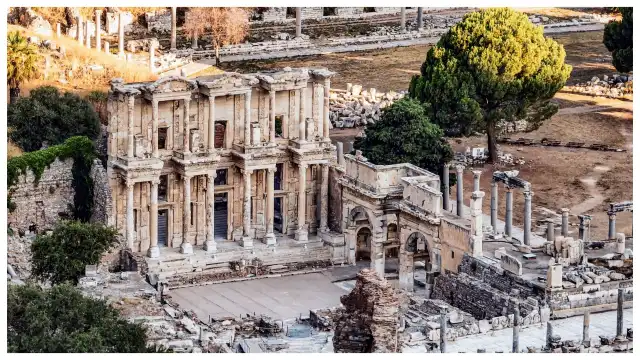
Back in 2010, excavation teams working in Ephesus found something bizarre. Hidden inside a brick channel lay the fragile bones of two tiny humans. For years, the full story of this grave remained locked away.
Fast forward to 2026. A brand-new investigation finally unlocked the genetic and forensic secrets of these bones.
According to the groundbreaking Austrian Academy of Sciences OeAW study, led by bioanthropologist Caroline Partiot and archaeologist Lilli Zabrana, this burial is entirely unique. Their findings, published recently in the Childhood in the Past journal, prove that these children were not discarded discards. They were mourned members of a community. For parents today who understand the fragility of pregnancy, this ancient story hits incredibly close to home.
Ephesus temple of artemis odeon connection
Location is everything in archaeology. To understand why this grave is so weird, you have to understand exactly where it sits.
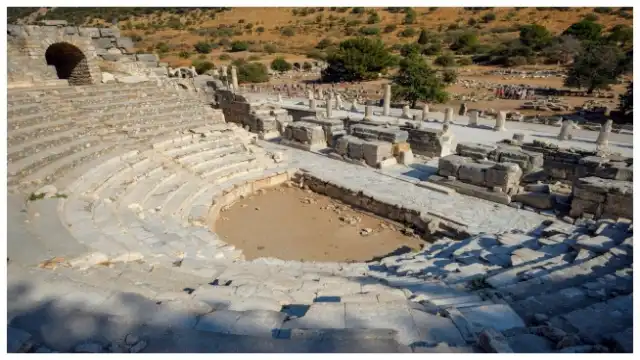
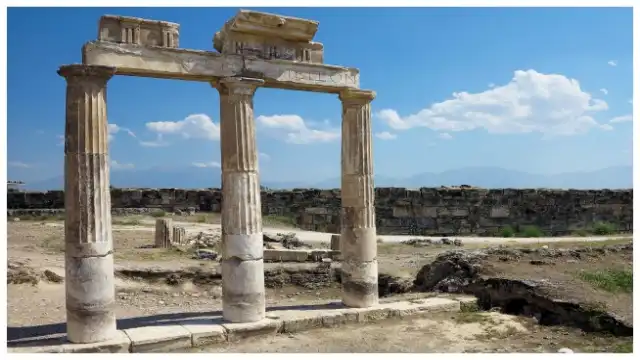
The grave lies within the once-glorious precinct of the Artemision — the sanctuary dedicated to the Greek goddess Artemis. Just a short walk away sits the ruins of a massive theater. This specific area, the Ephesus Temple of Artemis Odeon, was built in the first century AD. It served as a cultural hub for musical performances, poetry readings, and plays.
When you host massive crowds, you need infrastructure. During the second or third century, engineers added a public latrine directly beneath the Odeon. This was not a modern private bathroom. It was a communal facility featuring about 30 stone seats positioned over a deep drainage channel.
Cities change. Empires fall.
By the time the eighth or ninth century rolled around — the Middle Byzantine period — the Odeon had collapsed following a massive fire. The latrine was completely abandoned. The Roman Empire had fractured, and Byzantine Christianity now dominated the cultural landscape. The bustling theater district had transformed into a quiet, ruined ghost town.
Someone in the 8th century looked at that abandoned, dried-out sewer channel and saw the perfect, sheltered hiding spot for a tomb.
Science of premature tragedy
What exactly did the lab tests reveal about these two babies? The bone data is simultaneously fascinating and tragic.
First, researchers measured the tiny upper arm bones. Both infants were incredibly small, measuring only about 17 inches long. This size tells us they never reached full term. They died at roughly 33 to 34 weeks of pregnancy.
Because their skeletal development was virtually identical and they were buried touching each other, the science points to one obvious conclusion. This is a very rare medieval twin infant tomb.
Did they die in the womb? Did they survive a traumatic premature birth only to pass away hours later? The skeletons cannot give us a definitive time of death. However, in an era long before neonatal intensive care units or infant incubators, being born at seven and a half months was almost always a death sentence.
Mystery of the extra rib
The physical examination revealed another massive clue. One of the twins possessed a supernumerary cervical rib.
What does that mean? Basically, the infant grew an extra rib high up in their neck. This is an incredibly rare genetic anomaly. Today, doctors know that this specific mutation carries a high risk of severe developmental disorders. It is heavily linked to miscarriage and stillbirth.
Finding this defect is a massive deal for bioarchaeologists. According to the research team, this is only the second documented case of this specific anomaly found in perinatal (around the time of birth) human remains anywhere in the world. It provides a direct, biological explanation for why the pregnancy ended prematurely.
Why choose a disused sewer?
If the family loved these twins, why bury them in a toilet?
To answer that, you have to get inside the head of an 8th-century Byzantine Christian. During the Early Middle Ages, society operated under strict religious rules. Baptism was the ultimate dividing line.
If a baby died before being baptized — which was obviously the case for stillborn or highly premature twins — they existed in a theological gray area. They held a liminal, unclassified social status. Because they were not officially initiated into the church, religious authorities often banned families from burying them in formal, consecrated church cemeteries.
This left grieving parents in a terrible bind. They needed a place to put their children, but they were locked out of the official graveyards.
Most families resorted to burying unbaptized babies under the dirt floors of their houses. Sometimes they used dried-up wells.
The parents in Ephesus chose the old Roman latrine. Why? Because it offered something a shallow dirt grave could not: heavy-duty physical protection. The thick brick and stone walls of the underground sewer channel provided a ready-made vault. It kept scavenging animals away. It shielded the fragile bodies from the elements.
They didn’t see a toilet. They saw a fortress for their babies.
Decoding the burial rituals
The Byzantine infant burial Ephesus Roman latrine site wasn’t a quick drop-and-run operation. The archaeological evidence shows meticulous, time-consuming care.
- Fresh Soil: The parents didn’t just lay the babies on the dirty floor of the sewer. Plant analysis shows they hauled in loads of fresh, clean soil to create a soft, pure bed.
- Westward Facing: They placed both infants flat on their backs. They carefully aligned their tiny heads to point directly west. This was not random. Facing west was the strict Christian burial custom of the Byzantine era, symbolizing readiness for the resurrection.
- Burial Shrouds: The bones stayed in a tight, restricted cluster as they decomposed. Researchers also found a single iron pin near one of the skulls. This proves the babies were tightly swaddled in fabric burial shrouds. The pin held the protective cloth together.
- No Grave Goods: Pagan Romans loved burying their dead with coins, jewelry, and pottery. Byzantine Christians rejected that. They believed you couldn’t take material wealth into the afterlife. The complete lack of grave goods here perfectly matches standard Christian traditions of the time.
Forensic environment: Archaeothanatology
How do we know so much about the environment inside this tiny grave? Archaeothanatology.
That is a complex word for a very cool science. It involves studying exactly how bones shift as flesh decays over centuries. The researchers noticed that some of the tiny hand and foot bones had floated slightly away from the main skeletons.
This displacement told them that water periodically flooded the old sewer channel while the bodies were decomposing. This specific detail helps environmental experts map out the ancient climate and the shifting water table around Ephesus during the Middle Ages.
Fall of a wonder of the world
Why was the area around the Odeon so desolate and available for a secret burial by the 8th century?
The Temple of Artemis was once one of the Seven Wonders of the Ancient World. It was a massive, gleaming marble structure that drew pilgrims from across the Mediterranean. However, paganism eventually lost its grip. In the 3rd century, invading forces heavily damaged the temple. Later, as the Roman Empire officially adopted Christianity, emperors ordered the closure of pagan temples. Locals stripped the beautiful marble from the Artemision to build churches and houses.

By the time these twins were born, the once-great sanctuary was a massive, overgrown stone quarry. The Odeon, once echoing with music, was a collapsed hazard. But for grieving parents seeking a quiet, undisturbed place, this ruined landscape was perfect. It was out of sight from the bustling new Christian city center. It gave them the privacy they needed to perform their unauthorized burial rites in peace.
Harsh reality of byzantine medicine
Surviving a twin pregnancy is tough today. In the 8th century, it was a terrifying gamble.
Byzantine medical texts actually show a surprisingly advanced understanding of gynecology for the time. Physicians relied on skilled midwives to handle complex deliveries. However, they possessed no technology to stop premature labor. If a mother went into labor at 33 weeks, nature simply took its course. The infants lacked the lung development to breathe effectively on their own. They lacked the body fat to regulate their temperature.
The fact that the mother survived to bury these children — assuming she did — is a minor medical miracle in itself. The extra cervical rib found on one twin hints at underlying genetic complications that likely triggered the early labor.
A Human connection across the centuries
It is incredibly easy to look at ancient history purely as dates, ruined columns, and dusty pottery. We forget that the people who lived 1,200 years ago felt the exact same emotions we do today.
Imagine the sheer physical and emotional toll this event took. A mother endured a high-risk twin pregnancy in a world without modern medicine. The devastating loss of both children at 34 weeks would have shattered the family.
Denied access to the local churchyard, they didn’t just throw their hands up in despair. They scouted the ruins of the old Artemision. They climbed down into the dark, collapsed underbelly of a 700-year-old theater. They carried in clean dirt. They wrapped their tiny children in cloth, pinned it shut, and laid them facing the setting sun.
Changing how we view the past
Before this excavation, experts assumed that finding babies in sewers always meant a society didn’t value newborn life. The Ephesus twins force historians to completely rethink that narrative.
Location does not always dictate intention. Sometimes, a place that looks like a trash can to us was actually chosen as a deeply secure, highly protected sanctuary.
Eventually, nature reclaimed the entire area. Massive floods in the 13th and 14th centuries dumped over 20 feet of thick river mud on top of the Artemision, burying the ruins, the Odeon, and the tiny grave for centuries.
Thanks to modern radiocarbon dating — which pinpointed the burial between AD 692 and 887 — and cutting-edge genetic bone analysis, these twins are no longer forgotten. They stand as a powerful testament to parental love. They prove that even in the darkest, most ruined corners of the ancient world, humanity still found a way to show profound care for its most vulnerable.

