
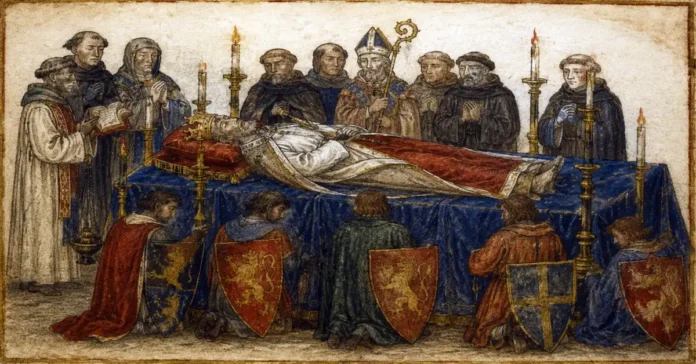
William the Conqueror forged an empire with an iron fist, yet his earthly departure became one of the most undignified disasters in royal history. When the mighty king took his final breath in 1087, his loyal court vanished into thin air, leaving his stripped body rotting on a stone floor. The chaotic spectacle that followed exposed the raw fragility of Norman power and triggered a brutal succession war that tore England and France apart for nearly two decades.
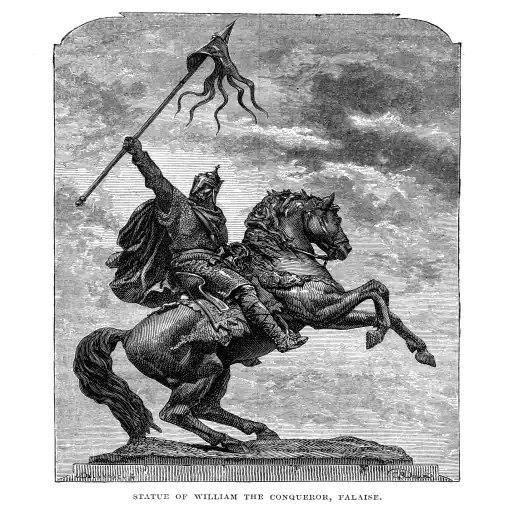
To understand how a king who redrew the map of Europe ended up abandoned by his closest allies, you have to look at how he lived. William spent decades fighting everyone from rival French dukes to Saxon rebels, surviving assassination attempts and crushing rebellions without blinking. By the summer of 1087, he was an aging, heavy-set warrior leading a vicious border campaign against King Philip I of France. During the sack of the border town of Mantes, William rode through the burning ruins, watching his soldiers torch houses and churches. His warhorse suddenly stepped on hot timber embers, reared in panic, and threw the heavy monarch violently against the tall iron pommel of his saddle. The blunt impact ruptured his intestines, inflicting a lethal internal injury that medieval physicians had zero chance of repairing.
Agonizing pain forced the king to withdraw sixty miles west to the priory of Saint-Gervais, located just outside the fortified walls of Rouen. For six grueling weeks, the man who terrified Europe lay dying in the sweltering late-summer heat. Chroniclers like Orderic Vitalis recorded that as William stared into the abyss of his own mortality, pure dread set in. He had spent his life ordering executions, burning entire villages during the brutal Harrying of the North, and seizing lands by force. In his final days, he tried to barter with God by handing out royal treasure to monasteries and ordering the release of high-profile political prisoners, including his own treacherous half-brother, Bishop Odo of Bayeux.
Deathbed negotiations were messy, but dividing his kingdom proved outright catastrophic. William faced an impossible family dilemma that would ignite the legendary Norman succession crisis. His oldest son, Robert Curthose, was an arrogant rebel who had literally waged war against his own father just a few years earlier. Custom dictated that Robert inherit the ancestral Duchy of Normandy, which William reluctantly confirmed because the Norman barons had already sworn allegiance to the boy. His second surviving son, William Rufus, was the king’s favorite and received the crown of England. The youngest boy, Henry, got no land at all, walking away instead with five thousand pounds of silver and an eerie prophecy from his father that he would eventually eclipse both older brothers.
Splitting the realm was an administrative nightmare waiting to happen. Anglo-Norman nobles owned massive estates on both sides of the English Channel, meaning they suddenly answered to two rival lords who despised each other. If a baron supported Duke Robert in Normandy, King William Rufus could confiscate his English castles. If he sided with the English crown, Robert could seize his ancestral Norman estates. By trying to balance family inheritance, the dying king accidentally planted a ticking time bomb beneath his dynasty.
On the morning of September 9, 1087, the church bells of Rouen began to ring for prime, the first morning prayer. William opened his eyes, murmured a brief prayer dedicating his soul to the Virgin Mary, and died. What happened the second his heart stopped beating? Total, unvarnished pandemonium.
The attending physicians and noblemen did not drop to their knees in reverent prayer. They did not organize an honorable vigil or prepare the body for state honors. Instead, they panicked. The dukes and knights scrambled out of the priory, bolted to the stables, and rode at breakneck speed toward their own estates to fortify their castles against expected rebellions. With the aristocracy gone, the royal servants realized nobody was watching the treasury. They swarmed the bedchamber like vultures, stealing gold goblets, silver plate, fine linens, and royal weapons. They even tore the silk tunic off the king’s corpse, leaving the ruler of England stripped stark naked across the bare stone tiles.
Think about the sheer contrast here. In the grand tradition of medieval royal funerals, a dead monarch was supposed to be surrounded by incense, round-the-clock liturgical chanting, and grieving subjects. William, the man who subdued an entire nation at the Battle of Hastings in 1066, lay abandoned in an empty room like an anonymous pauper. For nearly a full day, not a single person came forward to wash his skin or cover his body.

The awkward silence was broken by a modest country knight named Herluin, who possessed more moral backbone than the entire royal court combined. Guided by Christian charity and sheer pity, Herluin paid out of his own pocket to hire embalmers and undertakers. He secured a wooden barge, loaded the rapidly decomposing body, and escorted it down the River Seine before traveling overland toward Caen.
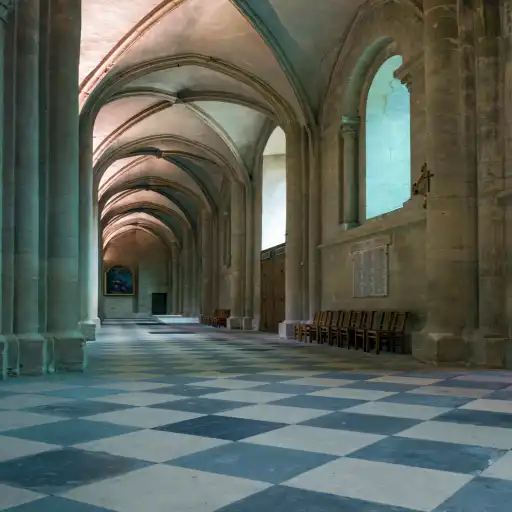
The chosen destination for the William the Conqueror burial was the magnificent Abbaye-aux-Hommes Caen, also known as the Abbey of Saint-Étienne. William had founded this soaring Romanesque monastery years earlier as an act of papal penance for marrying his distant cousin, Matilda of Flanders. It was meant to serve as the eternal monument to his piety and dynasty. If Herluin thought reaching the abbey would restore dignity to the king’s final journey, he was dead wrong.
As the funeral cortege arrived at the gates of Caen, a frantic cry rang out across the streets. A devastating fire had suddenly erupted in the town center, sending thick black smoke billowing into the sky. Local townspeople, monks, and guards immediately broke ranks, running away from the hearse to fight the blaze and save their homes. The corpse was left sitting alone on the road, enveloped in literal smoke and ash. It felt as if chaos itself was chasing the dead king to his grave.
Once the fire was subdued, the procession finally reformed inside the soaring nave of the abbey church. High-ranking Norman bishops, abbots, and local nobles gathered around the bier. Prince Henry stood quietly among the mourners, clutching his inheritance, while his two older brothers were already off scheming for their crowns. Gilbert, the Bishop of Évreux, stepped up to deliver a stirring funeral eulogy. He praised William’s military triumphs, his defense of the church, and his role in expanding Norman glory, before asking the congregation to pray for the king’s soul and forgive whatever earthly sins he had committed.
Before the bishop could finish speaking, a local man named Ascelin fitzArthur pushed his way through the crowded aisle and shouted down the clergy. Ascelin was furious, and he had every right to be. He loudly proclaimed that the very ground everyone was standing on belonged to his family. William had seized the land by force years earlier, tearing down Ascelin’s ancestral home without paying a single penny to build his grand abbey. Ascelin publicly banned the burial, demanding justice in the name of God before the king’s body touched the soil.
The funeral halted immediately. The bishops knew Ascelin was telling the absolute truth, and proceeding with a burial on stolen land risked desecrating the entire ceremony. After a tense, whispered negotiation near the open grave, the clergy dipped into their purses and paid Ascelin sixty shillings on the spot for the physical grave plot, guaranteeing future compensation for the rest of the land. Only then did the aggrieved landowner step aside.
What could possibly go wrong next? The physical reality of human biology answered that question in the most stomach-churning way imaginable.
The late-summer heat, combined with weeks of travel and rudimentary embalming, had turned the king’s body into a pressurized chamber of putrefying gas. When the gravediggers prepared to lower William into the stone sarcophagus carved into the floor, they realized a massive logistical mistake. The stonemasons had carved the tomb to standard dimensions, completely underestimating the king’s massive, bloated frame. The corpse simply would not fit inside the stone box.
Instead of pausing the ceremony to find a larger coffin, the attendants attempted to force the issue. They pushed, leaned, and jammed the swollen corpse downward to make it fit beneath the stone lip. The excessive physical pressure caused William’s distended abdominal wall to violently rupture.
An unbearable, sickening stench of decayed intestines erupted through the church, instantly overpowering the heavy clouds of frankincense and burning myrrh. The foul odor was so overwhelming that priests, monks, and noble attendees choked, gagged, and began vomiting into their robes. Panic swept the nave as people scrambled for the stone doors to breathe fresh air. The remaining clergy frantically gabbled the final prayers, dumped the lid onto the tomb without proper ceremony, and fled into the daylight.
The utter humiliation of the William the Conqueror funeral was not just a bizarre piece of dark historical comedy. It was an unmistakable symbol of political bankruptcy. The second the conqueror’s iron grip relaxed, the illusion of supreme authority vanished, leaving behind greed, theft, and unresolved land disputes. The grotesque scene at the abbey mirrored the violent collapse of order that was about to engulf his entire empire.
The Norman succession crisis erupted into open warfare almost immediately. William Rufus sailed across the Channel, secured the support of Archbishop Lanfranc, and was crowned King of England at Westminster Abbey in late September 1087. Back in Rouen, Duke Robert took control of Normandy, bitterly resentful that his younger brother held the wealthier English kingdom.
In early 1088, the Anglo-Norman nobility launched a massive rebellion against Rufus, orchestrated by none other than Bishop Odo, the very man William had pardoned on his deathbed. Odo and his fellow barons wanted to reunify England and Normandy under Robert, whom they viewed as weak, lazy, and far easier to manipulate than the ruthless Rufus.
William Rufus proved to be just as brutal and cunning as his father. He appealed directly to native English soldiers, promising lower taxes and hunting privileges if they helped him crush the rebel barons. The English rallied to their new king, besieging Odo inside Rochester Castle and forcing the rebellious nobles into unconditional surrender. Rufus banished his treacherous uncle from England forever and firmly secured his grip on the English crown.
Yet peace remained entirely out of reach. For the next decade, the brothers waged constant proxy wars against each other across Normandy. William Rufus used England’s vast tax revenues to bribe Norman fortress commanders, chipping away at Robert’s territory. Robert, constantly bankrupt and struggling to maintain law and order, eventually mortgaged the entire Duchy of Normandy to Rufus in 1096 for ten thousand marks so he could join the First Crusade.
When Robert rode off to the Holy Land, Rufus took absolute control of Normandy, finally stitching his father’s split empire back together through raw financial muscle. But destiny was not finished playing tricks on the Norman royal family.
In August 1100, William Rufus rode out for a hunting trip in the New Forest, the private royal hunting reserve his father had created by evicting dozens of peasant villages. While tracking a stag, an English nobleman named Walter Tirel fired an arrow that supposedly bounced off a tree trunk and struck Rufus square in the chest. Rufus dropped dead instantly.
Was it a tragic hunting mishap or a calculated assassination? Historians still debate the mystery today, but the immediate beneficiary was obvious: their youngest brother, Henry.
Henry, who happened to be on the exact same hunting party, did not waste a single second grieving over his brother’s bleeding corpse. Repeating the grim pattern of his father’s death, Henry abandoned Rufus’s body in the woods and galloped straight to Winchester to seize the royal treasury. Three days later, Henry had himself crowned King of England at Westminster Abbey before his older brother Robert could even return from the Crusades.
When Duke Robert finally returned from the East married to a wealthy Italian heiress, he realized he had been outmaneuvered once again. Robert invaded England in 1101 to claim the throne, but Henry bought him off with a hefty yearly pension. Henry then turned the tables, launching a methodical invasion of Normandy to eliminate the threat of Robert once and for all.
The climactic showdown between the brothers took place on September 28, 1106, at the Battle of Tinchebray in southwest Normandy. In a brisk, decisive engagement that lasted barely an hour, King Henry’s infantry shattered Duke Robert’s knights. Henry captured his older brother on the battlefield, stripped him of his title, and locked him in royal prisons for the remaining twenty-eight years of his life until Robert died an old man inside Cardiff Castle.
By winning the Battle of Tinchebray, Henry unified England and Normandy under a single, iron-fisted ruler, finally closing the bloody succession crisis that his father’s death had unleashed nineteen years earlier. Henry proved to be the most capable administrative mind of the entire dynasty, establishing the Exchequer and centralizing royal judicial power across the Anglo-Norman world.
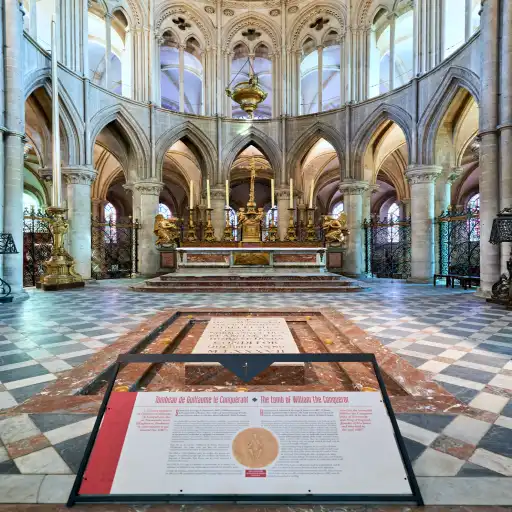
Even in eternal rest, William the Conqueror could not escape violence. Over the centuries, his tomb at Caen was repeatedly desecrated. During the sixteenth-century French Wars of Religion in 1562, Protestant Huguenots sacked the Abbey of Saint-Étienne, broke open the stone sarcophagus, and scattered the king’s bones into the street. A local monk managed to salvage a single thigh bone, which was dutifully reburied.
During the French Revolution in 1793, radical revolutionaries smashed the royal monument again. Today, beneath the soaring Romanesque arches of the abbey, a simple white marble slab in the chancel floor bears a Latin inscription marking the spot where that lone thigh bone rests.
The saga of William’s demise delivers a timeless lesson on the mechanics of raw political power. William spent his life forcing men to bow through violence, fear, and sheer force of personality. The second his physical pulse ceased, that fear vanished, leaving behind only the cold self-interest of those who survived him. From the looting of his bedroom to the exploding sarcophagus and the decades of sibling war, his chaotic exit proved that without an enduring legal foundation, an empire built solely on the sword collapses the exact moment the sword falls from the hand.

